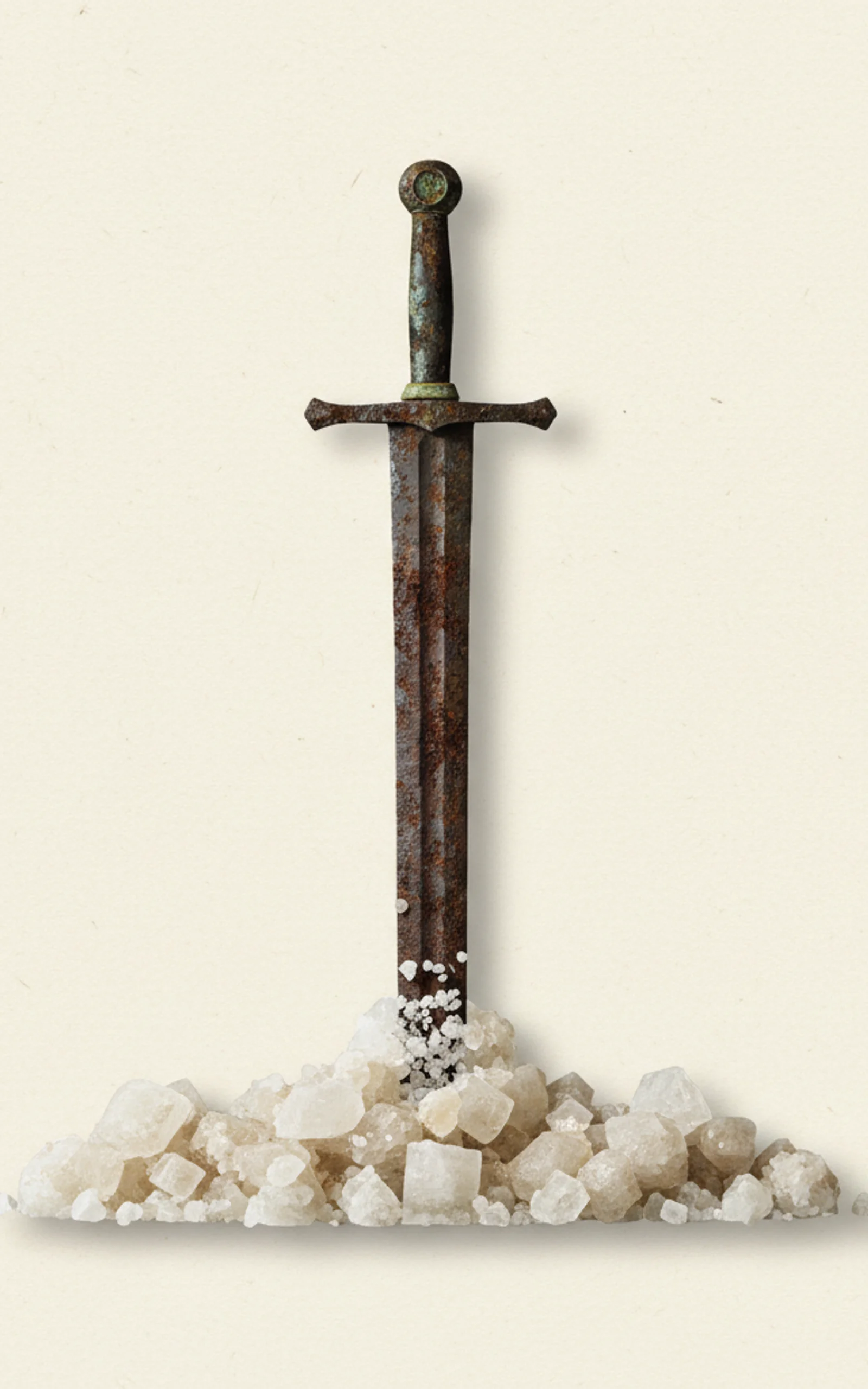
Cover for The Salt and the Sword
Shared with you

The Salt and the Sword

Two brothers, bound by blood and fractured by ambition, race to prove their worth to a dying father as enemy ships breach the horizon—and the only way to save the fortress might demand the ultimate sacrifice from one of them.

19 chapters~200 min read
Chapter 1

The Inheritance of Stone

The Walls That Named Us

The eastern parapet walk ran two hundred and thirty-seven paces from the Serpent Gate to the artillery post above the tidal shelf. Aldric knew this the way he knew the weight of his sword belt, the particular drag of chain mail on his left shoulder where the rivets had been re-seated three times. He walked it every morning before the garrison's first horn, in the hour when the Karrath cliffs exhaled cold salt air and the sea below was still deciding what color it would be.

Today the sea had chosen grey-green. Corpse water, the garrison called it. The color it turned when weather was building offshore.

He stopped at the first watchtower and looked at the duty log without touching it. The man on watch—a veteran with a scar running jaw to ear from a Vedran boarding skirmish three years back—stood at proper attention without being told. That was worth something. Most of the garrison's discipline was purchased through the slow accumulation of exactly these small moments: a man who straightened when the elder son of Lord Gareth appeared on the parapet at dawn, not because he feared punishment but because Aldric had once stayed awake three consecutive nights during the fever that swept the lower barracks, carrying broth he'd made himself to men too sick to argue about rank. That was the trade. Not spoken.

"My lord. Two Vedran galleys ran north along the horizon line before the third watch. Didn't approach. Counting us."

"Both the same build as last week's pair?"

"Wider beam on the second one. Different house flag. Couldn't make the device in the dark."

Aldric looked out where the man was pointing. Nothing there now but the grey-green swell and a raft of seabirds riding the wind. The birds nested in the cliff face forty feet below the wall and their noise at dawn was constant enough that the garrison stopped hearing it. Aldric still heard it. He had trained himself to hear anything that became background.

"Log it twice. Once in the duty record, once in a separate note to Captain Voren marked urgent."

"Already done, my lord."

He moved on.

Karrath had been built in the reign of Aldric's great-grandfather to answer a specific problem: how do you hold a coastline against a sea-going enemy when your cavalry is inland and your navy is still a generation away from being capable? The answer had been stone. The original fortress was just the cliff itself, shaped—a natural bowl in the headland with one approachable face, that face walled with granite blocks hauled up from the tidal flat below on sleds that killed two oxen a day for eleven years. The inner keep came later, built over the ruins of a Vedran supply post burned to the foundations in a conflict whose name no one had bothered to preserve. The garrison wing came later still. And then the towers—four of them—planted at the corners of the outer wall like teeth, each one taller than the last because each successive lord had needed to see a little farther, as if distance itself was a thing you could own if you built high enough.

It had taken Aldric until his eighteenth year to understand that the shadow was the point. Karrath was not built to be comfortable. Every addition had been made for dominance—a better line of sight, a longer kill zone, a deeper cistern. The stone corridors were too narrow for two men abreast because width was waste. The windows were slits because glass let in light but also let in arrows. Even the great hall, where Lord Gareth had received vassals for thirty-one years, was low-ceilinged and cold in the manner of a room designed to intimidate. The message was architectural: we did not build this for you.

The south tower watch had a broken shutter that clattered in the wind with a loose, irregular beat—the kind of sound that eroded men's sleep over weeks. Aldric had sent a carpenter to fix it twice. He stopped at the base of the south tower stairs and looked up.

The shutter was still broken.

He went up.

The carpenter's apprentice—a young man who smelled of pine resin and had, visibly, been sleeping on a folded sack when Aldric's boots hit the top step—scrambled to standing with the look of someone calculating how bad this was going to be.

"The shutter," Aldric said.

"My lord, the hinge pin is stripped. I need a new pin turned by the smith and the smith is—"

"Is the smith aware that you need it?"

A pause. The telling kind.

"Tell him this morning. Write the order out yourself and have him sign it so there's a record. If it isn't done by evening watch I want to know which one of you to hold responsible." He didn't raise his voice. He had learned that from his father, and it was one of the things he'd learned that he didn't want to give back. A man who shouts tells you his limits. "Open the other shutter. Cross-ventilation. The men sleeping below don't need the noise but they need the air."

He came back down thinking about the smith, who was competent but required constant pressure to prioritize anything beyond his immediate sightline. A petty thought followed, one he recognized and didn't bother dismissing: the man had been like this under his father's watch too, and no one had apparently found it worth fixing. Karrath had forty-seven such bottlenecks—men or systems or pieces of aging infrastructure that functioned well enough until they didn't—and Aldric had mapped all of them in a ledger he kept in his chamber, updated every three days. Not because his father had told him to. His father had never mentioned the ledger. His father managed Karrath through force of presence, the brute gravitational pull of a man who had never needed to explain himself because the alternative was too vivid to contemplate.

But Lord Gareth's presence had been thinning for two years now.

The coughing had started the autumn before last. At first it was the kind of thing a man could attribute to the salt air, to the damp that crept into stone fortresses and lived there permanently. Then it produced blood. Small amounts. Then less small. The Karrath physician—a cautious man who had been bleeding patients and measuring their phlegm in this same cold room for twenty years—had used the word "progressing" in a way that made the word mean the opposite of progress.

Lord Gareth had told no one but the physician and Aldric.

Aldric had told no one at all.

He reached the inner ward as the morning horn finally sounded—a long note from the barracks that bounced off three different stone faces before dying against the cliffside—and watched the garrison's day begin. Fires lit in the cooking yard. Men in various states of armament moving toward their posts with the blend of routine and alertness that distinguished a garrison on elevated watch status from one that had grown slack. They were not slack. He had spent fourteen months ensuring they were not slack—through the ledger and the morning walks and the insistence on double-logging and the quiet conversations with Voren about which sergeants needed replacing and which ones just needed watching. Two years of building a machine that could function without his father's gravitational pull, because that pull was failing in increments he could measure and no physician could fix.

Captain Voren came across the inner ward from the direction of the armory. Wide, salt-worn, nothing wasted. He had served Lord Gareth for nineteen years with the particular fidelity of someone who had seen the man at his worst and decided the worst was still worth serving. He fell into step with Aldric without being invited. He knew which moments required ceremony and which ones didn't.

"The Vedran galleys."

"Ossel told you?"

"Before he told you, probably." Voren pulled his cloak tighter against the wind without breaking stride. "Different house flag concerns me more than the count. Means someone new is committing ships. If there's a second house involved, the fleet we've been watching isn't the fleet."

"It's the advertisement," Aldric said.

"Yes."

Below the wall, far below, the tidal surf broke against the cliff base in long recursive crashes that came up through the stone as vibration rather than sound. The fortress absorbed it without complaint, without yielding. By simply being denser than whatever was striking it.

"My father should be told."

Voren looked at him sideways. "Your father should be told about a lot of things."

Aldric said nothing. The implication sat between them like a third man.

"Does Brennan know?" Voren asked.

"Brennan arrived last night." Aldric watched a gull catch an updraft from the cliff face and hold it, effortless, riding the compression of air against stone. The bird hung there a long moment, then dropped from sight below the parapet wall. "Ask me tomorrow whether he's bothered to look at the horizon yet."

The Son Who Came Back Thin

Brennan came back with three fewer fingers on his left hand and a story that changed every time someone asked.

The gatehouse guards saw him first—a figure on the coast road from the south at midmorning, moving with the shambling economy of a man who'd learned not to trust his own legs. Captain Voren was at the south parapet running drill rotations when the sentry's horn gave the single low note that meant known approach. He counted the silhouette against the grey chop of the Irrath Sea and felt his gut do the particular thing it did before bad news arrived wearing a friendly face.

"Open it," he said.

By the time Brennan crossed the inner ward, word had threaded through Karrath's stone corridors the way rot threads through timber—invisibly, structurally, everywhere at once. The fortress occupied a wound in the cliffside above Irrath Bay, its eastern face sheer rock dropping forty metres to a killing surf, its western walls thick enough that the interior rooms sweated cold even in high summer. Lord Gareth's grandfather had sunk the foundation stones into basalt seams using methods the quarrymen took to their graves, and the result was a place that felt less built than grown—as if the cliff had been persuaded over centuries to tolerate human ambition. Salt had eaten the mortar between certain courses of the lower curtain wall to a depth that Aldric measured privately each month and told no one about. Magnificent and failing, both at once, longer than anyone cared to put in writing.

Aldric was in the eastern armory reviewing the weapons manifest when Meredith found him. She said only, "He's at the inner gate," and watched her brother set down the manifest with a care that was itself a kind of violence.

"How does he look?"

"Thin. Wrong hand wrapped."

Aldric moved past her without a word. She followed, and he didn't slow for her, which she noted.

In the ward, Brennan stood with the sun behind him and three saddlebags at his feet that held, by appearance, everything he'd brought back from six months on the Veth Coast. He was twenty-six. He looked forty. He'd grown a beard that didn't suit his face and hadn't trimmed it, and his coat—good wool, once—had been mended with cord in at least four places visible from thirty paces. The left hand was wrapped in cloth that had started white and wasn't anymore.

They looked at each other the way men do when the last conversation they had ended with something that can't be taken back.

"Aldric." Brennan's voice was level. Practiced.

"The fleet?" No greeting. Aldric didn't waste either of their time with it.

"Gone. Fourteen ships. I have the count if you want the count."

"I want to know how."

Brennan looked past him, briefly, to where Meredith stood at the armory door. Something crossed his face—not shame, not quite. More the expression of a man who has already run his own tribunal and arrived at a verdict he can live with, barely.

"Storm off Veth Point took four. The Caerun navy accounted for seven. Three we burned ourselves to stop them being taken." He met Aldric's eyes again. "The harbor at Selvith is gone. The factor and his family are dead. I don't know about Marten or Councillor Osh—they were ahead of me at the ridge when the line broke."

The ward was not empty. Soldiers moved at its edges with the pointed industry of men pretending not to listen. Voren had descended from the parapet and stood near the inner gate with his arms at his sides.

"Come inside," Aldric said.

"I want to see Father first."

Four seconds of silence. It felt much longer.

"Father is resting," Aldric said.

"Father is dying." Brennan said it quietly but not gently. "Don't manage me. I've been riding for nine days."

Meredith made a small sound—not quite a word. She shifted her weight toward Brennan, then stopped herself.

Aldric's jaw tightened, the muscle below his cheekbone pressing outward. Thirty-one years old, eldest son of a great house with enemy sails on a clear horizon, standing in his own courtyard negotiating access to his own father with a brother who had just destroyed their coastal holding. He had a brief, petty thought: that Brennan had always known exactly which door to push.

"He's awake two, maybe three hours in a day. The physician—"

"I don't care about the physician." Brennan picked up one saddlebag with his right hand, leaving the other two in the dirt, and walked toward the main keep. Aldric stepped into his path.

They stood close enough that Aldric could smell the road on him—horse sweat, salt, old blood, woodsmoke—and could see that the right side of Brennan's neck carried a scar maybe three months old, imperfectly healed, pulling the skin at an angle that meant the wound had been closed by someone who wasn't a surgeon.

"He doesn't know about the fleet," Aldric said, low enough that only Brennan could hear.

"Then he'll find out."

"He's dying, Brennan."

"You keep saying that like it excuses something." Brennan's voice cracked fractionally on the last word, the first break in the level tone, and he caught it and sealed it shut again. "He's been dying for two years. At some point we stop using it as a reason."

"Then what is it?"

"A leash." Not with heat. The way men state geography.

Aldric moved aside. Not because he agreed, and not because he'd lost the argument, but because the alternative involved physically restraining his brother in front of Voren and the yard garrison, and there were consequences to authority made visible as force that couldn't be undone.

Brennan walked into the keep. His boots echoed on the stone in the way Karrath always echoed—the cliff face throwing sound back against itself, the fortress holding everything.

Meredith came to stand beside Aldric. In the bay below the eastern wall, three specks moved on the horizon in the configuration Voren's lookouts had flagged as Caerun scouting pattern: two lead vessels angled forward, a third hanging back to observe and carry report. Eleven days of it now. Marking distances, counting towers.

Aldric looked at the saddlebags Brennan had left in the dirt and thought about the fourteen ships—each one a name, a crew, a line in the supply accounting that would now have to be crossed out—and thought about his father's hands, which had once broken a man's jaw one-handed against a stone wall, and which now could not reliably hold a cup.

Voren appeared beside him with the noiseless placement of a man who'd spent thirty years moving through fortress corridors without being heard until he chose to be.

"Do you want him stopped?" A practical question. That was Voren—his loyalty so complete it had become interchangeable with ruthlessness.

"No."

"The men saw."

"The men see everything." Aldric kept his eyes on the horizon. "Rotate the evening watch at the east tower. Full complement, visible from the water."

"And the fleet losses—"

"Not yet."

Voren nodded and withdrew.

Meredith had not moved. She was watching the keep entrance, her face doing the careful shuttered thing it did when she was deciding how much of what she knew to offer.

"He lost more than the fingers," she said.

Aldric bent and picked up the two saddlebags Brennan had abandoned. Heavy. He didn't open them. He stood there a moment with the weight of them pulling at his shoulders, looking at the place where his brother had stood, the flattened dirt and the empty air above it.

"When hasn't he," he said, and carried them inside.
Chapter 2

The Shape of a Dying Man's Love

A Man Made of Precedents

The chamber smelled of camphor oil and the particular sweetness of a body metabolizing itself from the inside. Two tallow candles threw competing shadows across the coffered ceiling—shadows that had no business agreeing with each other, and didn't. Lord Gareth lay propped against bolsters of Castravian wool, his chest rising with the careful deliberateness of someone who had learned to ration breath. His hands—those hands that had broken a siege ladder over his knee at Torrath Ford forty years ago—rested open on the counterpane like things that had already been set down.

Brennan reached the door first. He always reached the door first, and that small advantage had never once been enough.

Aldric was three steps behind, having relinquished the saddlebags to a garrison page with specific and quiet instructions about where they were not to go. He entered the chamber as if he'd been expected—which, given how his father calculated these things, he probably had been. He thought, briefly and without pride, that Brennan had run.

"Both of you." Gareth didn't open his eyes. His voice had the quality of water moving over gravel—still directional, still purposeful, only slower. "Close the door."

Brennan pulled it shut. The latch caught with a sound like a small verdict.

The room was Karrath in miniature: salt-pitted stone beneath tapestry bought with revenue from three fishing villages that had since burned; a weapons rack holding a sword Gareth would not swing again but hadn't ordered removed; a basin of water clouded with dissolved herbs from the fortress physician, who understood his patient would not follow half his recommendations and had accordingly recommended twice as many. The single window faced north, toward the strait. The light coming through it was the gray of old armor.

"The courier said two ships." Gareth opened his eyes. They were still his best feature—pale brown shot through with darker amber, eyes that had once read maps by torchlight and found errors other commanders missed. "Which of you wants to tell me it was more?"

Neither answered immediately. That pause said everything their words would have to work hard to obscure.

"Seven," Aldric said. "Seven of the coastal patrol vessels. The Vadris Narrows, four nights ago. Storm pushed Toreval's fleet through the gap we had no coverage on."

Gareth's jaw moved once, as if tasting something. He looked at Brennan.

"He's right," Brennan said—the concession cost him something visible, a tightening around the eyes that a stranger would miss but that Meredith would have catalogued and filed. "Seven confirmed. There may be an eighth. The wreckage I passed through—" He stopped. Recalibrated. "The sailors I spoke to at Havenmere weren't certain."

"And you came straight here from Havenmere."

"Yes."

"Stopping where?"

Brennan's hands were clasped behind his back—a habit developed at fourteen when he learned his father watched hands for lies. "The bridge at Colwick. Overnight. The horse needed it."

"The horse." Gareth said it without inflection, which was its own kind of inflection. He turned back to Aldric. "The garrison. How much do they know?"

"As of this morning, the patrol schedule discrepancy. Not the full count. I've kept the courier traffic consolidated through Voren."

"Captain Voren is a garrison commander, not a secretary."

Aldric absorbed that without moving. He had the density of someone who had been taking in blows since boyhood and converting them to ballast. "He volunteered. The men trust him. Information moving through him moves cleanly."

"And information moving through you?"

The question landed in the room and lay there. Brennan looked at the floor, then stopped looking at the floor, because he'd trained himself out of that.

"My men trust me," Aldric said.

"I asked what they know."

"Then the answer is: what I've chosen to tell them."

Gareth made a sound—not approval, not disapproval, something older than either. He pressed one open hand flat against the counterpane and studied it the way a reader examines a contract for clauses he hasn't signed yet. The skin across his knuckles had gone the color of birch bark. When he flexed his fingers the tendons moved, but slowly, as if receiving the message late.

"You," he said to Brennan, "saw the fleet yourself. You counted them. What did you tell the people at Havenmere?"

"That Toreval's ships were through the Narrows and moving north. That Karrath would respond."

"Would respond."

"Has responded," Brennan corrected, and the small precision was its own kind of ambition—his calibration was, as always, set about a quarter-turn too high. "I misspoke."

"No you didn't." Gareth shifted against the bolsters. The effort was small and terrible—the body that had once waded through the surf at Crestfall now requiring an audience just to sit upright. He let the pain move through his face without hiding it. Three months ago he had still been hiding it. "You said what you believed. That Karrath has not yet responded. That someone needs to make a decision."

Brennan said nothing. Gareth turned to Aldric.

"And you believe you've already made it."

"I believe the decision about the garrison's knowledge was mine to make in the time between the report arriving and your having it. I made it. The decision about the fleet response is yours."

"For now."

Two words. They fell between the brothers like an axe through green wood—the sound, and then the split slowly widening.

Gareth watched both of them receive it. Watched Aldric's face sustain its stillness through effort rather than peace. Watched Brennan's chin come up by a degree—not assertion, not hope, something that lived in the country between them.

"Meredith," Gareth said.

"She's here," Aldric said. "In the ward."

"Bring her in before evening. I want her present for the captains' report." He paused. "Not to speak. To listen."

Brennan made a sound that was not quite protest—the vocal equivalent of someone stopping mid-step. "She'll form her own conclusions," he said.

"Yes." Gareth's eyes didn't move. "She will. That's why I want her there."

The fire in the corner grate had burned down to orange coals banked under gray ash. The physician had requested it kept moderate—the camphor useful for the lungs, the heat slowing the fever's nightly climb. These things Gareth did comply with: the fire, the herbed water, the bolsters. He had made his accommodations with the room. Not with anything larger.

"Seven ships," he said, as if the number needed repeating to become real. "Toreval moves faster than I expected."

"He's had time to prepare." Brennan shifted his weight, boot scraping the stone. "We've known about his shipbuilding at Ancrath for two seasons. I sent reports—"

"I read your reports."

"Then you know the northern passage was vulnerable before this winter."

"I know what you wrote about it." Gareth's eyes moved to Aldric. "And what did you write about the northern passage?"

The muscle at Aldric's jaw moved once. "That the patrol rotation was adequate given our current strength."

"Adequate."

"It was my assessment at the time."

"One of you was wrong," Gareth said. "I want to know which one before Toreval's ships reach the outer headland. By then it won't matter."

He closed his eyes. His chest continued its careful rationed work. The candle shadows stretched and compressed with each draft from the ill-fitted window frame—salt wind coming through where the leading had corroded, where three successive stewards had noted the repair requirement in the household ledger, where three successive years had found other urgencies.

"Leave me," Gareth said. "Both of you. Send Voren."

Brennan moved first. He always moved first. He had his hand on the latch—dark iron worn smooth where a hundred hands had preceded his, where his own hands had preceded his own hands back through a childhood when the door had seemed larger—when Gareth spoke again.

"Brennan."

He stopped.

"The sailor who wasn't certain. About the eighth ship."

"Yes."

"Find out."

Brennan let go of the latch. He turned, but his father's eyes were already closed, and there was nothing to read—no opening, no warmth, only the instruction, delivered in the same voice Gareth used to order fence repairs and ledger audits. Brennan held the moment for two seconds that served no purpose, then stepped through the door.

Aldric followed. He did not look back.

In the corridor, six feet apart, they stood without speaking. Cold stone. Guttering torch. The sound of sea pushing against cliff base sixty feet below—constant enough in Karrath that the mind usually filtered it, but audible now, in the silence between brothers after a man has spent thirty years calibrating them against each other and sees no reason to stop.

What the Physician Knows

The physician's name was Osren, and he smelled of pennyroyal and something underneath it that didn't wash out. Aldric had known him since boyhood, when Osren had set his broken wrist after a fall from the eastern battlement, and even then the man had given him the news without softening it. The bone has shifted. It will heal wrong unless we break it again tonight. That was Osren's gift: honesty that arrived without ceremony, like a knife finding the gap between ribs.

He was waiting in the physic alcove off the second garrison corridor, not in his proper workroom—Aldric noted that. The workroom had witnesses. Stone shelves lined three walls, crowded with apothecary jars whose labels had been rewritten so many times the parchment had gone soft as skin. A rushlight on the corner ledge threw shadows that made every object twice its size. The fortress above them groaned in the November wind, and through the single slit window came the smell of the sea, cold and indifferent, forty feet below the cliff face.

"Close it," Osren said, without looking up from the small glass vessel he was tilting toward the light.

Aldric pulled the iron-strapped panel shut. The latch caught with a sound like a tooth being pulled.

"How long?" He didn't waste breath on preamble. Osren had sent for him specifically—not Brennan, not Meredith. The fact of that exclusion sat in his chest like a coal.

Osren set the glass down. He was a compact man in his late fifties, face creased not by age alone but by the specific exhaustion of tending the dying across three decades. His hands were immaculate. They were always immaculate, which Aldric found harder to look at than blood would have been.

"Weeks." He said it the way someone speaks after holding a thing in their mouth too long. "Six, if the swelling in his joints eases and he keeps food down. Three if it doesn't."

"His mind?"

"Coherent now. Mostly." Osren picked up a flat-bladed instrument from the shelf and turned it over once in his hands—not using it, just something to hold. "The fevers push him. When a fever breaks he comes back clear. But the intervals will shorten. It's not a question of if."

Aldric's fingers found the seam of his glove cuff. He pressed down against it without pulling. "He's spoken to you about the succession."

"He's spoken to me about everything." Osren's voice was flat as a hearthstone. "He spoke last night for two hours about the yield records on the eastern grain stores from eleven years ago. He spoke about your mother. He spoke about one named Corrith who died in the Vreth campaign—apparently Lord Gareth owes him a debt no living person could collect." A pause, calibrated. "And he spoke about his sons."

The rushlight flinched in a draft.

"Tell me what he said."

"He said—" Osren stopped. Set the blade down. Met Aldric's eyes with the steadiness of someone who has learned to deliver damage without flinching. "He said he loved you both. And he said that love was the problem."

That landed differently than Aldric expected. He had braced for the inventory of comparisons, the disappointments rehearsed across thirty years. Not that.

"He doesn't believe you're the same kind of capable," Osren continued, quieter, the words measured out like medicine. "He said Aldric holds a wall. Brennan breaks one. And that the fortress needs both." He pressed his palms flat on the worktable. "He hasn't told you this. He hasn't told Brennan either. He told me, at three in the morning, when the fever had cracked and he was wrung out and honest in the way men only get when they think they're already half-dead."

Aldric said nothing. Outside, the sea moved against the cliff base with a rhythmic, grinding patience—like something that had been waiting for the stone to finally give.

"There's no written order of succession," Osren said.

"I know."

"Then you understand what happens if he loses coherence before—"

"I said I know." Aldric's voice came out harder than he intended. He pulled it back, conscious that the sharpness had cost him something, that Osren was watching. "Who else have you told?"

"No one." A fraction of a pause. "Yet."

The word hung there. Osren hadn't moved, hadn't shifted his weight or glanced away, but the architecture of that pause made it clear: he was telling Aldric first, but the order of disclosure was still negotiable.

Aldric turned to the slit window. Pale gray sea-light knifed through it, cut the floor into a stripe of cold and dark. Below the cliff, breakers collapsed against the rocks in long, exhausted heaves. He thought about Brennan, who had spent breakfast this morning laughing at one of the gate sergeant's stories—laughing genuinely, with his head thrown back—and had then cut his eyes toward Aldric once, just once, with something behind them that had nothing to do with laughter. Aldric had thought it affectionate. He was no longer sure.

"Captain Voren should hear this," Aldric said.

"Yes." Osren's agreement came too readily. Which meant Osren had already decided Voren would hear it—the question was who got there first.

"Does Meredith know the severity?"

"She asked me two days ago in the courtyard. I told her Gareth's condition was serious." The physician folded his hands. "I did not tell her serious meant weeks."

Aldric walked to the worktable and placed both hands flat on it the way Osren had. For a moment they stood across from each other like men at a negotiating table that neither of them had agreed to sit at. The jars on the shelves held their pale contents without explanation. Dried root. Pressed bark. Something dark that moved when the rushlight moved, an optical lie.

"My father had thirty years to write it down," Aldric said. "He chose not to."

"Yes."

"That's not an oversight."

Osren said nothing. Which was its own kind of answer.

Aldric pressed harder on the table edge. The wood grain bit into his palm.

"When is he next coherent?" Aldric asked.

"Tomorrow morning, if the night goes well. He wanted you." Osren picked up the glass vessel again, tilting it toward the light as he had when Aldric first entered, as if the conversation had merely interrupted something. "He asked for you specifically. Brennan visits on his own—you know how Brennan is—but Gareth said bring Aldric in the morning. Those were his words."

Aldric straightened. The glove cuff had left a red mark on his wrist where he'd pressed.

"Then I'll be here." He turned toward the panel. His reflection fractured across the dark glass of three apothecary jars—a figure in pieces, each shard angled somewhere different. "Osren."

"Yes."

"If Brennan comes to you first—"

"He already has."

The garrison corridor was empty when Aldric stepped back into it, but he could feel its shape—its length, its echoes, the place forty yards ahead where it branched toward the armory stairs and toward the south tower where Voren kept his quarters. The torches in their wall brackets burnt low and guttering in the salt draft. His boots on the stone made a sound that followed him a half-beat behind, like a second person keeping pace.

Through the nearest arrow slit, enemy ships sat on the horizon like dark punctuation—patient and numerous, waiting for whatever sentence the fortress was in the middle of writing.

He started walking. Quickly.
Chapter 3

Salt in the Mouth

Smoke on the Water

Pedr arrived at a run, salt crust on his eyelids and a split lip from where he'd bitten through it on the cliff stairs. He didn't knock. You don't knock when seven sails have crossed the Ardenne shelf.

"Eight," he said, correcting the number before anyone had spoken it. His fist hit the map table hard enough to scatter the brass weight markers. "Counted eight. The seventh and eighth running dark — no lanterns, no house colors."

Aldric was already at the table. He'd been there before the scout arrived, which was the kind of thing people noticed about him and resented without quite knowing why. His finger traced the Ardenne approach channel — fifty fathoms of open water narrowing to thirty-two between the Godsbone reefs and the outer breakwater.

"Dark running vessels on the western flank." He didn't phrase it as a question. "That's a gap close. They're not blockading, they're threading."

"Or they want us to think they're threading." Brennan came through the armory door still adjusting his gauntlet, one buckle loose and dragging. He'd heard the scout's boot heels on the outer flagstones — Karrath's stone corridors carried sound the way cold water carries salt, uniformly, without mercy. "Show a main fleet, push two fast hulls quiet around the reef approach while we're watching banners."

"In a running swell." Aldric turned. "Godsbone in a running swell. In autumn."

"It's been done."

"By Ardenne captains."

"Yes. By Ardenne captains who grew up in these waters and know the passage better than we do." Brennan reached the table and moved the brass weight marker for the reef line four inches east of where Aldric had set it. "Their chart corrections are different from ours. Father has the Carrick pilot books. I've read them."

Aldric looked at the shifted marker. He did not look at Brennan.

Captain Voren stood at the window cut into the eastern wall, a vertical slot two hands wide that framed a strip of gray sea and grayer sky. He'd been watching the horizon since before the scout arrived — some quality of the morning light, he'd said to no one, some particular cast. The Ardenne fleet was visible now as eight smears of charcoal on the line between sea and cloud, close enough that the tallest masts showed their crosspieces.

"They're not running a gap." He turned from the window, his face carrying the stillness that comes from thirty years of watching men react badly to information. "The dark vessels are holding station on the main body. That's a coordination posture, not an advance."

"Which buys us time or means they're waiting on a signal," Aldric said.

"Or both," Meredith said.

She was standing at the armory door — she'd come in behind Brennan and neither brother had registered it, which told her something about the room's gravity she filed away without pleasure. She had a wax tablet in her hand, the morning's supply tallies still visible beneath fresh numbers she'd scored across the surface without erasing the old ones. Provision counts beneath projected garrison requirements.

"Karrath's granaries are at sixty-three percent," she said. "Enough for a fourteen-week siege. Not a nineteen-week one." She set the tablet on the table between both brothers. "That's the conversation we're actually having."

Pedr looked at the floor. He was young enough that the mathematics still surprised him.

"Fourteen weeks is enough for a relief force from the inland marches if Father sends riders today," Aldric said. "If the Ardenne intention is blockade rather than direct assault, we hold and we wait."

"Father can't send riders today." Brennan said it quietly, which was the worst way he could have said it. "Father doesn't know the ships are there yet, and when he does, we don't know what he'll be able to decide."

The room shifted. Not physically — Voren didn't move, Meredith didn't lift her eyes from the tablet, Pedr kept studying the flagstones. But something redistributed itself among them.

Gareth had been declining since midsummer. The tremors in his right hand. The days when the chamber door stayed shut past noon. The dispatches routed first through Aldric, then increasingly through Meredith, with instructions that felt less like command and more like testimony.

"He'll be informed," Aldric said. "Immediately. Personally."

"Of course he will." Brennan picked up one of the scattered brass markers and turned it between his fingers. "And then? He confirms your hold-and-wait. You've had his ear for six months."

"I've had his ear because I've been here."

"You've been here because you made it impossible for me to stay without looking like I was waiting for him to die." Brennan set the marker down with a precision that was its own kind of violence. "Which is what you wanted everyone to see."

Aldric's jaw moved once, the way stone shifts before a fracture. "There are eight Ardenne ships on the horizon and you want to—"

"I want a sortie." Brennan's hand flattened on the map. "Two galleys, night launch, before they complete formation. Hit the dark-running hulls before they establish the gap approach. Make them recalculate whether Karrath is a siege target or a cost."

The silence had texture. The kind a room full of experienced soldiers produces when they hear a plan they know is brave and possibly correct and possibly catastrophic.

"You'd lose the galleys," Voren said. Not dismissively. A fact.

"Maybe. You'd also signal to eight captains that this fortress launches against numerical disadvantage — the only thing an Ardenne admiral fears. They fight the math. Give them bad math."

"Or you give them two galleys and an excuse," Aldric said, "and they advance before we're at stations."

Meredith pressed her thumbnail against the edge of the wax tablet until a hairline seam appeared in the surface. "Send word to Father. Both of you go. Together. Let him hear it the same way the walls hear everything — all at once, from every direction."

Neither brother answered. Pedr shifted his weight and his boot scraped grit across the flagstone and everyone looked at him.

"Eight," he said again, because it was the only thing he knew for certain. The word sat in the middle of the room like a coal no one wanted to pick up bare-handed.

Voren crossed to the door. "I'll put the watch rotations on war footing regardless." He paused at the iron latch. "Whatever you decide, the men need to see the walls manned. They're already reading the sky."

The door closed behind him with soft, deliberate finality.

Aldric turned back to the map. His finger found the reef line again — thirty-two fathoms, gray water, autumn swell — and traced it without moving the marker Brennan had repositioned. He left it where his brother had placed it. He told himself this was tactical open-mindedness. He was not entirely sure.

The eight smears on the horizon held their position, patient in the way of things that have already committed to what comes next.

Two Maps, One Table

The map was wrong and Aldric knew it before Brennan opened his mouth.

Not factually wrong—the coastline was accurate enough, the sandbar marked, the cliff approach rendered in the careful hand of some fortress cartographer dead thirty years. What was wrong was the assumption baked into every ink line: that Harrowmere's seawall could absorb the first wave and still be worth defending on the second day. Aldric had walked that seawall in February. He'd pressed his boot heel into the mortar between the lower courses and watched it crumble like old bread.

He said nothing. He stood at the table's far edge, hands at his sides, and watched the council assemble around their own blind faith.

Karrath's map room occupied the northeast tower—walls six feet of packed rubble and dressed limestone, one arrow-slit facing sea, one facing landward, no windows large enough to admit a crossbow bolt. The table was older than Lord Gareth's title, a slab of Orveth oak worn to deep amber by generations of commanders' elbows and spilled wine. Two iron lamp brackets threw tallow-smelling heat, and above the table, suspended on chains, a relief model of the Karrath headland hung—the harbor mouth, the outer reef, the fishing settlement at Brentallow where forty families had already pulled their boats ashore and gone to ground.

They'd been spotted at dawn. Three sail at first light. By the time the watch captain had roused Captain Voren and Voren had roused the household, there were nine. By the time Gareth had dressed and descended—which took longer than it should have, longer than last year, each step on the stairs audible through two floors of stone—the harbor watch counted thirteen, sitting heavy on the swells three leagues out.

Waiting.

Gareth sat at the table's head. He'd stopped wearing his full plate to council eighteen months ago, the weight of it no longer something he absorbed without effort, and the shift had registered in every man in the room the day it happened. He wore now a high-collared wool surcoat the color of weathered pewter, his house sigil embroidered at the chest in thread gone slightly dull from washing. His hands rested flat on the table. Between them, a sealed report from the harbor watch.

He had not opened it.

"One of you," he said, without looking up, "begin."

Brennan moved first—of course he moved first—stepping to the table's center and pressing his knuckles into the map with a familiarity that bordered on contempt, as though the parchment owed him something.

"They're not raiding." His voice carried the particular confidence of someone who had spent the night convincing himself. "Thirteen ships at anchor three leagues out is a statement, not an approach. They want us watching them. They want us calculating and deliberating and doing exactly this—standing in a room arguing while they decide whether we're worth the trouble." He dragged his finger along the northern channel. "We take the two fastest galleys we have and go out to them. Show force. Make them name their grievance or turn their sails. If we sit behind these walls and wait, we surrender the initiative and tell every coastal lord between here and the Selvern Mouth that Karrath blinked."

No one spoke for three seconds.

Meredith sat at the room's edge, apart from the men at the table in a way that had never been formally mandated and had never needed to be. She had her father's map—the older one, annotated, with his notes crowding the margins, the one Brennan apparently hadn't thought to ask for—open across her knees. She marked something with a thumbnail. Said nothing. Aldric noticed this, and noted also, with a small uncharitable precision, that she looked less surprised by Brennan's speech than he would have liked.

"Two galleys." Aldric finally let the words out. "Against thirteen."

"Two fast galleys under a parley banner—"

"A parley banner they are not obligated to honor." Aldric moved to the table, not to the center where Brennan stood but to the coastal edge, to the section showing the seawall and the lower harbor approach. "This isn't Selvern politics. These aren't treaty partners sending a delegation with teeth. Look at the ship classes—" He tapped the watch report Voren had placed beside the map. "Three of those are troop landers. You can see it in the draught estimates. They're not sitting out there deciding whether we're worth the trouble. They've already decided."

Brennan's jaw tightened. A small thing, barely visible. "So your strategy is to hide."

"My strategy is to not send our two fastest ships into a formation that includes troop landers and whatever those outer two are—" He turned to Voren, who stood at the room's second corner with his arms crossed, his face doing the thing it did when he was waiting for someone senior to say the obvious. "Voren. The outer two."

Voren unfolded his arms. He was a compact man, fifty-three years old, built the way coastal garrisons built men—dense, economical, permanently braced against horizontal wind. His face bore a scar running from his left earlobe to the corner of his mouth, earned in a sea engagement nine years before Aldric was born. He had the habit of touching it when he was being asked to say something a lord's son wouldn't like.

He touched it now.

"Fire ships," he said. "Or I'm thirty years wrong about hulls."

The room shifted. Not dramatically—no one cried out, no one moved—but the quality of attention changed, the way candlelight changes when a door opens somewhere in a distant corridor.

Brennan straightened. "Fire ships don't anchor in formation. Fire ships run on tide and wind."

"Fire ships anchor in formation when they want you to come out and give them a target," Voren said, with the patience of a man who had stopped being surprised by how willing commanders were to disbelieve inconvenient intelligence. He was looking at Gareth when he said it. Not at Brennan.

Gareth had not moved. The sealed harbor report sat untouched between his palms.

"Father." Aldric kept his voice even. "The seawall holds if we provision it correctly. The north cliff approach is impassable without a land force they don't have in those hulls. We reinforce the harbor chain, we send riders to the inland garrisons at Crale and Dunholt—two days, possibly three—and we wait behind walls that have held six sieges in the last century." A pause. "We do not send our ships into the mouth of a trap because the alternative feels like cowardice."

"It is cowardice," Brennan said.

"It is survival."

"For who?" Brennan's hand came down flat on the map, between the two positions they'd each been claiming, and the sound of it in that stone room was like a sentence ended badly. "For the forty families at Brentallow who are already—what, acceptable losses? For the fishing boats they left on the shore because we haven't committed to protecting the outer harbor? Sitting behind your wall and waiting for Crale means three days of whatever those ships decide to do to the settlement before we're reinforced. Tell me what survives of Karrath's reputation after that. Tell me what Gareth's name means on the tongues of coastal lords who'll hear about it."

The name landed in the room like something thrown.

Gareth finally looked up.

Aldric felt it—the specific gravity of his father's attention, the assessment behind it. He had grown up under that look. He had shaped himself around its angles, trimmed his failures to fit its tolerance, and believed for most of his adult life that eventually the look would shift. Something like certainty. Something that acknowledged the shaping had worked.

It hadn't yet.

"Meredith," Gareth said.

She looked up from the annotated map. She had been waiting for this. Aldric could see it in the stillness she'd maintained, the fact that she hadn't leaned forward once during the argument.

"The Brentallow families." Her voice was even. "There's a sea cave system at the base of the Dunner cliffs. Local knowledge—Father's notes." She held up the older map briefly, enough for the room to register the handwriting in the margins. "If someone rides to Brentallow within the hour—not two galleys into the channel, just a single rider down the cliff path—those families have a place to shelter before any fleet makes an approach run."

Silence.

Brennan turned toward her slowly. Not angry, which was almost worse than anger. Measuring.

"That's not a strategy," he said. "That's a footnote."

Meredith folded the map. "So is dying heroically."

Voren made a sound that was not quite a cough. He recrossed his arms.

Gareth pushed back from the table—the scrape of his chair a raw, unfinished sound—and stood with effort that everyone in the room pretended not to notice. He crossed to the arrow-slit facing the sea. Outside, the morning had gone a flat, specific gray. The color of a sky that has already chosen its weather.

Thirteen ships. Still not moving.

"The rider goes," Gareth said. "Now." He did not turn around. "The rest—" A pause, too long, a familiar held breath that had come to occupy more and more of his silences in recent months. "—continues until I return."

He walked to the door. No one moved to open it for him, because opening it would have meant acknowledging that he needed it opened.

The door closed.

The map lay between his two sons. The lamp brackets ticked against their chains. In the harbor far below, the water was the same gray as the sky, and the thirteen ships sat on it like a question no one in the room had yet answered correctly.
Chapter 4

The Spy in the Salt

The Shape of a Traitor

The tidal notations were wrong.

Aldric saw it before his eyes had finished moving across the eastern approach chart — penciled figures in a hand that wasn't Denys's, the draft shallowed out to offer the Ardenne fleet an entry the autumn cliffs had no business giving them. He pressed his thumb to the nearest mark. Graphite smeared against his skin. Three days old. Maybe less.

He stood very still.

The map chamber occupied the fortress's oldest section, a northeastern tower whose stonework predated the current house by two centuries, mortar packed with ox blood and kelp ash to hold against the salt. Black limestone underfoot, quarried from the sea cliffs. Campaign charts back to his great-grandfather's time hanging on every wall — stained vellum, cracked leather, the accumulated warcraft of a bloodline that had held this coast by force and patience and the occasional willingness to do ugly things quickly.

Someone in this room had told the Ardenne about Gareth. About Severin's condition — the court's polite name for the Lord of Karrath's grip loosening, as though it were weather and not the signal every vulture fleet in the Narrow Sea had been watching for across forty years.

Aldric crossed to the door and opened it. The corridor was empty. He could hear the distant scrape of boots on stone somewhere below, the low groan of the tide shifting in the cistern pipes. He closed the door again.

The access list was short. Gareth had kept it short on purpose, back when he still trusted his own instincts about people.

Denys the cartographer, seventy-three years old and half-blind in his right eye, who had mapped three coastal campaigns and lost two sons to the sea and appeared to have used up his appetite for betrayal sometime in his fifties. Captain Voren, who held the tower keys and whose loyalty Aldric had never adequately tested because he'd never had cause to doubt it. Meredith, whose access had been Gareth's gift to her at twenty — an act of inclusion Aldric still carried a quiet grievance about, even now. Brennan, who appeared in the access ledger with an irregularity that suggested he came here to feel important rather than because work required it.

Five people. Including Aldric.

He unlocked the iron strongbox beneath the campaign table, the key from the cord under his gambeson. The ledger inside recorded entries in three hands — his own, Voren's formal script, Denys's cramped notation where the sevens looked like scythes. He pulled the eastern approach file.

The previous tidal survey was dated to the third week of autumn. Denys's work, unmistakably. The altered notation on the master map belonged to no hand in this room.

His finger moved along the entry margins and stopped.

The twenty-first. Two visitors after the evening watch rotation. Voren's name logged second — that tracked, Voren ran his own nightly audit of the strategic materials, a habit Gareth had installed in him two decades ago. But the first entry, at second bell, carried no name. Just rank notation: Lord's proxy, family seal confirmed.

The family seal. Four people.

Aldric returned the ledger to the strongbox and locked it. The candle on the campaign table had burned to a finger's width. Somewhere below, the cistern pipes groaned with the tide — a sound Karrath made every six hours, which he'd stopped consciously hearing before he was twelve and now only noticed when his body needed something external to hold onto.

Brennan had been here three nights ago. Aldric couldn't prove it. The shape of that certainty felt different from accusation; it felt like recognition, which was worse.

He needed to be careful with himself here. Recklessness was not the same as selling your father's vulnerability to a fleet positioned to use it. Brennan wanted to matter — had always wanted to matter with a hunger that occasionally looked like ambition and occasionally looked like a wound. There was distance between that hunger and destruction. Aldric needed to know if his brother had crossed it.

He needed to know before Voren did.

Voren would bring it to Gareth. Formally, plainly, the way a man survives three lords by never cushioning his reports. Brennan would be arrested before he could explain or deny or panic properly, and Gareth's response would depend on how much strength remained in him. Aldric did not currently know the answer to that.

He went to the eastern wall, to the low cabinet where older surveys sat rolled in oilskin. Third from the left — the Ardenne coastal approach, his grandfather's tenure. He drew it out and held it beside the master map.

The draft adjustments matched the Ardenne's own recorded charts. Whoever had altered the map had not invented new information. They had corrected Karrath's notations to align with the Ardenne's version of the same geography.

Which meant access to Ardenne charts. Which meant information hadn't been moving in one direction.

The candle flame did not waver. The room was sealed well enough for that.

Aldric pressed his tongue to the roof of his mouth and counted, the way his father had taught him before his first campaign — an undignified technique he'd resisted for years. He used it anyway. Four seconds. Five.

He rolled the archive survey back into its oilskin, replaced it exactly as he'd found it. Straightened the campaign table's edge to align with the floor seam. Left everything as though nothing had been disturbed. Then he blew out the candle.

In the dark, the smell of the sea came through the stone, and somewhere in the fortress below, footsteps moved with the particular pace of someone who had already decided where they were going.

Caen's Separate Map

Brennan found the kitchen boy behind the rendering vats, elbow-deep in tallow and apparently invisible to the rest of the world.

The vats were enormous, black-iron, sweating steam in the predawn cold where the fortress kitchens backed against the cliff face. Salt spray came through the ventilation gap cut into the stone—just enough to cure meat and corrode everything else. The boy's name was Osk. Eleven, maybe twelve, with the narrow shoulders and wide attention of a child who had learned that staying unnoticed was its own kind of skill. Brennan had found him three weeks ago by accident, when Osk had vanished beneath a refectory table during one of Aldric's dinner lectures on garrison discipline and caught Brennan's eye across the flagstones with an expression of exquisite, shared boredom.

Brennan crouched beside the vat now. "You saw Pellart again last night."

Osk kept working the ladle. "Don't know who that is."

"Quartermaster's third clerk. Walks with his left heel lifting, like a man trying not to step on something that isn't there."

The boy's rhythm didn't break, but his eyes moved. That was enough. Brennan waited, turning a copper halfpenny over his knuckles.

"He went down to the tide cellars," Osk said finally, his voice aimed at the tallow. "Past second bell. Carrying a lamp he didn't need because the moon was full."

"Who met him?"

"Didn't see."

"But you heard."

Osk stopped ladling. He turned with the wariness of a child who has learned that telling the truth to powerful men is a wager with your own skin. "They were speaking past the echo point. You know how it is down there—the rock bounces it wrong."

"I know exactly how it is down there."

"Just," Osk said, then reconsidered, then tried again: "A voice I didn't know. Lower than Pellart's. And something metal got set down on stone. I didn't stay."

Brennan pressed the halfpenny into the boy's tallow-slick palm. Not enough to draw notice. Enough to remember. He stood and looked through the ventilation gap at the sea below, where gray morning had begun to distinguish itself from sky—two shades of nothing pulling slowly apart into coast and horizon.

The enemy fleet was out there. Three days, maybe four, before outriders confirmed position. Lord Gareth had stopped attending dawn briefings without explanation, which meant either the pain had worsened or he'd decided he no longer trusted what the briefings would tell him. Possibly both. And someone inside these walls was talking.

Brennan descended to the tide cellars through the provisioner's stair, which Aldric had never bothered to learn. Servants' route. The stair was cut directly into the cliff: uneven risers, no railing, walls close enough to touch with both hands, the smell of the sea coming up through the stone like breath through a mouth. At the bottom, the cellar opened into six interconnected chambers—salted fish, pickled vegetables in sealed crocks, barrels of rope-smoked pork. Iron rings driven into the walls for hanging. The furthest chamber pooled ankle-deep when tides ran high, and the stone floor was stained the color of dried rust throughout.

Brennan studied the floor near the entrance arch.

Something had been set down here. A flat-bottomed object, wider than a cup—a faint impression in a crust of dried salt, a rectangle maybe a hand's span across. The same salt crust that forms whenever seawater dries and leaves its ghost. Whoever left it had come and gone between two tides. Eight hours ago. At most.

He got onto one knee, tilted his lamp.

Beside the rectangle: a second impression, partial, where something had been dragged. And here—he moved the lamp—a single dark spot on the stone that wasn't rust and wasn't brine. He pressed a fingertip to it. Still slightly tacky.

Blood.

Not much. The amount from a cut hand, maybe, or a split lip. Something that would leave a mark without leaving a man. He stood. He did not let himself feel the cold that had been gathering in his chest since Osk first told him about the lamp.

He thought about Pellart. The clerk was from Maren's Reach, forty miles south—a coastal town contested three times in the last generation, one that had changed loyalties with the practical ease of people who had learned that loyalty belonged to the landlocked. Brennan had verified this eleven days ago by going to the harbormaster's records himself. Not his role. Not his authority. Done during a window of roughly two hours while Aldric was occupied with their father's physicians. He had said nothing to Aldric since. He was still deciding if that was strategy or spite. Both, probably—the answer sat in his stomach like an old bruise freshly pressed, and for a moment he thought, not charitably, that Aldric would have simply reported it upward and called it duty and gone to sleep.

Back through the provisioner's stair, past the rendering vats where Osk had gone silent and industrious, up through the narrow corridor behind the armory into the main garrison passage. Here Brennan paused. Captain Voren was forty feet ahead, moving toward the northeastern tower.

Toward Aldric.

Voren moved with the economy of a man carrying information and knowing it—cape flat against his back, no wasted motion. Brennan watched until the Captain turned the corner. The timing was almost funny. Almost.

He had perhaps half an hour before Voren reached Aldric and whatever conversation followed reshaped the board. He used five minutes of it standing in the garrison corridor, letting soldiers pass with the blank deference they gave the lord's second son—a deference barely distinguishable from dismissal, which Brennan had always read clearly and never once accepted.

A serjant named Wick was coming from the direction of the eastern gatehouse, unhelmeted, moving too fast for this hour.

"Wick."

The serjant stopped. He was twenty-six, built like someone had stacked two ordinary men vertically, and he had the look of a person interrupted mid-thought. "My lord."

"Pellart sent a runner to the gatehouse last evening. I want to know what message." Brennan didn't move, just held his lamp slightly lower, let the light work on Wick's face.

Wick's expression went through something—not guilt, something adjacent, a recalibration. "I wouldn't know about any runner, my lord."

"You were on shift. Who relieved you?"

"Darveth took the evening watch."

"Is Darveth easy to talk to?"

Wick looked at the floor. Then at Brennan. Then at the floor again, conducting a private negotiation between fear and something else. "He's a good soldier."

"That's not what I asked."

A pause. Wick's hand found the hilt of his belt knife and rested there—not threat, just something solid to hold. "My lord, if there's a question about garrison conduct, Captain Voren would be—"

"Captain Voren," Brennan said, "is busy."

He let the silence do its work. Wick's hand left the knife.

"Darveth got a copper ring about three weeks back," Wick said finally, the words coming out clipped, amputated. "New one. Foreign stamp. He hasn't said where from."

Brennan nodded once, the way his father used to nod when a point had been conceded in council—not triumphant, just received—and turned toward the stair that would take him to Meredith's rooms.

She would read the implications faster than anyone alive in this fortress. The question was whether she would act on them or hold them as currency, and that question had never had a clean answer in thirty years of knowing her. He was still working out, climbing, whether he was going to her because he trusted her judgment or because he wanted a witness before whatever was coming came.

He was halfway up when he heard it: a sound from somewhere above, sharp and brief. A fist on a table. A door thrown open. Something else.

He stopped.

The sound did not repeat. The stairwell swallowed it the way the fortress swallowed everything—into stone, into salt, into the silence of a building that had been keeping secrets since before his grandfather's grandfather first put a torch to its hearths.

He started climbing again. Faster.
Chapter 5

What Severin Built

The Elder Son's Lesson

The map chamber smelled of salt and old ink, the vellum charts on its walls swollen and warped from forty years of sea air. Lord Gareth sat at the central table with his hands flat on the stone surface — not because he needed the support, not yet — but because he had always thought better when he could feel the cold come up through his palms.

Aldric entered without being announced. That much Gareth had insisted on, two days ago when the lucid stretch had begun. Come while I can still receive you.

"Sit down," Gareth said. He didn't look up from the chart spread before him — the northeastern coastline, the tidal approaches, the three coves where shallow-draft vessels could beach undetected in autumn. He had been studying it since before Aldric was born. "You know what this is."

"The Brennavar approach." Aldric pulled the stool back with his boot rather than his hand. Old habit — never turn your back on a room. "Karroth took the second cove in the war before your father's war."

"Before my father's war. Yes." Gareth's finger traced a line of cramped notation along the margin — his own handwriting, thirty years younger, before the knuckles had started to curve. "He held it for eleven days. Then lost it because he trusted a garrison captain who had a cousin on the wrong side of the water."

Aldric said nothing. He recognized the shape of a lesson.

"The captain wasn't a traitor. That's the part nobody tells." Gareth finally looked up. His face had lost its color since autumn; the sea-gray had settled into skin that used to be ruddy from campaigning. "He was a careful man who made one careless decision because he was tired. Eleven years of good service, one night of poor judgment. The cove fell. Forty-three men drowned in the shallows because the timing broke."

"What was the captain's name?"

Gareth blinked. A small crack in the composure. "Rendell. Tomás Rendell."

"What happened to him?"

"He lived another twenty years. Kept horses in the south pasture. Wouldn't speak about the war." Gareth's gaze returned to the chart. "I'm not telling you this because Rendell matters. The cove still exists. The tidal pattern hasn't changed. And there is a man in the outer garrison right now whose brother-in-law holds warehouse contracts with the Serevani merchants."

"Dorath's man. Pell."

"You've noticed."

"Three weeks ago." Aldric kept his voice even, though the acknowledgment stung in a place he hadn't expected. "I flagged it to Voren. He's watching him."

Gareth was quiet. Outside, the sea hammered against the base of the cliffs — rhythmic, indifferent, ancient. "Good," the old man said. Not warmly. As though crossing a line off a list.

Aldric had been trained to accept this. Accept acknowledgment without needing more of it. He'd told himself that for fifteen years. He almost believed it. What he didn't tell himself — what he noticed now for the first time, with a small sourness he immediately pushed down — was that he'd half-hoped Pell would turn out to be nothing, just to prove Voren had been watching the wrong man.

"Your grandfather built this chamber." Gareth smoothed the curling edge of the vellum. "You know that?"

"I've heard."

"He built it after the second siege. After he'd held the main hall with nine men and a broken portcullis for four days while the relief column missed the tide." Gareth's voice dropped register — less instructional now, something underneath it. "He wanted somewhere that was only about information. No throne. No fireplace. Just the charts and the cold and what you know versus what you think you know."

Aldric looked at the walls. He had spent hours in this room since boyhood, often alone, tracing coastlines the way other children traced the edges of their beds in the dark. He knew which coves silted in winter, which headlands offered cover for archers, which tidal windows were seasonal lies. He had never thought about who built the room itself.

"He didn't trust my father with it, in the beginning." Gareth said this carefully, each word moved into position before the sentence could hold its weight. "Thought my father was too eager. Too quick to decide. He let him in when he was thirty-two."

Aldric was thirty-one.

Neither of them said it.

The silence had a texture — gritty, like sand in a wound. Gareth's hands hadn't moved. His breathing had the careful quality of a man rationing something finite.

"You have never made a catastrophic mistake," Gareth said. "In fifteen years of command responsibilities, you have not lost a man to poor judgment, you have not misread an approach, you have not trusted someone you should not have trusted." He paused. "Do you know what that tells me?"

Aldric waited.

"It tells me you have never been in the position where you had to." Not cruel — that would have been easier. Clinical. The voice of a man pressing on a bruise to check the depth. "Every test I've given you has been within your scope. Excellent within your scope. But the fortress doesn't care about scope. When the tide window opens, you get one decision and you make it with bad information and a body that hasn't slept in forty hours. And I don't know — I have never been able to see, clearly — whether you will hold."

The cold pressed up through the stone floor, through the soles of Aldric's boots. He became aware of his own hands, held still against his thighs with effort he hadn't noticed making.

"You've had fifteen years to find out," he said.

"Yes."

"You pulled me from Brennavar the season Karroth tested the outer wall. You put Voren in command."

"I needed Voren there."

"You needed to not risk me failing in front of the men." Aldric's voice stayed flat. He had rehearsed nothing; the sentence arrived intact because it had been alive in him for three years. "Those are different things."

Gareth did not deny it. He looked across the warped vellum and cramped annotations, and his expression held the particular exhaustion of someone found out in a thing they had considered a kindness.

"If I was wrong about Brennavar," Gareth said, "I am sorry for it."

"I don't want the apology." Aldric stood, the stool scraping back on stone. "I want to know if you've changed your assessment. Before you die. I want to know what I'm inheriting."

The question hung in the chamber. Outside, a gull screamed once, far below, and was gone.

Gareth looked down at the chart. His finger found the second cove again — the one Karroth had held, where forty-three men drowned in shallow water because one tired man made one careless choice. He pressed his fingertip against the notation and left it there.

"The fortress needs someone who will hold it," he said.

Aldric waited for the sentence to finish.

It didn't.

The Younger Son's Permission

The fever had broken by morning. That was the miracle Meredith hadn't dared name aloud — she'd watched too many false remissions crater into something worse. But Lord Gareth had eaten half a bowl of barley porridge, called his body-servant by the correct name, looked through the salt-scoured window at the Gorrath fleet's distant pennants and said, with bloodless clarity, they'll wait another week before making a move. Probably right, too. Which was its own kind of grief.

Brennan found out about the lucid day from one of the kitchen women — not Meredith, not Voren, not a summons from the chamber itself. Just a woman with raw knuckles setting bread to rise who said, almost as an afterthought, your father's asking for you, the younger one, he said your name twice already.

Twice. As if repetition were a tenderness his father had never quite learned to perform.

The corridor to Gareth's chamber ran along the eastern seawall, and the sea asserted itself through every crack in the mortar: cold salt breath, the low percussion of swell against cliff-face forty feet below, the faint mineral stink of barnacle crust that workmen scraped from the outer stones each autumn. Three arrow loops gave onto nothing but grey. Brennan counted them as he always had — three, then you turn, then you're there. He'd been counting them since he was nine, still running messages for his father's steward because no one had thought to give him something more dignified to do. He'd never stopped counting, even when he'd tried.

The door to the chamber was open, which was strange. Gareth had always kept it closed — made men wait outside just long enough that their anxiety peaked before the latch turned.

Gareth sat in the high-backed chair near the window, swathed in wool despite the weak morning sun angling through salt-hazed glass. He looked smaller. Not diminished in the tragic sense Brennan had braced for, but compressed — like a blade somebody had sheathed too long. The muscle across his shoulders had gone. His beard, always trimmed to a precise finger's width, had grown past that into something like surrender. His hands, though. Knuckle-scarred from the years before the title, broad-palmed, the ring of Karrath loose on the left forefinger where he'd lost the flesh to hold it.

Sit, he said. Not unkindly.

Brennan sat beside him — not the chair opposite, which would have meant an audience. Beside him. He noticed, and hated that he noticed.

You've been talking to Aldric's people, Gareth said. His eyes were on the window, on the grey water where the Gorrath fleet had anchored two miles out like a sentence not yet finished.

I've been trying to understand what happened in the Keswick granaries. Brennan kept his voice flat. Someone diverted three months of reserve stores. Aldric's seal is on the transit papers.

I know. The window-light caught the silver in his beard. I authorized the diversion.

Brennan went very still.

To the harbor garrison, Gareth continued, as if reading from a ledger. Before the fleet appeared. I needed Voren's men fed and positioned without announcing to every spy in Karrath that I thought a siege was coming. He finally looked at Brennan. Aldric had nothing to do with it. I used his seal because I needed a mechanism I trusted not to ask questions.

The silence held the full weight of everything Brennan had spent four days constructing. Every inference. Every note passed to Meredith beneath her door. His father had just walked through it like it was made of smoke.

You should have told him, Brennan said. Aldric. He doesn't know.

No.

He thinks—

I know what he thinks. Something shifted in Gareth's expression — not guilt exactly, but a cousin of it. Something habitual and old. Aldric has spent his life thinking I doubt him. Easier, sometimes, to let a man hold a grievance than to explain why you trusted him enough not to explain yourself.

Brennan stared at him. That's monstrous.

Yes. No flinch, no qualifier. Just the word, bare. It is.

Outside, a gull struck the window's edge with a hollow sound and banked away. Neither of them moved.

I'm going to tell you something, Gareth said, that I have not told your brother. He settled deeper into the wool, and for a moment his eyes closed — not sleep, something more deliberate. You have better instincts than Aldric. You always have. You read people the way I used to, before I learned it was more efficient to outlast them. He opened his eyes. But you spend those instincts on me. On trying to catch me in something. And I understand why. I've given you cause. Nothing but cause.

Brennan's throat had gone tight in a way he found humiliating. He pressed the ball of his thumb against the chair's arm, focusing on the splinter lodged there — the bright, specific bite of it.

You are not less, Gareth said. You have never been less. I don't know how to have told you that in a way you'd have believed, or at a time when it would have mattered rather than just — arriving. Like this. He gestured at himself with contempt. When I am dying and you have no choice but to hear it.

Dying. His father said it the way he said everything structural — without ceremony, without the hedge the word deserved when offered to a son.

What do you want from me? Brennan asked. His voice held.

Stop investigating your brother. Gareth picked up the ring on his forefinger, rotated it once, set it back. Not because he's right. Not because you'd lose. Because what's coming through that harbor needs both of you, and you cannot afford to arrive at it already bled out from each other. He paused. The Gorrath commander is a man named Essker — patient, eleven years, three fortresses taken. He does not break walls. He waits for them to break from inside. Gareth turned to look at Brennan fully, and there was something in it that hurt to receive — recognition, offered late, without apology, the only currency the old man had left. Don't give him the satisfaction.

Brennan stood. Not in anger. The room was simply too small for everything the chair was asking him to contain.

He walked to the window and looked at the fleet two miles out in the grey water. Seventeen ships. Probably more behind the headland where the chart showed deep anchorage. Patient, his father had said.

Behind him, the slow shift of wool as Gareth settled deeper into the chair — the sound of a body surrendering another fraction of itself.

You should have told us, Brennan said to the glass. He meant the granaries. He meant everything else. Both of us. Years ago.

No answer. He didn't turn.

Below, the swell hit the cliff-face and threw spray high enough to catch the window, and for a moment the fleet dissolved into a smear of salt and refracted grey.
Chapter 6

The First Blood of Karrath

The Beach at Nightfall

The fire arrows went up from the watchtower, and the beach below them caught the light.

Aldric saw the bodies from the cliff walk before he heard the screaming — Ardenne soldiers rolling in the surf two hundred yards south of the Saltgate, armor stripped by the undertow, faces turned to the sky. Voren had seized him by the forearm in the map chamber seventeen minutes ago and said only Beach, and now Voren stood ten paces ahead at the head of the switchback path, one gauntlet pressed to the cliff face where salt erosion had scalloped the stone into something like teeth. Below, the cove called Saltgate Hollow — two hundred feet of black shingle bracketed by basalt shoulders rising sheer from the water — was burning. Pitch torches drove back the autumn dark. The screaming was not coming from the Karrath side.

Not yet.

"How many made the beach?" Aldric called.

"Fifty. Sixty." Voren didn't turn. "They've got pikes. First rank planted them in the shingle and Caen's boys walked into them."

Caen. A garrison sergeant who'd held the Kethrow Pass against Essker's outriders with nineteen men and a wall of burning carts. Good men were bleeding on black shingle and Aldric was still moving down a cliff path. He stopped calculating and started running.

The path dropped three switchbacks to the beach access — a narrow gullet between basalt shoulders barely wide enough for two men. The sound changed as he descended. The clean cold of the clifftop gave way to something thick with copper and rendered fat, pitch smoke mixed with what the body releases when iron passes through it. Two Karrath soldiers were coming back up the path. One was missing his left hand at the wrist, the stump wrapped in gambeson cloth already soaked black. The other was carrying him, and neither of them looked at Aldric as he pressed against the rock to let them pass.

He felt the warmth come off the wounded man's skin. The wet transferred to his sleeve.

He kept moving.

He came through the gullet at a run and pulled up short — not from fear, but because the geometry needed reading before he walked into a pike line. The Ardenne landing force had formed a crescent along the waterline, backs to the surf, pikes angled outward. Disciplined. They weren't advancing. They were holding. Behind them, at the tide's edge, three flat-bottomed assault craft sat grounded on the shingle, and men were still coming over the gunwales — not soldiers, but cargo. Crates. Rope-wrapped bundles. The crescent was dying to buy its delivery time.

Caen's company had cracked the southern horn. Four Ardenne soldiers lay outside the pike line. Three Karrath men were down in the stretch of shingle between the opposing forces, and one was crawling in a direction that had no particular logic to it.

Aldric went left.

He hit the northern horn with Voren and six soldiers at his back — the horn had been watching the southern engagement and hadn't tracked them coming. The first man he killed was still turning when the blade went through the join between gorget and pauldron, down through collarbone, the resistance of it reverberating up into his shoulder socket in a way that had nothing to do with the practice yard. The man sat down on the shingle and looked at the wound with something close to concentration, as if tallying the damage.

Aldric stepped over him and pushed into the breach.

The next ninety seconds reduced the world to arm's length. A pikehead carved his vambrace and the sting beneath told him it had found skin. The shingle shifted and ground underfoot, ankle-wrenching, treacherous as wet timber. A pommel strike to the temple sent white across his vision and the salt air tasted briefly of something electrical before it cleared. He killed two more men and put a cut across a third's thigh — a hard diagonal stroke, deep — and didn't know it had opened the femoral until the man dropped in six seconds.

The crescent broke at both horns simultaneously.

The center held for another half-minute — the bravest thing Aldric had seen in a year of border skirmishes — and then it dissolved. Men ran into the surf. Two threw down weapons. One of Caen's soldiers killed them before Aldric could order otherwise, which put a question into the air that the night wasn't equipped to answer.

Caen was sitting against the basalt shoulder with a pike through his left shoulder. Not the chest, which was why he was sitting and talking instead of dead. His hands gripped the shaft with the futile precision of a man trying not to move something already moved.

"They weren't holding the beach," Caen said, when Aldric crouched in front of him. He'd crouched partly to look Caen in the eye and partly because his legs wanted a reason to stop. "Buying time for the cargo."

"I know." Aldric looked toward the waterline. The assault craft were already twenty yards out, oars working hard. "What came ashore?"

"Two crates. Maybe three. My boys were occupied." Caen's jaw tightened around the understatement. "Whatever it was, it went up the north gully while we were still in the shingle."

Voren materialized at his shoulder. Spattered. Functional. "North stairs in twenty minutes if you want the dawn brief."

"Find what they landed. Every crate. Every bundle. Before morning."

"Already sent two men up the cliff path."

"Send four more."

His temple throbbed where the pommel had caught him. The vambrace cut had soaked through and the inside of his sleeve was warm against his arm in a way that would stiffen badly by morning. Behind those sensations, further back, was the prior hour: the map chamber, the argument he'd been rehearsing for Gareth, the verdict he'd been trying to force out of a man who had not finished his sentences in forty years. He had an ungenerous thought that Brennan had probably spent those same seventeen minutes doing nothing at all. He let it go.

It came back.

Caen watched him from the ground, eyes still clear, fever not yet risen.

"The fort?" Caen asked.

"Whole." Aldric straightened. "For now."

The crawling man had stopped crawling. His outstretched hand lay open on the shingle, fingers slightly curled, the knuckles ground down by drag. The boots were worn at the heel in the particular manner of someone who walked on the outsides of their feet — a soldier's gait, or a farmer's. Aldric looked at him for two full seconds.

Across the beach, two Karrath soldiers were already dragging a body toward the base of the cliff path to clear the approach. The shingle crunched under the weight. Above, on the fortress walls, lantern-light moved along the battlements in slow orange pulses.

Somewhere below the surf line, iron was rusting in the dark.

Accounting for the Dead

The tide had come in far enough to reach the bodies.

Aldric stood ankle-deep in surf the color of diluted rust, watching the Ardenne soldiers sink into the shingle one slow inch at a time. Fourteen of them along this stretch of Saltgate Hollow, some face-down, some staring at a sky gone the pale gray of old pewter. The tallest was barely twenty. You could tell by the way he'd fallen — arms out, nothing braced, no soldier's instinct to cushion the drop. Just gone.

Brennan was forty yards up the beach.

"You were late," Aldric said, not turning.

Brennan came down through the shingle fast enough to spray gravel behind his boots. His left gauntlet was gone, and the bare hand underneath was scabbed across three knuckles and still trembling. He stopped six feet back. A careful distance.

"The cove path was cut," Brennan said. "Twelve men and a siege cart blocked the approach. You want arithmetic, start there."

"I want to know how long you held at the cove before you moved."

"As long as it took."

Aldric turned. His brother's face was split at the left brow — not deep, but the kind that bleeds persistently — and he'd clearly stopped trying to stem it, because a dried black trail ran to his jaw and disappeared into his collar. His eyes were moving even now, tracking the cliff path, the treeline, the water. Brennan had always catalogued exits before entrances.

"Three of my men are dead because your line didn't hold the southern cliff," Aldric said. "I sent runners twice. Nobody came back the second time."

"Your runners never reached me."

"Then where are they?"

Brennan's gaze dropped to the nearest body — the tall young soldier half-submerged, surf nudging him with horrible patience. When he looked up, the recklessness was still there, but something else moved underneath it, something Aldric couldn't read in poor light.

"I don't know," Brennan said.

The honesty landed harder than a denial would have. Aldric had prepared for deflection, for Brennan's particular brand of forward aggression that made accusation feel like an insult to his competence rather than a question about it. He had not prepared for this. He turned back to the water.

Far out, the Ardenne rear-ships were pulling around the headland. Whoever had commanded this landing force knew Karrath's geography — the hollow was the one beach south of the fortress where the cliff steps descended close enough to allow rapid deployment. They'd hit it in two waves, thirty minutes apart, and in the gap Aldric had lost control of the southern cliff approach for eleven minutes. Eleven minutes was enough.

"Captain Voren will need a count before morning," Aldric said.

"Voren needs more than a count." Brennan moved up beside him, and the careful distance collapsed. Up close he smelled of smoke and turned earth and fear-sweat that had dried and re-wet twice. "He needs to know what the Ardenne rear-ships are carrying. That second wave came off the water too heavy. Supply lines or siege equipment — I couldn't tell from the cove."

"Neither could I from here."

"So we agree on something."

"Don't." Aldric said it quietly. Not cruelty. A line.

For a moment neither of them moved. The surf came in and found the tall young soldier, rocked him slightly, and Aldric watched the boy's hair lift and spread in the shallows like seagrass. He caught himself thinking, almost petulantly, that Brennan would not have noticed the boy's age — and disliked himself for the thought without quite letting it go.

"I saw what happened at the third breakwater," Brennan said. He wasn't offering comfort. Reporting a fact. "You took four men through Ardenne crossbow formation without cover. Killed the standard-bearer and broke the right flank. That's why there are only fourteen bodies on this beach instead of forty. Including mine."

"I need you to hold the cliff path."

"I know what you need."

"Brennan."

"I heard you." A flat stone rolled under Brennan's boot; he caught himself without looking down. "I'll hold it. But if you send runners, mark them. Karrath grey on their left arm. Otherwise I can't distinguish them from Ardenne scouts in the dark, and I may have already —" He stopped.

Aldric waited.

"One of your runners may have gone down in the cove skirmish," Brennan said. "I'm not certain. I'll know when we count."

The admission did something to the air between them. Aldric thought of Meredith, eight months ago: You treat his errors as proof of something. He treats yours as accident. Neither of you is right, and you're both doing it on purpose. He'd had no answer for her then. He had less of one now, and the memory irritated him precisely because she'd been correct.

Up the cliff path, torchlight appeared — Voren's men descending, which meant the fortress gates had held. The torches moved with the careful spacing of soldiers who expected ambush on every turn.

"Father will hear the engagement report at dawn," Aldric said. "He'll want to know why the southern cliff failed."

"Then tell him why it failed."

"What do you imagine I'll tell him?"

Brennan looked at him with an expression that was almost tired — not the theatrical exhaustion he sometimes performed, but something genuinely worn at the edges. "Tell him the path was cut and you couldn't reach me. That's what happened. He'll find something wrong with it anyway, but at least you won't have to construct something worse."

"You think I'd construct something worse."

"I think you'd believe it before you finished saying it." Brennan pressed the back of his bare hand against his split brow, checking the bleed without looking.

The torchlight reached the beach. Voren descended last, his bulk unmistakable even at distance, his voice already carrying down the shingle: Stand clear of the surf line — body identification starts now, drag them above the tide mark. He moved with the authority of a man who expected orders to land on solid ground.

Aldric bent and grabbed the tall young soldier under both arms and hauled him clear of the water. The body was already stiff in the wrong places and loose in others. He laid him on dry shingle above the tide line and straightened.

Brennan was three feet away, dragging another man by the collar, not watching Aldric. The bare hand was shaking again.

Voren reached them before the rest of his men did. He looked at the fourteen bodies, then at Aldric, then at the dark water where Ardenne lights still moved.

"Second wave disembarked three hundred yards north of the expected point," Voren said. No preamble. "Someone told them where our cliff access was."

Aldric and Brennan both turned.

Voren's face was not the face of a man proposing a theory. It was the face of a man who had counted the bodies and begun the next question.

"Intel came from inside the fortress," he said. "Had to. The approach geometry doesn't exist on any chart we haven't issued internally."

Saltwater ran off the dead boy's boots and made channels in the shingle.
Chapter 7

The Informant Speaks

The Name They Did Not Want

Aldric read the parchment strip twice. The coordinates were in Meredith's hand.

He knew her script by its pressure, the way she bore down on downstrokes as though uncertain the ink would hold—account ledgers, household orders, the letters she'd sent during his two years at the northern garrison. He knew it the way he knew his own voice played back wrong. He stood with it and did not move.

Voren was already in the war room when Aldric had come down with his accounting of the southern cliff collapse—forty feet of outer revetment sheared clean, the secondary artillery position a rubble-choked ledge overhanging a forty-foot drop. He'd found the captain at the salt-crusted map table, hands very still, the seal on a courier cylinder already broken. That stillness had been the first wrong thing.

"You're reading the courier dispatches," Aldric had said.

Voren had set the cylinder down with great care, like a man handling something he wished he'd never touched. "Gareth asked me to consolidate overnight correspondence. He's been sleeping past the second bell."

"My father hasn't delegated courier access to anyone."

Aldric had taken the cylinder. Found the parchment inside—not the expected troop count from the eastern headland, but a confirmation of rendezvous coordinates. Deepwater anchorage. Saltgate Hollow. Tonight's tide.

Brennan came through the secondary passage from the armory side. He smelled of whetstone oil, carried a shallow cut across his knuckles he hadn't explained. He stopped when he saw Aldric's face, then Voren's.

"Tell me," Brennan said.

Aldric set the parchment on the table.

Voren reached for the dispatch ledger beneath the table's edge—a thing that should have been locked in the cipher room—and Brennan was already moving. Three strides and his forearm across Voren's throat, driving the older man back hard enough that the bronze weights marking fleet positions scattered. One rang against the stone floor like a dropped coin finding a dry well.

"Don't," Brennan said.

Voren went still. Forty years of fortress service had left him broad through the chest, but Brennan had been fighting since adolescence with the particular desperation of someone handed nothing. That counted.

"I am not the traitor," Voren said, hoarse. "I want that said while I can still say it."

"Then explain the ledger."

"It documents who has been reading dispatches. I've been keeping it myself because I suspected one of the cipher room clerks." He coughed, thick. "Let me speak, and I'll tell you what I found."

Brennan shifted his arm from throat to collarbone—less choking, more containment—and looked at Aldric. He was still breathing hard, jaw set. He didn't look sorry about the cartilage.

Aldric read the parchment again. The coordinates matched the deepwater anchorage below Saltgate Hollow—accessible only at low tide, half a mile north of the collapsed revetment, sheltered by the cliff overhang that the subsidence had failed to bring down on schedule.

"The cliff collapse wasn't subsidence," Aldric said.

"No," Voren said.

"Someone cut the rubble pins."

"The stonemason who did the quarterly inspection—Colm Drey, eleven years in household service—he didn't survive the collapse. Buried under the primary fall. His tools were found forty yards from the failure point." Voren exhaled slowly. "I don't believe Colm acted alone. I believe he was instructed by someone who needed that anchorage accessible for a specific tide window."

"Tonight's," Brennan said.

"Which is why I was reading the dispatches."

The parchment bore Meredith's hand. She had been in the fortress six days, arrived claiming concern for Gareth's health, sat at his bedside with grief that Aldric had read as authentic. He'd needed it to be authentic. He understood now that need was the problem.

"Where is she," he said.

"Her chamber is empty. Fire banked, bed dressed. Her personal chest is still there—she left expecting to return."

Brennan released Voren and stepped back. He picked up one of the fallen bronze fleet markers and turned it between his fingers—a habit since boyhood, hands moving when his mind outpaced him. "She's already at the beach."

"The cipher clerk started accessing restricted dispatches eight months ago," Voren said. "But the coordination pattern goes back further. Eighteen months."

Eighteen months. Aldric did the arithmetic without meaning to. Eighteen months ago, Gareth had stood in the great hall and used the phrase the question of succession as though it were a matter of grain allocations. Aldric had kept his hands flat at his sides and felt something calcify in his chest. He'd spent the following weeks quietly resenting Brennan for looking unbothered, then later learned Brennan had gone straight to the armory and sparred until a training partner's nose broke.

He thought about Meredith's hand covering their father's. Her tears.

Maybe they were genuine. Maybe she wept for Gareth and also sent enemy fleet coordinates using his courier system. People contained worse contradictions. He was standing here with the evidence of it.

"She's not acting for herself," Brennan said. "She never wanted the succession. So she's acting for someone else's arrangement—someone she thinks will be better than either of us."

"Or worse," Aldric said, "and she knows it, and she's made her peace."

Voren crossed to the wall peg and took down his scabbard with the mechanical ease of a man who has performed the action ten thousand times. He buckled it without ceremony. "The tide window is two hours. The meeting happens before dawn or not until the next neap cycle."

Brennan was already at the passage door.

"She's still our sister." Aldric said it without authority, because authority had never worked on his brother. Quieter than he intended.

Brennan turned. His face in the war room's low firelight was not cruel and not cold—worn through, the way stone wears through where the tide finds the same groove each day. The look of someone who has been bracing for an impact so long that arrival is almost a relief.

"I know what she is."

He set the bronze marker on the map table. It landed precisely on the deepwater anchorage below Saltgate Hollow. He left without looking at it.

What the Traitor Carried

They found him in the salt cellar beneath the granary stair. Not hiding—which was the first wrong thing. Callen sat on an overturned barrel with his wrists bound in front of him and his eyes open, calm as a man who had already decided what his silence was worth. Eleven years a records scribe in Lord Gareth's household. He smelled of tallow and dried fish and the particular sour sharpness of someone who had been afraid for a long time and had since stopped.

Aldric crossed the cellar in four strides and pulled the man's chin up by two fingers, studying his face the way you study a map when you suspect the cartographer lied.

"Who receives the dispatches?" No preamble. No threat—which was its own threat.

Callen didn't flinch. "I want to see Lord Gareth."

"Lord Gareth is dying." Brennan came through the low arch behind Aldric, ducking the stone lintel, a tallow candle in his fist because the cellar's lone sconce had guttered out. He wedged it onto a shelf beside the herring casks and turned his gaze on Callen the way he regarded most things—measuring the distance between what was claimed and what was true. "You'll speak to us."

"I've nothing to say to either of you."

"You carried a letter cipher matched to the Orvane fleet's signal codes." Aldric released the man's chin but didn't step back. "Our cryptographer identified the hand in under an hour. Yours. The same hand that copies the garrison ledgers. The same hand that listed our water cistern capacity in the October supply report." He waited. "So. Who receives the dispatches."

Callen's jaw moved. Not an answer—something turning over behind his teeth.

Brennan crouched to eye level, elbows on knees, the candle throwing half his face into amber and half into nothing. "Eleven years. That puts it back before the Ardenmere campaign. Before the Saltgate refortification." He didn't raise his voice. "Everything we built on this coast, you've been measuring for someone else."

Callen said nothing. His hands tightened, rope cutting into the skin above his knuckle joints, and Aldric watched it happen.

"Who gave you your first instruction?" Aldric said. "Not who receives the current letters. Who started you."

Brine dripped through stone somewhere above them. Steadily. Then Callen spoke.

"Severin." The name hit the cellar air and stayed there. "Lord Gareth's steward. He came to me three months after your father's first apoplectic episode. Said the house needed a contingency—parties who needed to know the fortress's vulnerabilities, for negotiation. He said your father had authorized it."

Aldric went very still.

Brennan stood slowly. He pressed his thumb against the candle flame—one second, two—then pulled his hand away and wiped it on his thigh. "And you believed him."

"I believed him because he had your father's seal." Callen looked directly at Aldric now, and there was something in it that might have been apology or might have been relief at finally not carrying this alone. "His personal seal. Not the household stamp. The crescent-and-anchor press that Lord Gareth keeps in his own chamber. I'm sorry. I know what you'll do with that."

"Severin left this fortress six years ago." Aldric's voice had gone flat. "Took a stewardship in the Caled lowlands. That's what we were told."

"I know what you were told."

Brennan turned away. He stood facing the herring casks, and Aldric had nothing but his back—that particular stillness Brennan performed when he was deciding whether to say something he couldn't take back.

"Does Meredith know about Severin?" Not to Aldric. To the casks.

Aldric wanted to say no. "Ask her," he said instead.

Brennan turned back around. Crossed his arms and kept them there.

"The cipher," Aldric said to Callen. "Walk me through it. Every dispatch in the last eighteen months. Every figure you passed on."

Callen looked at him for a long moment. Then, with the methodical calm of someone reciting a debt tallied in secret across years, he began.

He spoke for forty minutes.

Cistern capacities—correct to within ten barrels. The garrison rotation schedule—accurate to the shift hour. The location of the secondary powder stores behind the chapel undercroft, which only Aldric, Voren, and Lord Gareth were supposed to know. The southern cliff approach. The sea-gate timing. The draft map of the eastern battery that had gone missing from the war room in March—missing in the way things go missing when someone carries them out folded against a forearm.

He told them, in a voice that never wavered, that he had delivered a full transcription of Lord Gareth's deteriorating health to Orvane fleet command nine weeks ago. Not speculation. A transcription. Dates. Symptoms. The physician's prognosis, rendered in shorthand on a strip of lambskin.

Aldric had Callen off the barrel and against the stone wall before he'd decided to move, his forearm across the man's throat, Callen making a sound like cloth packed into a drain. The candle tipped. Brennan caught it.

"Nine weeks." Aldric said it to the wall above Callen's head. The man's fingers scraped at the forearm grinding his larynx, face going the color of the salt-packed herring behind him. "The fleet movements, the cliff demolition, the rendezvous at Saltgate. This isn't opportunism. They have a timetable."

Brennan said his brother's name. Once. Quietly.

Aldric let go. Callen dropped to his knees, gagging, one hand at his throat where the skin had gone raw. He breathed in long ragged pulls and did not try to stand.

"The seal." Aldric's voice was steady again, though his hand was not. "Severin used father's personal seal. That seal hasn't left father's chamber in twenty years. Which means either Severin had access no one acknowledged, or someone gave it to him—"

"Or father knew," Brennan said.

Neither of them touched it after that.

Callen knelt on the stone floor with the specific blankness of someone who has surrendered everything and now waits. His wrists had bled where the rope tore skin during Aldric's grab; a thin thread ran down his palm and dripped from the tip of his middle finger onto the flagstone. Drip. Drip.

Aldric noticed, briefly and without pride, that Brennan had caught the candle faster than he would have.

"Who else knew about Severin?" Brennan asked. "In the household."

"I don't know." Callen's voice was rough, half-collapsed. "I only ever dealt with him."

"Meredith," Aldric said. Not a question. He rubbed the heel of his hand down his jaw—the roughness of two days' stubble catching. "She was here when Severin served. Twelve, thirteen years old. She followed him around the keep for a whole summer. Everyone thought it was harmless. A girl attached to the only adult who took her seriously." He stopped. "She would have seen things."

"That's not evidence." Hard.

"No. It isn't." Aldric lifted the candle over Callen's face. The man squinted against it. "Did Severin ever mention Lord Gareth's daughter?"

Callen's pause was half a second too long. "No."

The candle flame bent sideways in Aldric's grip. No draft in the cellar. None that either of them could feel.
Chapter 8

The Father's Confession

Both Sons at Once

The salt cellar smelled of brine and rot and something older — the particular mustiness of stone that had never once been warm. Aldric had been counting the barrels for twenty minutes, not because the count mattered, but because his hands needed something to do that wasn't reaching for Brennan's collar.

Brennan had stopped counting at eleven. He leaned against the far wall with his arms folded, jaw working silently, chewing on something Callen had told him that he hadn't yet decided to share. Aldric noticed and said nothing, which was its own small cruelty.

Aldric spoke first. "We go to him together."

"We agree on that much."

"We agree on that. Nothing else."

"Fine." Brennan pushed off the wall. "Then let's not waste each other's time pretending otherwise."

They went up through the service passage, single file, the ceiling too low for Aldric's shoulders. Torchlight from the junction above threw their shadows back down the steps — two long, misshapen things with no resemblance to brothers.

Lord Gareth's chamber occupied the seawall's eastern horn, where the cliff face had been excavated three generations back to add a room with no strategic value except the view. The masons had hated it. Gareth had commandeered it as his private space the year he turned forty, which was also the year his wife stopped sleeping in the main tower. The connection had never been discussed aloud.

Voren was outside the chamber passage — not at the entrance itself, but stationed at the iron bracket where the corridor kinked left, close enough to hear, far enough for the fiction of privacy. He watched both brothers approach without moving. His expression was the settled blankness of a man who had already made his accounting of the night and found himself owed nothing.

"He's awake," Voren said.

"We know," Brennan said.

Voren looked at Aldric. Aldric looked back. Voren stepped to the side — which was not the same as stepping aside.

Gareth was sitting up in bed with a cup of something steaming on the window ledge. The sea tonight was indistinct — grey on grey, no horizon visible, enemy fleet somewhere out in that formless dark pressing toward the cliffs as sure as any tide. A brazier burned low in the corner. Chalked figures on the slate board near the bed marked troop disposition and supply requisition: the small arithmetic of a fortress that expected to bleed.

He looked at both of them in the doorway. His face did something controlled and brief.

"Close it," he said.

Aldric closed the door.

For a moment the three of them occupied the same square of stone and firelight without speaking. The silence had the dissociated quality of a confrontation rehearsed so many times in private that its actual arrival felt slightly wrong, like a word repeated until it loses meaning.

"The salt road negotiations," Aldric said. "Ardenne."

Gareth lifted his cup and drank. Steam curled and vanished.

"And the controlled leak," Brennan added, moving to set one hand on the back of the nearest chair without sitting in it. "The one that told Essker's people where the southern cliff access was. Before the collapse."

Something moved across Gareth's face — not surprise, not guilt in any clean form, but the tightening of a man who had known this moment was coming and had been hoping, against his own intelligence, that it might not arrive tonight.

"Sit down."

"No," Aldric said.

The old force was still in Gareth's eyes — that authority that had made garrison commanders flinch — but it sat now in a face gone hollow around the cheeks, a throat that showed every tendon when he swallowed. His left hand, resting on the blanket, carried the faint tremor that had started in early autumn and which nobody in the household had been permitted to name.

"The Ardenne negotiation was necessary," Gareth said. "Tarrant salt would have cut our supply chain inside of six months. The eastern holds were already shorting their winter stores."

"That's not what we asked," Brennan said.

"I'm answering the question behind the question. Why I went to Ardenne without informing the garrison council."

"You went to Ardenne," Aldric said, "and someone came back with knowledge of our southern cliff access that they did not have before."

Gareth set the cup down on the ledge with more care than the gesture required. Outside, waves struck the base of the cliff. The fortress shuddered — not structurally, just the perpetual tremor of stone that has accepted its position above a battering sea. Like someone breathing badly in the next room.

"There was a conversation," Gareth said, "with Ardenne's harbor-factor. A man named Cevren. He wanted assurance that our southern approach was genuinely compromised — a real vulnerability, not a fabricated one. Worth his lords' investment in Essker's terms."

Brennan's voice dropped. "You gave him that assurance."

"I gave him partial information. Enough to satisfy, not enough to—"

"Twelve men are dead." Aldric's words came out flat and factual, like a measurement. "The cliff face came down. Twelve men were in the southern garrison when the demolition charges went off, and their names are in Voren's records, and you gave Ardenne's harbor-factor the cliff access."

The silence afterward was fuller than the first. The brazier hissed as something shifted in it — a small, ordinary sound arriving at exactly the wrong moment.

"I gave partial information," Gareth said again. No break in his voice, no fracture in register. Just the flat recital of a man who had been living with this stone in his chest long enough to breathe around it. "I didn't know they intended demolition. I believed it was intelligence gathering. A negotiating position."

"You believed," Brennan said.

"Yes."

"Did you believe it hard enough to warn the southern garrison to relocate?"

No answer.

"Did you believe it hard enough to tell Voren to pull the overnight watch?"

Still nothing. Gareth's hand on the blanket had gone still — the tremor controlled by something that cost him, because a vein at his temple stood up briefly and subsided.

"The fleet comes in six days," Gareth said. "The question of the cliff garrison is a question about the past. The fleet is—"

"Don't." Aldric's voice cracked across the room like a door swinging into its frame. Hard, hollow, final. "Don't ask us for anything yet. You don't have that currency right now."

Gareth looked at his elder son. Aldric had his arms at his sides, face arranged into the expression he wore when performing composure for subordinates — but they were not subordinates, and the performance was cracking at the corners. His eyes were bright with something that was not grief and was not anger, though it contained both, compressed until they fused.

"I know what I did," Gareth said. Quietly. "I know the count of it."

"No." Brennan's mouth pulled sideways, not quite a smile. "You know the count of what you intend to admit. That's a different number."

Gareth said nothing at all. He turned his face toward the window and the formless grey sea, and in profile his age was complete and undefended — the face of a man who had made, at some precise and unrecoverable moment, the choice to buy time with other men's lives, and had not yet settled on what to call that.

Brennan moved to the door. His hand on the latch was the same hand that had, that morning, pressed a blade into the mortar-joint crack of the salt cellar wall and confirmed the spacing of the charges by touch alone. He had not told Aldric that part.

"The Ardenne harbor-factor," he said, not turning around. "Cevren. Is he still in the city?"

Gareth didn't answer.

Brennan opened the door.

Aldric stayed another three heartbeats, watching his father's profile. The old man did not turn. The tremor had returned to his hand — small, persistent, entirely involuntary, the body making its own confession while the mind held its silence.

Aldric left.

After the Room

Voren's torch had already rounded the far corridor junction when Brennan reached the arrow slit. He pressed both fists against the granite ledge, knuckles grinding into stone, and stared at the black water below.

Aldric came out of the chamber last. The door clicked shut behind him — a small, domestic sound that had no business in the middle of this. He stopped two paces into the corridor and didn't close the distance.

"Twelve years," Brennan said. Still facing the water. "By his account."

"By his account."

"You're doing that thing—"

"I'm not deciding what I believe yet."

Brennan turned. In the torchlight his face showed the specific damage of a man who had walked into a room expecting a particular kind of wound and received a different one entirely. "He kept Meredith out."

"He said he kept her out."

"Her fire was banked." Aldric's voice dropped half a register. "You bank a fire when you're gone long enough for the coals to matter."

Something shifted in Brennan's jaw — a small tightening. His thumb moved once against the pommel of his knife, then stopped. He turned back to the arrow slit.

Below, the sea came in on a long, building swell — not storm chop yet, but the kind that preceded it by hours. Both of them had grown up with that sensation in their feet before they'd see it with their eyes. They had never once compared notes on it.

"He chose the coast over succession," Brennan said. "Kept both of us available. Both of us useful."

"That's one reading."

"What's yours?"

Four full seconds. Long enough that Brennan glanced back over his shoulder.

"He was afraid of either answer," Aldric said. "Afraid of what choosing me would cost him with you. Afraid of what choosing you would reveal about what he'd already done."

"You're defending him."

"I'm describing him."

"At some point those are the same act."

That landed the way Brennan's arguments always landed — finding the seam, sliding something cold in. Aldric had spent years telling himself it was debater's craft. He had not entirely believed it.

A guard rounded the far corner, registered both brothers outside the lord's chamber, and chose a different route. The torchlight wavered in the draft his departure made.

"Cevren," Aldric said. "That's the thread that matters tonight. He knows the full arrangement. If the fleet reaches signal range before he's in a cell or—"

"I know."

"—then what we heard in there becomes a bargaining position for someone else's war."

"I said I know." Brennan came away from the arrow slit. He was shorter than Aldric by an inch and a half and had spent twenty-seven years compensating for it. Right now he looked tired in a way none of it could cover. "I was already moving on Cevren before you started explaining Cevren to me."

"And Meredith?"

That stopped him mid-stride. He turned back slowly, voice going careful — careful the way a man is careful on ice he's already cracked once. "What about her."

"She left before the confession. She knew it was coming."

"You don't know that."

"Her fire," Aldric said again.

Brennan's mouth opened. Closed. He looked down at the salt-bleached grout between the floor stones — looking at them the way a man looks at something when he needs to look at anything except the person speaking.

"She's my sister," he said.

"Mine too."

"Don't make this a contest of who loves her correctly."

"I'm not. I'm telling you she went somewhere specific before a conversation she knew was coming, and I don't know what that means, and neither do you. We should both act accordingly."

The tallow sconce at the corridor bend guttered, throwing their shapes long and mismatched against the wall. Three floors down and through two feet of stone, the next swell found the cliff. The vibration came up through the floor first — a faint, animal tremor — before the sound arrived.

"I need to go," Brennan said. "Cevren won't stay findable."

"Go."

He was six paces toward the intersection when Aldric spoke again.

"He told you something he didn't tell me."

Brennan stopped. The corridor offered him two choices at the junction: left toward the inner keep, right toward the garrison stairs and the outer battlements. He'd memorized both routes at fifteen. Never mentioned it to Aldric.

"When we were alone with him separately," Aldric said. "Before Meredith. I'm not asking you to tell me what it was."

"Then why—"

"Because it's going to sit differently now. After what came out in that room. I need you to know I know it exists — so when it starts shaping your choices, neither of us has to pretend otherwise."

The silence had a texture to it. Not the absence of sound — the sea was still working at the rock below, and somewhere above them a shutter had come loose and was knocking in the rising wind — but the particular weight of two people not saying the thing that would take the longest to unsay.

Brennan stood with his back still to Aldric, facing the split corridor.

"You're a cold bastard," he said. Nothing in his voice resembling heat.

"Yes."

He went left.

Aldric stayed. The stone wall was colder than his palm when he pressed it flat. He stood there while the swell hit again — that low, structural shudder moving up through centuries of fitted rock — and the loose shutter knocked twice more, then went quiet, as if someone above had reached out and caught it.

He did not push off the wall.
Chapter 9

The Siege Tightens

Rationing What Remains

The granary ledger hit the table like a verdict.

Aldric had asked for it three times before the steward—a hollowed man named Pell who'd served Gareth since the harbor expansion twenty years back—finally surrendered it with the expression of someone handing over a confession. The numbers were written in two different hands. The first, in Pell's careful copperplate, recorded what the fortress should have held: forty-two bushels of rye, nineteen of emmer wheat, salt fish packed in nine barrels, smoked venison enough for sixty days at full garrison ration. The second, scratched beside them in the quartermaster's hurried hand, recorded what was actually in the stores.

Twenty-one days. Perhaps eighteen if the civilians were counted honestly.

And they had to be counted. That was the part the garrison commanders preferred not to discuss—the three hundred and forty people who were not soldiers. Weavers and their families. Fisherfolk who'd fled the headland villages when Essker's outriders torched the smokehouse at Caldrin. A midwife and seven women near their time. Two dozen children young enough that the postern gate grinding closed had made them cry in the night, a sound that came through the keep stones like water moving through old rock. Aldric had lain awake listening to it and told himself it was tactically relevant information about civilian morale. He had not entirely believed himself.

"Seal the lower cistern intake," he said to the steward without looking up. "Run the eastern aqueduct only at dawn and dusk. Any household drawing more than two buckets mid-day gets their water token pulled for forty-eight hours."

Pell's stylus hovered. "The civilians will—"

"Survive." Aldric looked up. "Which they won't if we lose the cistern to contamination when Essker's engineers find the culvert line. They will find it. Seal it now, before we're watching from the walls."

Pell's mouth pressed into a line, but he made the notation.

Aldric moved through the inner ward before the morning horn, when the light came off the sea at a low angle and turned everything the color of old iron. The ward was barely recognizable. In peacetime it had held a small market three days each week—griddlecakes, a blind musician with a gut-strung rebec near the northern archway. Now the stalls were stripped, the timbers redistributed: three-quarters already feeding the arrowhead forge, where Voren's smith had not slept in two days and the charcoal smell reached every corner of the enclosure. The remaining timber had gone to shore up the southern bastion's second floor, weakened by the deliberate demolition of the cliff face in ways still being mapped, stone by stone, crack by crack.

Voren was at the armory, elbow-deep in a crate of bodkin points, sorting by shaft quality with the focus of a man using his hands to keep his mind from going somewhere worse.

"How many archers can you actually stand on the seawall in a rolling assault?" Aldric asked.

"Thirty-two with training worth mentioning. Fourteen more who can hold a position if they're not being flanked." Voren didn't stop sorting. "Essker's fleet—if the headland watch count is right—carries enough ladder teams to hit three points simultaneously."

"It's right."

"Then thirty-two archers is—" Voren set down a bodkin with a small, final sound. "It's what we have."

"Crossbows?"

"Forty bolts per bow. After that, we're cutting and fletching from the stall timber." He paused. "Which burns faster than it fletches, as it turns out."

Aldric pulled a bodkin from the crate and turned it between his fingers. The point was good—clean grind, no burring. Someone had cared about this one. He set it back. "I need Brennan."

Voren's face did nothing visible, but his hand moved differently on the next point, a fraction too careful. "Last I saw, he was heading toward the Cevren quarter."

"Cevren hasn't been in his quarter since the third day of blockade."

"No," Voren agreed. "He hasn't."

The implication sat between them like something dead and beginning to smell. Cevren was Brennan's contact—had been for two years, a middle-distance merchant who moved between Ardenne-held ports and the neutral chandlery houses, valuable precisely for his illegibility, his refusal to be readable as anyone's creature. If Cevren had gone to ground before the fleet arrived, the explanations sorted into two categories: he had received warning that gave him time to flee, or warning of a different kind—the sort that didn't leave you needing to flee because it didn't leave you.

Neither was comfortable. Only one implicated Brennan.

Aldric was not yet deciding which.

He found Brennan in the lower passage connecting the armory undercroft to the seawall's inner stair—a throat of fitted stone barely wide enough for two men abreast, where centuries of shoulders had worn the granite smooth and the salt damp had grown a green-black mold that Aldric associated, without reason he could name, with the smell of their father's sickroom. Brennan was moving fast, a folded document pressed against his ribs by his forearm, the way a man carries something he hasn't decided to share.

"Where've you been?" Aldric said.

"Walking." Brennan didn't slow.

"Cevren's gone."

That stopped him. Not dramatically—just the efficient halt of someone whose body had done the calculation before his face could arrange itself. He turned. In the low passage light his face was the color of the limestone around it.

"Gone how?"

"Gone as in not present. Gone as in his room hasn't been slept in since the Ardenne flag was spotted off the Caldrin headland—which means he left the same night, same hour, as the first signal fires."

Brennan's thumb moved against the folded document at his ribs. Feeling for reassurance and trying not to be seen doing it.

"He spooked," Brennan said. "He spooked before, at Holwick market, when the tariff inspectors came through. He runs."

"He runs after getting word."

"Yes. That's what informants do, Aldric. Someone tells them a thing, they react. That's the entire mechanism."

"Who told him?"

The pause wasn't long. Six heartbeats, maybe. The mold on the walls. The smell of the room where Gareth sat propped against bolsters and breathed with the sound of a man fighting each breath for the right to take the next.

"I don't know," Brennan said.

Aldric looked at him—not through him, not hunting a lie yet. He was trying to find the fear, to measure it, to determine whether it was the fear of a man who'd made a catastrophic mistake or the fear of a man who knew what mistake had been made and by whom.

What he found was both. They were wearing the same face.

"The document," Aldric said.

Brennan's arm tightened.

"I'm not asking for it. I'm asking what it is."

"Father's hand. A list of the families holding lease-bonds under the fortress charter." Brennan's voice was flat in a way that meant he'd recently decided how to describe it. "He gave it to me this morning. Said the civilians needed someone to speak for them in any terms we negotiate."

Negotiate. The word dropped into the passage and neither of them looked at it.

"Father said that."

"Yes."

"He said negotiate."

"He said," Brennan repeated, very precisely, "that the civilians needed a voice." He held Aldric's gaze without flinching, and Aldric thought, briefly and uncharitably, that Brennan had always been better at the performance of candor than the thing itself.

Outside, through the seawall's stones, the sea had changed in the last hour—a different interval between waves, a shortened period that came with weather from the northwest, and with the subtle displacement of many keels moving in formation. A fleet altering the rhythm of water for miles simply by existing on it.

The morning horn had not yet blown. Somewhere above them, a child was crying—the same thin, formless cry from the night before, from the night before that, until the sound had become indistinguishable from the fortress itself, another thing the stone had always held.

Aldric took the one step that brought him within arm's reach of his brother and stopped there.

"When the assault begins," he said, "those families are going to need more than a voice."

Brennan met his eyes. Didn't look away. That, at least, was still true.

"I know what they need," Brennan said. "That's why I'm still here." He pressed the document harder against his ribs as he said it, knuckles whitening briefly against the fold.

The child's crying stopped—cut short by something, a hand or a voice or simple exhaustion—and the silence it left had weight, the particular weight of a sound that has gone on long enough to become structural, and whose absence is now a different kind of presence.

The Plan That Costs Someone

The undercroft smelled of rust and old tallow—the armory's lower gut, where spare chainmail hung in salt-crusted coils and the stone floor had been worn concave by three centuries of boots dragging iron. Aldric moved through it without a torch. He'd mapped this passage in the dark a hundred times, nine years ago, when his father had locked him belowground for three days as a lesson in patience. He still didn't know what the lesson was supposed to teach. He'd emerged angrier and more precise.

Brennan was already at the seawall stair when Aldric reached it, crouched over a section of flooring prised up to expose the drainage channel beneath—a shallow stone gutter, no wider than a man's shoulders, running south toward the outer cliff face. Meredith stood two steps up the stair with her back to them both, watching the landing above.

"You're late," Brennan said, not looking up. He had a charcoal stylus in one hand and a piece of vellum spread across the flagstone, anchored by his knife and a broken hinge he'd found somewhere. The vellum showed the Ardenne fleet in rough strokes—seventeen silhouettes, the flagship marked by a double line at the waterline. Numbered port to starboard. "Voren's changed the watch rotation again. We have maybe twelve minutes before the north stair guard swings this way."

"Then stop narrating," Aldric said.

He stepped over the open channel and crouched beside the vellum. The flagship sat at the formation's rear center—protected, patient, the positioning of an admiral who believed in outlasting rather than outfighting. Escort vessels in a forward crescent, seven to the west, five staggered east, two anchors in reserve. The work of someone who'd read the same coastal texts Aldric had. He felt a small, involuntary irritation at that.

"He won't move the flagship until the walls start showing gaps," Aldric said. "He's waiting for a breach report before he commits."

"Which means he's receiving breach reports," Brennan said. He tapped the stylus against the double-lined hull. "Which means someone in this fortress is writing them."

Aldric had suspected this since the southern cliff. What had kept him awake on the stone floor of his quarters for three nights was whether the intelligence moved outward through Brennan's network of half-debts and favors, or through some channel Brennan himself had been too reckless to notice he'd compromised. There was a difference. It hadn't felt like one.

"Your contact in Cevren," Aldric said. "How does the message chain work?"

Brennan's stylus stopped. He looked up for the first time. "You think it's Cevren."

"I think you owe me an answer before I stake the garrison on whatever plan you're about to propose."

A beat. Meredith, on the stair, said nothing—she had the particular quality of a person pretending not to listen while absorbing every syllable.

"Cevren sends through a tallow merchant out of Drevast." Brennan's voice was flat, stripped of its usual performance. "The merchant has a second son in Ardenne service. I didn't know about the son when I set the chain up. Found out four months ago." He picked at a loose edge of the vellum with his thumbnail.

"And you kept using it."

"I stopped sending anything that mattered. Kept it open so I'd know if anyone else was." He held Aldric's gaze. "And someone is. The traffic pattern is wrong—too regular, too timed to our internal meetings. The leak isn't my chain. My chain is just how I found out there was one."

Aldric studied him. The problem with Brennan was that his best lies and his most genuine moments had the exact same texture.

"If you're wrong," Aldric said, "we lose everything on a plan you designed."

"If I'm right and we don't move, we lose everything anyway." Brennan pressed his finger against the vellum, the tip whitening. "The fleet has maybe four days before the storms push them into the eastern shallows. After that they either commit or withdraw for winter. They won't withdraw. The flagship is where the admiral runs the tidal calculations, where assault timing gets issued. You cut that vessel, you cut the fleet's coherence. Escort captains won't know whether to hold formation or push in. They'll spend a day sorting command." He looked up. "We can hold one day."

"One brother goes out," Meredith said from the stair. Her voice arrived before she turned. "One holds here. Say it plainly."

Neither of them answered immediately.

"The seaward approach is a fifteen-foot drop from the outer cliff shelf," Aldric said. "At night, running with a following current, a shallow-draft vessel could reach the flagship in just under an hour. In the dark, with Ardenne torches concentrated forward—" He stopped.

"Possible," Brennan finished. "Not comfortable. Possible."

"Who goes," Meredith said. Still from the stair. Still not asking—marking the shape of the problem.

Aldric looked at the vellum. At the flagship's double line. He thought about his father propped in the great hall chair, hands resting on the armrests with the deliberate stillness of a man managing his own diminishment. Lord Gareth had not asked after the southern cliff. He'd been told three times that the collapse was deliberate demolition, and each time he'd nodded as though hearing something expected but distant, a door closing in a room he'd already left. Aldric had told him a fourth time, just to see. Same nod.

"Father won't survive a full assault on the walls," Aldric said. The words carried no particular emotion—that was the worst thing about saying them, how accurate they felt. "If the fleet lands infantry, the inner keep becomes a killing ground within three hours. He can't move fast enough to evacuate."

"He wouldn't go anyway," Brennan said, quiet.

"No." Aldric pressed the heel of his hand against the cold floor. "Which means whoever stays is watching him die by standing still. And whoever goes is abandoning him by moving."

Meredith came down one step. "I'll say what you're both protecting each other from." She crossed her arms, not looking at either of them directly. "Aldric, you're the better sailor. You know the coastal charts down to the submerged shelves. You have three former Ardenne prisoners in the garrison who can tell you where the flagship's anchor chain runs. That's the seaward mission." A pause. "Brennan, the garrison trusts you to hold a bad situation through sheer reckless audacity. That's the walls. It's less of a compliment than it sounds."

Brennan laughed—brief, unhappy, no humor in it. "She's right. I hate that she's right."

"I need Voren," Aldric said. "He'll have to know the full plan. And accept that if I don't come back, Brennan commands."

"Voren won't like it," Brennan said.

"Voren doesn't have to like it."

Brennan rolled the vellum with both hands, the charcoal diagram disappearing into a cylinder. He tucked it inside his coat. Beyond three feet of limestone and two hundred feet of cliff, the sea moved as it always did—indifferent, methodical, relentless. The Ardenne fleet sat out there on black water, torches at the bow rails, seventeen ships waiting for someone inside the fortress to hand them their timing.

"The leak," Aldric said. "Before I go anywhere—we find it. Whoever it is, they know this plan the moment we brief anyone else."

"I know." Brennan didn't look at the floor. He looked directly at Aldric in a way that cost him something—you could see it in the slight thinning of his mouth, a man paying a debt he'd been carrying for years. "I already know who it is. Two days. I was working out whether to tell you before or after I dealt with it myself."

The drainage channel between them smelled of brine and iron runoff. Water moved through it in a slow, cold thread.

"Tell me," Aldric said.

On the stair, Meredith's hand found the wall without her looking for it.
Chapter 10

Severin's Last Night

The Night Watch

The tallow dips in the sconce had burned to their collars by the time Aldric heard his father's breathing change—not dramatically, not with the rattling theater of storybook deaths, but in the way a millstone slows when the grain runs out. A gradual unweighting.

He'd been sitting on the three-legged stool his father had used for boot-pulling since before Aldric could walk. The cedar chest at the foot of the bed still held the smell of camphor and old wool, two things he associated with the word home so completely he could not have said which had come first, the smell or the feeling. He was not thinking about the assault, or Brennan, or the enemy's ships anchored beyond the headland in numbers he'd counted at dusk and counted wrong, twice, because the light off the water kept confusing him.

He was thinking about whether his father was cold.

"Blanket," Lord Gareth said. Or something close to it. The word came out thickened by whatever was pooling in his chest—fluid or failure, the difference had stopped mattering around midnight.

Aldric pulled the fox-fur coverlet from the cedar chest. His father's feet, when he tucked them, were the temperature of stream water in late autumn. He took one between both palms and held it.

"You don't have to—" Gareth began.

"I know." Aldric shifted his grip, thumbs finding the arch.

The fire in the brazier had been rebuilt twice. The room was not cold. He held the foot anyway, feeling the knuckled architecture of it—the broken middle toe that had never healed after a sparring accident forty years ago, the thick callus along the heel from a lifetime of boots not quite the right width, the tendons standing up under thinning skin like cables beneath fraying rope. He had never touched his father's feet before. It seemed important now, and also grotesque, and also simply necessary.

Gareth made a sound that might have been gratitude.

"Tell me about the Caerwyn campaign," Aldric said.

A pause. Then: "You've heard it."

"Tell me again."

So Gareth told it—the winter crossing, the way the ice on the Melvane river had groaned under armored men like it was complaining, the cook who'd slipped and gone under and come up three hundred yards downstream clinging to a pike handle, screaming obscenities that Gareth still found funny. The voice was halting, interrupted by wet coughs that Aldric absorbed without reaction, keeping his eyes fixed at a point slightly above his father's face because looking directly at him had started to feel like staring into something collapsing. He listened. He let the words fill the room.

When the story trailed off, Gareth lay still. Outside, wind drove salt rain against the narrow window. The iron hasp rattled in its frame.

"You've not slept," Gareth said.

"No."

"The assault's at first tide."

"I'm aware."

The old man's chest rose and settled, each interval fractionally longer than the last. The tallow drip from the sconce had formed a stalactite of white wax over the past hour, and Aldric had been watching it lengthen the way you watch things that don't matter because the things that matter are too large to look at directly.

"Brennan," Gareth said.

Aldric's thumbs stopped moving. He waited.

"He came to see me. Two days past. Did he tell you?"

"No."

"He wouldn't." A sound from the back of Gareth's throat that wanted to be a laugh and couldn't manage it. "He wanted to know if I was frightened. Of dying. He asked me straight, no preamble, no ceremony. Standing there in that doorway like he was ready to bolt if I gave the wrong answer."

Aldric said nothing. He pressed his thumb harder into the arch of his father's foot than he meant to.

"I told him I was frightened of getting it wrong. The leaving of things." Gareth's eyes, half-lidded, tracked the water stain on the ceiling—a running hound that had been there since Aldric was six. "He sat with me for an hour. We argued about whether the lower granary yields had been reported honestly. It was—" He stopped. "The best hour I've had in months."

The wax stalactite broke off and hit the floor tile with a sound like a cracked knuckle.

"You should have told me," Aldric said.

"You were managing the garrison."

"I was here."

"You're always here, Aldric." Not unkindly. That was the worst of it—no reproach in the voice, just a plain statement of plain fact that landed like a dirk between two ribs. Always here. As if presence were somehow the wrong answer to a question nobody had told him he was supposed to be answering. He had the sudden, small, mean thought that Brennan had simply walked through a door he'd never thought to try.

He released his father's foot and set it down with a care that felt ridiculous, as though the man were made of river ice. He moved to the window and pressed his forehead against stone that was cold and damp and tasted, when the wind shifted, of low tide and rotting kelp.

Below, the harbor bastions were dark shapes against darker water. A single torch moved along the seawall—one of Voren's men on the three-hour circuit. Sixty-eight steps from the southern battery to the iron postern gate, four minutes to cross the upper curtain wall. Aldric had walked it so many times he could have done it blind. The torch disappeared behind the gatehouse tower.

"What did you tell Brennan?" he asked, still facing the window. "About being frightened."

The silence stretched long enough that he turned.

Gareth's eyes were closed. His chest moved, once, with a peculiar effortfulness—the whole torso lifting as if the lungs were appealing to something above the ceiling—and then settled and did not rise again.

Aldric crossed the room in four strides. He pressed two fingers to the pulse point beneath his father's jaw and felt the last of it, not a heartbeat exactly, more like the echo of one, the way a bell still vibrates in the metal after the clapper has stilled. Then that too was gone.

The fox-fur coverlet was pulled to Gareth's sternum. His hands lay on top of it, folded—Aldric had done that sometime in the past hour without noticing, tidying his father like a room he was about to leave.

He stood there. The wind threw rain against the hasp again.

He should send for Meredith. He should send for Voren, and by extension half the fortress's command structure. He should think about what this meant for the assault—for the men sleeping in their armor below, for the loyalties triangulated around Gareth's living authority that would now need to be retriangulated around someone else. He should think about Brennan.

Instead he picked up the tallow stub that had fallen and set it back on the sconce ledge. He pulled the fox-fur up another two inches, to the base of his father's throat. He straightened the candlestick that had been listing left all night.

Then he went to the cedar chest and sat on the three-legged stool and put his hands on his knees and looked at his father's face—the deep seam of scar along the left temple, the white eyebrows gone unruly in old age, the collapsed-in look around the mouth where Gareth had lost two back teeth to an abscess the previous winter. He breathed in camphor and old wool. Outside, the torch reappeared from behind the gatehouse tower and continued its circuit along the seawall.

Morning Without Him

The candle had burned to a finger-length of tallow before Gareth stopped. No rattle. No last word. Just the chest forgetting, increment by increment, to rise—the millstone running out of grain.

Aldric stood at the window when it happened. He'd been watching a torch trace its circuit along the seawall below, sixty-eight steps from the southern battery to the iron postern gate, when the quality of the room behind him changed. The way a fire changes when the last log catches. He turned, crossed to the bed in four strides, pressed two fingers beneath his father's jaw. The pulse was already memory by then—the ghost of a vibration, metal still humming after the clapper stills. Then nothing.

He stayed standing. The fox-fur coverlet was pulled to Gareth's sternum. His hands lay on top of it, folded—Aldric had done that sometime in the past hour without noticing, tidying his father like a room he was about to leave.

He did not call for anyone.

Brennan found him an hour later, when the arrow-loop windows had gone from black to the bruised grey of a healing wound. He came up the tower stair still pulling a glove onto his left hand, catching his breath from the climb, and stopped in the threshold when he saw Aldric's posture. The locked elbows. The stillness that was different from vigilance.

"When," Brennan said.

"Before the gulls." Aldric didn't turn. "An hour at least."

Brennan crossed to the bedside without speaking. He stood opposite his brother with the body between them and looked at their father's face for a long time—the slack jaw, the white brows gone unruly in old age, the deep scar seam along the left temple that Aldric had touched once as a child and been told never to ask about. The illness had taken most of what Gareth had been. What remained looked abandoned. Like a sketch that stopped before the hands were finished.

Brennan reached out and pulled the blanket to Gareth's chin. A small, functionless gesture.

He did it anyway.

The room held the staleness of a sickroom in its final days—camphor, ash from burnt medicinal herbs in the clay bowl on the window ledge, old sweat gone cold in the linen. A tide chart was pinned above the brazier, Gareth's handwriting marking the assault window in red ochre. The ink had run crooked. His hands had been shaking even then.

"Meredith doesn't know yet," Aldric said.

"No."

"Voren?"

"No one." Brennan finally looked across at his brother. "You should have sent for me."

Aldric's jaw shifted. He moved to the window instead of answering, and the way he moved—deliberate, too deliberate—said the rest. Below, the inner ward was already turning over for morning: torches crossing the pre-dawn murk, the distant grind of the chain-gate winch as the postern cracked for the supply carts. None of them knew. That ignorance had an hour left in it, maybe less.

"The assault doesn't stop," Aldric said.

"I know."

"Tide peaks at midmorning. We miss it—"

"I know." Something harder underneath the word. Not just acknowledgment. Bitterness rising through compliance, slow as water through stone. "We tell them their lord is dead and ask them to bleed for him in the same sentence."

"We tell them he died with the order signed and sanctioned. That he gave it. That we carry it out in his name."

"And if they break?"

"Then we break with them."

Brennan exhaled through his nose—not a laugh, not quite. He came to the window and stood beside his brother. Both of them looked out at the torchlit ward, at the dark mass of the sea beyond the outer wall, at the enemy ships still visible as shapes against a sky going slowly, reluctantly, lighter.

"There's something else," Brennan said.

Aldric waited.

"The southern cliff demolition. The powder and fuse cord were Drennan-made—waxed linen, the kind Voren's quartermasters requisition for the signal batteries." His voice had dropped into the register he used when choosing carefully, easing a splinter out without breaking it. "I traced the materials back three days ago. I've been sitting on it."

The particular silence that follows something irreversible.

"You're saying Voren."

"I'm saying someone with access to his stores. Possibly with his knowledge, possibly not." Brennan's thumb moved across the back of his bare hand. "I don't yet know which is worse."

Aldric turned from the window. In the grey light his face was difficult to read—exhaustion had rearranged the shadows into something older than his years. "And you're telling me now." The gesture he made toward the bed wasn't quite pointing. More an acknowledgment of the body's proximity to everything being said in this room.

"There's no better time." Brennan's jaw tightened. "If Voren controls when this gets out—"

"He controls the succession framing before we've established anything." Aldric said it flat, the way you name something you've already accepted. He turned back to the window.

The tide chart above the brazier shifted in the draft from the arrow-loop. The corner Gareth had marked in ochre lifted, settled, lifted again.

Footsteps on the stair—quicker than Brennan's, lighter. Meredith came in without knocking, already dressed for the cold, wool mantle buttoned to the throat, hair wound back with a cord. She read the room in one breath: Aldric's back to her, Brennan's careful stillness, the quality of what remained in the bed. Her gaze went to their father and stayed.

She walked to his side. Laid two fingers against his neck—not to verify it, but because her hands knew to. When she took them away she wiped them against her mantle without thinking, the reflex so small and involuntary it landed like a blow.

"Voren's already in the lower hall." Her voice was level. "Asking for Lord Gareth's morning orders. He sent a runner up the outer stair—I passed the boy on the landing."

Brennan looked at Aldric.

Aldric crossed to the interior corner where Gareth's armor stood on its rack—the articulated plate he hadn't worn in two seasons, the breastplate still dented from a quarrel at the Gellen crossing. He unhooked the signet ring from the leather cord tied around the gauntlet's wrist-pin. Gareth had moved it there when his fingers grew too thin to wear it.

Heavy iron, black onyx. The seal worn smooth from forty years of wax. Aldric turned it once and closed his fist.

"Does Voren know?" Meredith asked.

"He's a runner." She pulled her mantle tighter. "He knows what Voren told him to know. Which means Voren already suspects something's wrong—otherwise he'd have waited until the usual hour."

"How long before the boy reaches this floor?"

"Minutes." She met Aldric's eyes. "Maybe less than that."

Aldric moved to the threshold. "We go down together. All three of us. We tell the hall before Voren can frame it." He looked at Brennan. Then at Meredith. Then, briefly, at the bed—at his father's hands curled inward against the coverlet, the fingers curved like something still trying to hold what it could no longer reach. "He planned the assault. He signed the orders. The men don't need to know the hand that signed them has gone cold." He stepped onto the landing. "They need to believe it still reaches."

Meredith didn't follow immediately. She stayed one moment longer, then turned and went.

The runner's knock came just as their footsteps faded below. Three quick raps, then silence. Then the sound of the boy shifting his weight on the landing, uncertain whether to knock again.
Chapter 11

The Sword Is Drawn

Caen to Sea

The sea gate opened like a wound.

Caen heard the iron chain grinding before he saw anything—forty feet of rust-eaten links hauled through salt-crusted capstan teeth by men who'd been pulling rope since they could walk. The portcullis groaned upward in halting lurches, saltwater sheeting from its spikes in the thin grey light before dawn, and through the gap came the smell of the enemy fleet: pine pitch, unwashed bodies, the particular rancid sweetness of sheep tallow burned in signal fires for three nights running.

He was already in the water to his chest.

The assault skiff sat low and stupid-heavy with men—fourteen of them packed into a vessel built for eight, breathing through their mouths, weapons wrapped in oiled cloth and clutched against ribcages to keep iron from iron. The tide was coming. That was the plan's one mercy: the current would drag them through the gate passage faster than any man could row, and the rocks on either side of the channel were charted and marked with hempen rope strung from iron pins the stonecutters had set three days ago in the dark. The plan had been Aldric's. The ropes had been Brennan's idea, which Aldric had accepted without attribution and Brennan had not forgotten—and neither, watching them argue over the chart table two nights before, had Caen, though he'd kept that observation for himself like a stone in a pocket.

Caen was not either of those men. He was the one in the water.

"Gate's giving," said the skiff's oarsman behind him—a bowlegged riverman named Solt who smelled of eel fat and had three fingers missing from his left hand, lost to rope on a winter crossing he described differently each time he was drunk. "Current's going to take us before the chain's full up."

"Then we go before the chain's full up," Caen said. He didn't look at Solt when he said it.

Solt looked at the portcullis—still six feet from clearing—and said nothing, which was the most honest response available.

Above them on the gate tower, crossbowmen in Lord Gareth's livery crouched behind merlons already pocked with enemy shot. The fortress had taken a battering along the sea-face for two tides now, opportunistic ranging fire from war galleys positioned beyond the outer reefs, and the stone there wore fresh scars: splintered corbels, a battlement section missing entirely where a ballista bolt had punched through and taken a man with it into the sea below. What remained of him had washed against the sea-gate's base that morning. The soldiers walking the wall didn't look at it.

Caen pushed the skiff forward into the channel mouth.

The current took hold the way a fist takes hold—sudden, impersonal, absolute. The skiff lurched past him and he hauled himself over the gunwale by brute reflex, one boot scraping barnacled stone, the cold of the water still riding up his spine beneath armor that had been fitted for a broader man two decades dead. He lay across the bench for one gasping, graceless second, and then straightened because the men were watching.

They were through the gate.

Open water spread before them. The sky was lead-grey and featureless, the horizon eaten by fog sitting three miles offshore like a lid, and the enemy galleys were silhouettes in it: four hulls, maybe five, anchored or drifting slow. Behind those, further into the murk, something larger. A carrack or a transport, deep-drafted. It had not been in the intelligence Brennan had assembled from the fishermen, which meant either the intelligence was wrong or the fishermen had been. Either answer cost men.

They hit the first wave and the skiff shouldered through it badly—too heavy, listing to starboard where three of the fourteen had packed themselves onto the same thwart—and spray came over cold and salt-thick and someone in the bow vomited without announcement. The sound was intimate and ugly. No one spoke.

"Oars," Caen said.

Seven oars bit in. The eighth man was fifteen years old and hadn't managed the oarlock in the dark and was bleeding from a gash across two fingers where the iron had cut him while the skiff lurched. He pulled with what he had left, the handle slick, and Caen watched him and did not tell him to stop. There was no one to replace him and the current was running crosswise now, trying to push them back toward the cliff base where the rocks would eat the hull in under a minute.

A bolt came in low and struck the bow strake with a sound like a hammer on green wood. Not a crossbow bolt—too heavy, too flat. Arbalest. One of the galleys had picked them up.

"Pull harder," Caen said. Not a shout. The voice of a man reminding himself as much as others.

Solt had the tiller with one knee jammed against the transom, steering by feel, reading the swells, watching the galley silhouettes. His missing fingers didn't seem to bother him here. In the fortress he walked like a man who'd misplaced something. Out here he simply was.

The second arbalest bolt came in higher and struck the water four feet off the port side, punching down and skipping once before sinking, close enough that Caen felt the displaced wash against his boot. The fifteen-year-old flinched but kept pulling.

The plan—Aldric's plan, Brennan's ropes, Lord Gareth's seal on the orders—called for the skiff to reach the enemy fleet's anchor chain and cut it. Simple in conception, which was the only way anyone had agreed to it. Cut the anchor of the lead galley, let the tide work, and the rest of the fleet would spend the next two hours in navigational chaos rather than coordinated assault. Two hours was all the fortress needed to close the breach in the southern defenses. Maybe.

The southern cliff collapse had been deliberate demolition. Caen knew this and had not said it to either brother. The question of who ordered it had an obvious answer and the obvious answer was not survivable to speak aloud, so he had not spoken it, and he was here in a half-swamped skiff with a bleeding boy and a three-fingered riverman because silence cost less than truth. For now.

The fog came in from the north as they pulled, thickening, and the galley shapes blurred into suggestion. Crude luck. The kind that doesn't last. Two hundred yards to the lead anchor chain. Caen could see the surface-float: a painted buoy, faded red, bobbing with the swells like it had been waiting for them.

Then the fog thinned.

For thirty seconds it thinned, and the lead galley's deck was visible, crew visible, and the bow-mounted swivel gun was already tracking left.

Caen threw himself flat across the oarsmen—chest down, pressing two men into their seats—and the swivel gun fired. The report rolled out across the water and died in the fog, and the shot went high and took the skiff's single mast-socket fitting out completely, wood exploding into splinters that cut three faces and opened a gash across Solt's forehead. Solt bled immediately and silently and did not stop steering.

The fifteen-year-old's oar was gone. He was staring at where his right hand had been. The hand was still on the oar handle. The oar had gone over the side.

Caen sat up. He looked at the boy—Aldric would have asked his name at some point and kept it; Brennan would have made a joke of it to build loyalty; Caen had not done either, and sitting here now with the water coming in over the bow he felt something small and ungenerous cross his mind, that he'd been right not to bother, that names added weight—and he said, "Tourniquet, left side bench, canvas roll. Do it now."

The boy did it. Teeth pressed together, face gone white as new tallow.

Fifty yards to the buoy.

The swivel gun was reloading. Caen could see the loader's silhouette moving through the fog's next thinning. Thirty seconds, maybe less.

Solt hauled the tiller hard starboard and the skiff angled across the lead galley's bow, presenting a narrower target. Caen grabbed the boarding axe from the thwart beside him and stepped forward into the bow with his boots on the strake and the sea trying to take his footing with each swell.

The buoy chain rattled under his boot when they crossed it. He went in over the side before the skiff stopped moving, axe arm first, going under to the shoulder in water cold enough to make thought briefly impossible. He found the anchor chain by feel—iron links each as thick as his wrist, slick with weed, the tension in them almost musical, the whole weight of a warship pulling down into the dark below him.

He set the axe.

The swivel gun fired again.

Aldric on the Wall

The first bolt hit his shield before Aldric crested the parapet.

Not an arrow — a ballista bolt, iron-shafted, punching through the pine facing and stopping two inches from his forearm. He stared at it. Then the second took the man behind him through the throat and Sergeant Davan dropped like cut rope, bouncing off each stone step on the way down, the sound metronomic, distinct.

Aldric came up over the parapet into a sky gone entirely wrong.

The Ardenne fleet had come in on the tide — sixteen war-galleys, the intelligence said, perhaps twenty. The actual count, as Aldric gripped the merlons and looked out over the predawn bay, was closer to forty. Their lanterns made a second coastline below the real one. Between the ships and the cliff base, the white churn of surf was thick with small dark landing craft, dozens of them, oars working the black water with the mechanical rhythm of something that had been rehearsed.

Captain Voren was at the eastern merlons, one hand closed around an arrow embedded in the joint of his pauldron. He hadn't pulled it. He was using the injured arm to point at the demolished southern cliff approach — rubble fill now, unstable grade, no purchase for a formation. He looked at Aldric with an expression that wasn't fear. It was the particular blankness of a man revising everything he'd assumed about this morning.

"East landing beach," Aldric said. "How many?"

"Too many to count." Voren pulled the arrow from his shoulder. A wet, adhesive sound, boot leaving mud. He didn't make a noise, but his jaw tightened and blood came in a slow sheet down his upper arm. "Too few to stop, if I'm honest."

Aldric had trained on this wall since he could walk — every firing position, every dead angle, every load-bearing arch that couldn't absorb siege-engine fire. He'd drawn the fortification plans from memory at fourteen, and the old master-at-arms had corrected three things and praised twenty. He knew this place the way a cartwright knows the wagon he built, by feel, by what it could bear and what it couldn't. He knew the eastern wall had been designed to absorb a force of two hundred.

The shapes below him already numbered more than that. The boats were still coming.

"Crossbows to the east curtain wall, second rank archers to the barbican." He grabbed the nearest runner — fifteen years old, pimples on his chin, fear written across his face in exhaustive detail. "Find Sergeant Holt. The boiling pitch cauldrons, both of them, centered over the east gate passage. Repeat it."

The boy repeated it. His voice wavered on both.

"Go."

Below, the first landing craft ground onto the shingle. In the thin gray light Aldric watched men spill into knee-deep surf and the way they moved — fast, shoulder to shoulder, not stumbling — told him these weren't levies or contracted swords. Professional infantry, men for whom wet boots and predawn landings were routine. One already had a rope coiled at his hip. Not a grapnel. A climbing rig, with iron cleats.

That was wrong. Grapnels needed ledges. The eastern rampart was flush-cut stone for forty feet above the shingle, no ledges, nowhere for an iron hook to bite. Anyone who knew this fortress knew you couldn't grapnel the east face.

But climbing irons could be hammered into mortar joints.

"Voren." Aldric kept his eyes on the bay. "Someone showed them the stone."

Voren wound his sash around his shoulder one-handed, pulling the knot with his teeth. He said nothing.

Aldric filed that silence where he filed everything he couldn't yet afford.

The first volley from the Ardenne crossbows raked the parapet. A guardsman three merlons left took a bolt through the eye socket and fell backward without a sound, boots scraping stone. Another bolt clipped the merlon lip beside Aldric's hand and the stone chip opened a cut below his left eye so cleanly he felt nothing for three full seconds. Then he did — a line of fire, blood reaching his lips, iron and salt and underneath that the faint mineral taste of the wall itself.

He spat once. Raised his voice.

"Shields on the parapet. Crossbow ranks, kneel and lean, do not stand to fire." He moved along the wall as he shouted, not because his presence at any single position mattered but because the men needed to see him upright, still choosing direction. Fear spreads through stillness. He'd watched his father walk the Crestfall walls without armor during the siege eight years ago — Lord Gareth had explained it to him afterward: armor implies you think a bolt might reach you.

Somewhere in the tower below, Lord Gareth was cold and still and past giving explanations for anything.

Aldric kept moving.

The east gate passage erupted in steam and screaming as the first pitch cauldron went over. Men burning in salt water scream differently than men burning on dry ground — the water kills the flame but not the damage, and they keep screaming long after they should have stopped, which makes it worse than silence. Aldric didn't look down. He tracked the crossbow fire on the wall, identified two positions where men were bunching, reshuffled them with two sharp commands.

"Voren. Barbican."

Voren turned, leading with his good shoulder. "I should be at the south approach. If the rubble shifts—"

"The south approach is rubble." A pause. One beat. "Unless you'd rather be there."

That landed. Voren went to the barbican.

The landing craft kept coming. The formation on the shingle had resolved into a wedge — shields overlapping, moving up the cliff road with uncomfortable certainty, as if someone had handed them a survey. The first climbing irons appeared at the eastern parapet: iron hooks hammered into mortar joints, thin ropes going taut beneath them. Not grapnels. Worse than grapnels.

Aldric pulled his knife and cut the nearest rope where it crossed the merlon edge. The severed end vanished. A wet impact on rock below, then nothing.

Four more ropes came over before he'd moved three feet.

A guardsman was working down the parapet with a hand axe, hacking at whatever he could reach — young, already bleeding from a bolt graze on his forearm, working without instruction. Aldric grabbed the back of his gambeson.

"Name."

"Ossin, my lord."

"Ropes. Nobody climbs this wall." He let go and kept walking.

The eastern sky had turned from gray to a thin infected yellow — the color of old bruise, of something healing badly — and in that growing light the full scale below the fortress resolved without mercy. Forty-three vessels. The shingle packed. The cliff road already contested, the wedge grinding upward while archers on the flanking boats suppressed the parapet. Somewhere to the south, past sight, Brennan was moving through the harbor tunnels with seventeen men and a plan drawn up when there were half as many ships.

Ossin's axe rang against iron. Sparks jumped.

Three more ropes cleared the parapet edge at once.

Aldric drew his sword and moved toward the sound of climbing.
Chapter 12

The Flagship

Boarding

The anchor chain was old iron, each link the size of a man's fist, green with a century of barnacle and salt. Caen had been cutting at the second-from-bottom link for forty seconds when the swivel gun crew finished reloading.

He heard the elevation screw whine—tight metal riding tight metal—and pulled himself beneath the hull's overhang just as the shot punched the water where his torso had been. The concussion compressed his chest through the sea itself. He spat brine, gripped the chain with both hands, and kept sawing.

The Ardenne flagship rode at anchor forty yards off the fortress sea gate: the Vaunt, three-masted and painted the black-red of dried venous blood, her flanks studded with iron-bossed shields lashed there in some older tradition of warfare. Massive the way cliffs were massive—not threatening so much as indifferent to the smallness of the thing approaching her. Her waterline sat low with stores, with armament, with whatever Aldric's intelligence claimed was in her lower hold, and that low waterline was the only piece of luck Caen had been given tonight.

He felt the link give—not break cleanly, but fold, the iron fatigued and crystalline inside from years of wet and freeze—and the chain dropped in two pieces into the channel's black throat. The flagship's bow began its slow rotation downwind.

Behind him, three longboats.

"Move," he said. His voice carried no more authority than salt spray, but the oarsmen had been watching for his arm signal for three minutes in water that was fifty degrees and smelled of the fortress's drainage channels. Fourteen men total. He'd sent the other eight to create noise on the starboard quarter—enough noise that the swivel crew had something to aim at. Tactical. Also the kind of calculation that felt like spending other men's lives as coin. He did not look away from that thought. He kept moving.

They hit the Vaunt's hull at the forward anchor port—hanging open and useless above the dropped chain—and the first two men up the iron rungs were Perric and Sal, who had been doing this kind of work since before Caen had his first razor, and who communicated primarily in short nods. Perric went over the rail and disappeared. One scream. Then nothing.

He was eighth over the rail. The deck was already a map of the next thirty seconds: two bodies near the bow, both Ardenne sailors, one missing most of his throat, the other pressed against the bowsprit with Sal's knee on his chest and Sal's forearm leveraging his windpipe closed. The swivel gun crew—four men—had pivoted the weapon inboard and were resighting it at the longboats coming up the port side. Caen had his short axe in his right hand and a gutting knife in his left and he crossed the deck in seven running steps and brought the axe down on the swivel gun's elevation joint before anyone on the crew registered he was there.

The joint cracked. The gun barrel dropped and fired into the deck.

The explosion caught two of the crew. One man's sleeve was burning. The other had taken splinters—deck wood, iron fragments, the compound shrapnel of a weapon destroyed mid-use—across his face and neck and was sitting down very carefully, hands pressed to where his left eye had been, making a sound low in his register that Caen identified only later, after he had walked away from it, as something not entirely human.

The other two gun crew were professionals. They did not run. They drew and came at him together, and the next forty seconds were close enough that the first man's blade opened his jacket at the ribs. He knew from the cold track of it and the immediate wet that followed that it had gone deeper than jacket.

He put the axe into the second man's collarbone—too low, too far right—and the man went down but not out, and Caen had to finish it with the gutting knife, crouching over him. It took longer than it should have. It felt like labor. Like something a slaughterman would recognize.

The first man was still behind him. Caen turned and took a punch to his wounded side that took the breath completely out of him—not pain, not yet, just the total evacuation of function—and went to one knee. The man raised a boarding axe.

Perric's sword came through the man's back and stopped at the sternum.

No one said anything. Perric put his boot on the body and pulled his blade clear and moved to the hatch.

They took the upper deck in three minutes. The lower was longer.

The Vaunt carried forty-two crew—more than Ardenne fishing vessels, fewer than the warships blockading the southern channel. Some were below, sleeping or playing cards or doing the ordinary things men did in the hours before a battle that hadn't started yet, and those men came up through the main hatch armed and angry and defending home in the way that made enemies fight differently than they fought in open field. Three of Caen's fourteen went down in the hatch stairwell—Davan with a pike through the thigh, Morse with a blade across the chest that stopped just short of the lung, and a man called Brek whose name Caen hadn't known until someone said it over his body. Brek had been carrying a letter addressed to his daughter in Herath, folded against his hip. Caen found it later and didn't open it, which felt both decent and insufficient.

The hold cost them another twenty minutes and two more wounded before the last of the crew either surrendered or jumped.

Caen stood at the main hatch while Davan stitched his wound. Davan was bleeding through a bandage of his own, muttering about the quality of catgut available on enemy ships, his needle hand steadier than it had any right to be. The stitch job was adequate. It would not hold in serious exertion. Caen had already decided to treat that as someone else's problem for the next hour.

Then Perric came up from below.

Perric's face had been worn to functionality by thirty years of campaigns in which demonstrating feeling had offered tactical disadvantages. He came up the hatch steps and across the deck and stopped three feet from Caen and said nothing. Caen noticed the pause and filed it somewhere he didn't want to examine.

"What's in the hold," Caen said.

"You need to come down."

"Tell me first."

Perric's tongue moved across his lower lip. Involuntary. The kind of gesture men made when they were about to say something that changed the shape of things.

"The Ardenne don't have forty-two crew on this ship," he said. "They have twelve. The other thirty are chained to the hull frames below the waterline. Men from the Meric garrison. Three of them are already dead."

The Vaunt rocked on the incoming tide. Somewhere aft, Sal was calling bearings to the longboats still circling. Torchlight from the fortress sea gate painted the water in long orange repetitions. The fortress rose against the sky in its usual arrangement of towers and battlements—cold, gray, unchanged—and Caen stood looking at it with Davan's half-finished stitchwork pulling at his side.

"Gareth knows," Caen said. Not a question.

"Someone here knew." Perric wiped his blade on his thigh. "Whether that's the same thing."

Caen went down the hatch.

What the Admiral Offers

The hold reeked of bilge and unwashed men, but underneath — beeswax, vellum, the mineral bite of oak-gall ink. Caen registered it before his eyes adjusted. Wrong smell for a prison deck.

Seven men sat chained to the starboard strakes. Not huddled. Seated. One was eating dried figs from a cloth pouch, and he glanced up at Caen with the mild curiosity of a man interrupted at lunch.

"You're Caen." Admiral Senne Drac stood at the aft bulkhead with his hands clasped behind him. He was older than the fleet's movements had suggested — close to sixty, hair the color of sea-fog, face so weathered it had passed through skin and arrived somewhere denser. His coat bore the silver anchor of the Ardenne Admiralty, worn through at both elbows. Not a vain man. Possibly more dangerous for it.

Caen watched his hands.

"The fortress captain told me to expect someone who could make a decision that mattered." Drac's gaze moved over him with the dispassion of a man checking rigging. "Gareth can't walk the companionway. Aldric and Brennan aren't coming. So." He gestured at the table bolted to the deck — one lantern, one leather satchel, salt-stained, buckled twice. "Sit."

Caen didn't sit. He stood at the table's edge and waited.

Drac opened the satchel without ceremony. Inside: oilcloth, and inside that, a document folio bound in faded crimson ribbon. Not red. Crimson — the Ardenne juridical crimson that meant the contents had been registered with the Admiralty court.

"Twenty-two years ago," Drac said, "Severin Vaunt signed a conveyance of coastal mineral rights across the entire Thenwick Reach — forty-six miles of cliff-face, subsurface extraction to a depth of four chains, exclusive harbor access at the south anchorage." He set the folio on the table and left it closed. "He signed it under duress. We have testimony. We have witnesses."

"Under duress by whom."

"His chancellor. A man called Reth Solan, who collected the signing fee from Ardenne factors the following morning and died of a riding accident nine months later." Drac's expression didn't shift. "Solan's son came to us. He had kept the receipts."

The crimson ribbon had been knotted and reknotted. Old knots over newer ones, four or five deep.

"Open it," Drac said.

"You open it."

Something moved in the admiral's face — not offense. A fractional reassessment, the kind men make when they've been underestimating. He opened the folio.

The parchment was genuine. Caen had handled enough documents, forged and otherwise, to know the translucency of sheepskin aged twenty years in a sealed archive — the way ink sits into the grain rather than resting on top of it. The seal at the bottom was Severin Vaunt's personal device: the stag with broken rear legs, which Severin had used only on documents he meant to keep from the Admiralty register. Caen had seen that seal three times. Each time on something that should not have existed.

The signature was Severin's. He knew it the way he knew a scar by the shape of the raised skin.

"It means you have a piece of paper," Caen said.

Drac set both palms flat. "It means the Ardenne fleet is not here as an invasion force. We are here to enforce a registered legal conveyance the Vaunt house has been violating for two decades. Every year of violation accrues damages under the Thenwick Compact — which Lord Gareth's grandfather signed and which has not been abrogated." A pause. "We have not come to take the fortress. We have come to take the cliff."

The cliff. Not subsidence. Demolished. That had been gnawing at him since the morning's report, and now it broke open — everything shifting at once, like a rib out of place.

"Someone inside knew about this document," Caen said.

"Someone inside destroyed the precise escarpment described in the conveyance boundary." Drac's chin dropped slightly. "Which suggests that person would rather make the rights worthless than see them enforced. Desperation, not loyalty." He closed the folio. "We lost nineteen men in the cliff collapse. Survey teams working the base at low tide."

Nineteen. Caen's jaw tightened. He held his face still, and hated how easy that had become.

"Which is why we boarded," Drac said. "Not to raid. To demand an accounting. To know which Vaunt ordered the demolition, and whether Gareth sanctioned it — because if he did, we are past documents and into blood-price."

"And if he didn't."

"Then one of his sons acted without him." Drac re-buckled the satchel. Unhurried, each buckle seated fully before he moved to the next. "I have three more folios in here, each more inconvenient than the last. I didn't show you the worst one first. I am trying, with what remains of my patience, to find an ending that doesn't require me to reduce the fortress to foundation stones." He looked at Caen directly. "I have the ships. Tide tables give me six days before the northern current makes the approach untenable for another month. I don't want to kill Gareth Vaunt's children. I've read enough history to know what that hatred grows into."

"But you would."

"If no one in that fortress answers for nineteen dead survey men and the deliberate destruction of treaty property." He said it the way a man names a depth. "I would lay the stones in the water myself."

Caen looked at the folio. Severin's seal. The broken-legged stag that meant: keep this from everyone, including me.

He thought about Aldric three days ago when the collapse reports arrived — not surprised. Processing. The particular stillness of a man running calculations he had expected to run. And Brennan, who had brought Caen the first report, who had argued for the subsidence theory past the point where it held, who had pushed back against inquiry with a vehemence that could mean any number of things. Though Caen was aware he might be fitting faces to conclusions he'd already reached. That was its own kind of error.

He picked up the folio.

"I'll need until morning," Caen said.

"First bell after dawn. After that, I move the flagship into battery range and the conversation becomes considerably shorter."

Caen tucked the folio under his arm. The fig-eating man watched him move toward the companionway. His wrists were raw above the manacles but his posture was straight, almost ceremonial. A kept witness. Preserved for exactly this moment, this room, this purpose.

"One more thing," Drac said.

Caen stopped on the bottom rung.

"The document wasn't the only thing Solan's son brought us." Drac's voice dropped below the creak of the hull. "There was a letter. Severin wrote it the night after he signed the conveyance. Addressed to his eldest." The pause had weight in it, specific and placed. "It was never sent. Solan kept it with the receipts."

Caen turned. Drac held out a single page — unsealed, the paper furred at every fold from twenty years of hands that had no right to it.

"I'll want it returned," Drac said. "It's evidence."

The lantern guttered when Caen took it. The hold went amber, then caught.

He climbed the companionway without reading it, came out into salt-wind and the last stretch before dawn. The fortress stood on its cliff above him, lit in the tower windows — two sets of lights, upper and lower — where Aldric and Brennan were almost certainly not sleeping, almost certainly not speaking, in rooms that shared a wall.
Chapter 13

The Wall Falls

The Gap

The parapet gave way at the third bell.

Not the slow crumbling he'd been bracing for—not the incremental surrender of mortar already gray with salt rot—but a catastrophic shearing, forty feet of dressed stone peeling from the curtain wall in a single exhalation and dropping into the courtyard below. The impact traveled up through his boot soles and into his molars. He heard men cry out, then stop.

He was already moving.

The breach was wider than any gap a battering ram could have manufactured. Where the northern parapet had stood, there was now an open throat in the fortress wall, rubble cascading down the outer face into the ditch where Ardenne ladders were already swinging up through the rising fog. Whatever charges they had packed into the cliff face when they demolished the southern approach—they had planted more in the wall itself, and no one had found them. His inspection three days ago had passed that stretch of curtain wall in under a minute. He remembered thinking the mortar looked sound.

Captain Voren reached him at the tower stair, moving against the current of retreating garrison soldiers. Blood from a scalp wound had dried in a dark crust above his ear, and his cuirass was buckled where a quarrel had struck and failed to penetrate. He grabbed Aldric's arm without ceremony.

"How many?" Aldric said.

"Twenty-three confirmed dead from the collapse. Maybe more under the rubble." Voren's voice carried no tremor—a man who had filed his panic somewhere it couldn't interfere. "Ardenne van is already through the outer ditch. I've got eighteen spears I can put on that gap inside two minutes. Against what's coming—" He left the arithmetic unfinished.

Sixty feet of open wall. Ardenne had been marshaling in the fog below the northern cliff for the better part of two hours, and a prepared assault moved the instant the wall opened. Aldric had fought at Cressel's Ford and at the Tenwick siege lines. Eighteen men plugging a sixty-foot breach against a column already running was not a defense. It was an offering.

But the inner keep was five hundred yards and two gatehouses east, and the time it would take to consolidate behind the second wall was time the Ardenne forward elements would use to spike open the outer gates. Once those gates fell, the courtyard became a killing ground with his own men caught in the withdrawal.

Voren watched him. Did not suggest. Did not plead.

"Get Brennan," Aldric said.

"Your brother's at the south barbican—"

"I know. Get him."

Voren was gone before the sentence finished. Aldric turned back to the breach.

The first Ardenne soldiers were already cresting the rubble pile. No house sigil—the fleet's mercenary companies had been given first blood rights, a deliberate insult. They came fast and low, the way men moved when money was contingent on survival. Garrison crossbowmen in the flanking towers were firing. Some of the mercenaries dropped.

Not enough.

Aldric pulled the nearest man by the collar—a sergeant named Holt, calloused hands, the economy of motion of someone who had spent twenty years doing exactly what he was told.

"Holt. Torch every supply cache between here and the inner gatehouse. Grain stores, the hay yard, the cooperage." He watched the man's face register what that meant. "If they take the outer ward, they take nothing of use."

Holt moved without a word.

The fires would slow the Ardenne advance through the outer ward. They would also destroy everything Lord Gareth had stockpiled for a six-month siege—the reserves his father had spent two years assembling, haggling personally over grain weights with merchants who despised him. They would announce to every man inside that Aldric had already conceded the outer ward, which would either steady the garrison around the inner keep or collapse it entirely, depending on the kind of men they were.

He found that he didn't know. Three days ago he would have said he knew every soldier in this garrison.

Brennan arrived at a run, sweat-dark at the collar, a broken sword in his left hand with a grip too large for him. He took in the breach, the Ardenne soldiers streaming through it, the smoke already rising from the outer stores. Three seconds of silence.

"You burned the grain," Brennan said.

"I burned the grain."

"Father's going to—" He stopped himself. Looked at Aldric with something that could have been respect and could have been horror. "What do you need?"

"Rear guard. Cover the withdrawal into the inner keep. Every man who makes it through the inner gatehouse is a man who can hold the second wall."

The rear guard of a contested withdrawal was where soldiers went to be spent. Brennan knew it. The old question—the one that had carved channels in both of them since boyhood—surfaced in his expression and was ruthlessly suppressed.

"Why not Voren?"

"Voren has to hold the gatehouse mechanism. If the portcullis chain is cut, we lose the keep before your men can clear it."

"And if I ask whether this is strategy or whether you need me out of the command decisions while you consolidate—"

"Don't," Aldric said. "Not now."

Brennan's jaw shifted. He looked at the breach, at the advance, at the bodies half-buried under rubble that no one had time to recover. He looked at his brother, then deliberately turned away first.

"Forty men," he said. "I want forty."

"I can give you thirty-five."

"Then give me thirty-five and hope the arithmetic favors the house for once."

He was already shouting names, pulling soldiers from the retreating stream with the particular authority of a man who had spent his entire life learning to be heard in rooms that didn't want to hear him. Aldric watched him for four seconds.

Then turned back to the breach.

The Ardenne mercenaries had the rubble pile consolidated and were fanning into the outer ward in good order—one element toward the supply buildings, one toward the outer gate mechanism, one driving straight east toward the inner gatehouse. They had a plan. You didn't demolish a wall with interior charges and then improvise.

From somewhere behind him, inside the keep, he heard Meredith's voice. He couldn't make out words over the noise of the assault, but he knew the register. Not fear. She was organizing something—the wounded, the servants, the households quartered in the lower levels—doing it without being asked. He almost went to her. Felt it as a tightening across the chest, the pull of being near the one person in this fortress whose assessment he trusted without reservation.

He didn't go. What was on his face was not the expression of a man with a plan.

Smoke from the burning cooperage reached him—resinous, pine-thick, catching faster than he'd expected. By midnight the outer ward would be a furnace. The Ardenne advance through it would slow to whatever pace their discipline and heat-tolerance permitted.

He had bought time. The cost was the siege capacity of the fortress—his father's two years of preparation, gone in an hour. Perhaps sixty men dead between the collapse and the rear guard action combined. A decision made without counsel, without the succession settled, without anything resolved except the immediate tactical hour. And even that was provisional, dependent on Brennan holding long enough, Voren's chain remaining intact, the inner wall being what it appeared to be rather than another cavity packed with charges.

Below, the fog had thinned. He could see the fleet's masts gathered in the cove, close-spaced as fence posts. Lantern light moved across the water in patterns that meant signal flags—more columns being directed from the ships.

Voren appeared at his shoulder.

"Portcullis is secured. Eight men on the mechanism."

"If the chain goes—"

"Axes." Voren didn't elaborate. He had understood, before any order was given, that the inner gatehouse might need to be sealed against Brennan's own rear guard if the timing went wrong. He had prepared for it and said nothing until now.

Somewhere in the outer ward, a man screamed once with the specific pitch of someone who had caught fire.

The sound cut off.

Aldric pulled his sword and walked toward the inner gatehouse. Behind him, the cooperage collapsed inward with a sound like a held breath finally released, and the flames went forty feet into the dark.

What Is Left Standing

The gatehouse passage stank of cauterized flesh and something sweeter beneath it, something the body produces when it has been burning from the inside. Aldric registered this before he registered the bodies.

Seven of them. Laid in the corridor by whoever had carried them back from the northern ward, faces covered with whatever was at hand—a cloak, a split sack, one man with a strip of calfskin bandaging across his eyes like a blindfold someone had been too exhausted to properly tie. The flagstones beneath them were not wet so much as shellacked. Torchlight turned it the color of old lacquer.

He made himself count. Seven was not twenty. He held onto that.

Captain Voren met him at the inner portcullis with one gauntlet missing, the exposed hand wrapped in cloth that had soaked through twice. He held the hand at his side as though he'd forgotten it belonged to him.

"North wall?" Aldric said.

"Standing." Voren's voice had been stripped of its usual register—that slight formality, the careful distance of one who served by choice and needed you to know it. What remained was declarative. "Third tower is not standing. Two spans of curtain wall came down with it. Maybe forty feet of opening before the rubble piled enough to slow them."

"Barricaded?"

"After a fashion." The gauntleted hand opened, closed. "We lost eleven in holding the gap. Twelve if Fess doesn't last the hour."

He did not say which twelve. He didn't need to. He had known these men since before the siege, known their names in the dark the way Aldric had once known the names of horses.

Aldric stepped past the last body in the corridor. He did not look at the covered faces again. "Brennan."

"With the Vedran flagship's position confirmed, he went down to the docks before the north wall fell." Voren said it without inflection, but Aldric caught the fractional pause that preceded it—the half-second in which Voren had decided to report the fact rather than protect anyone from it. "He took Caen and two of the maritime officers. We haven't had word since the wall came down."

The cold in Aldric's chest had nothing to do with the draft pulling through the keep. He pressed on it. "Meredith."

"Inner hall. Keeping your father awake by reading his own dispatches back to him, as I understand it." Voren's mouth shifted—not quite a smile, too exhausted for that. Something wry surviving in someone who had been fighting since before the morning watch. "He hates it. She keeps going."

"Of course she does."

He turned toward the inner hall steps and Voren fell in beside him, slightly behind, the way men do when they're not following orders but don't know where else to stand. The stairwell was narrow, cut from the living rock of the headland, salt-bleached walls close enough that Aldric's armor scraped with each step.

He thought of the seven covered shapes below. He thought of the forty feet of open wall and the Vedran formations he had watched through the tower glass two hours ago—pike squares held in reserve, crossbow companies rotating at the treeline. The patience of commanders who were not improvising. They had built this breach into their calculations before they ever committed soldiers to it.

Three days ago he had watched the dust plume from the southern cliff base and thought: Vedran engineering is not this careful. He had thought: the rubble pattern is wrong for natural collapse. He had returned to the disposition maps and decided he needed confirmation. Confirmation took two days to arrange. The wall fell in the interim.

Demolition. Not subsidence.

The corridor above opened into the inner hall's anteroom. Through the iron-bound door he could hear his father's breathing—audible now at thirty feet, a wet labor that had no comparison in any healthy thing. Three months ago Lord Gareth had walked the outer ramparts in the rain, bellowing at the southern garrison about the quality of their mortar. That figure was not the thing behind this door.

Meredith opened the door before he reached it. She had been watching through the gap. She always had—the one who watched the threshold rather than the room.

"He's been asking for you since the tower fell," she said, low, not quite an accusation. "Every thirty minutes."

"I know."

"He knew about the wall before we did. He said the vibration pattern was wrong for a Vedran battery." She kept her eyes on his face as she said it, which she had been able to do since she was eleven, and it had never once been comfortable.

"He's right," Aldric said. "Demolition."

Something shifted in her face. Not surprise. She had measured it already and refused to say it aloud because she needed him to say it first. He recognized the dynamic and found he could not be angry about it, only tired in a way that had location—behind the sternum, specific as a blade tip.

"Brennan guessed too," she said. "Two nights ago. He didn't tell you because he thought you'd take it as an argument against his plan and he needed you to approve the flagship boarding." She moved to let him through the doorway, her shoulder brushing the frame. A small thing. He noticed it anyway, and felt briefly, uncharitably, that she had arranged the telling to arrive after it was too late to be useful.

The air in the anteroom was close. Rendered tallow, dried rushes, his father's breathing, the brine that soaked every stone in this fortress down to the foundation courses.

"Where does that leave us," Aldric said. Not a question.

Meredith touched his arm—not comfort, an anchor—and said: "Together in having been wrong about different things."

The inner hall door stood open. Lord Gareth's shape in the canopied bed was reduced from what it had been, limbs folded beneath blankets, the vast chest grown strange in its diminishment. His eyes were open and they still had their precision—the rest of him had been receding for months but the eyes remained uncompromised, watching Aldric cross the rush-strewn floor with the attention of someone inventorying everything he might leave behind.

"You waited too long on the southern cliff," Gareth said. His voice was corroded but not gone. "Tell me something I don't already know."

"Eleven dead holding the breach." Aldric stood at the bed's edge, armor still on—either disrespect or an unwillingness to pretend this was not what it was. "Twelve if Fess dies before morning."

Gareth's eyes closed briefly. Opened. "Fess has been dying of one thing or another since he was seventeen. He held the harbor gate for six hours during the Thornvale incursion with an arrowhead still seated in his shoulder."

"He's older now."

"So am I." A pause in which the breathing did its wet, mechanical work. "Brennan."

"On the flagship."

"He'll do something either brilliant or catastrophically stupid." Lord Gareth's gaze moved to the canopy above him, the embroidered coastline that generations of Valorian women had worked into the cloth—bays, headlands, the long arc of the outer reefs. "The two are not as distinct as I once believed."

Aldric pulled the chair from beside the writing table and sat. This too was a decision—to put off the command posture, to be in the room as the man's son while the fortress burned at its edges. He was not sure he had the right to it. He took it anyway.

The messenger found him there twenty minutes later. A garrison runner, seventeen at most, still breathing in audible gulps from the stairs. He held the folded note at arm's length as though it might burn him, and Aldric had to reach out and take it from his hand.

Aldric read it once.

Caen is in the flagship hold. Has prisoners. Sends word: the flagship crew knew about the cliff demolition. He wants orders.

He read it again.

The fortress had been sold before the siege began. Someone in these walls had given the Vedrans their angle of attack, their timeline, their forty feet of opening. The eleven bodies in the northern corridor and the seven in the gatehouse passage and Fess on his cot somewhere with his shoulder wounds and his twenty-year-old arrowhead scar—all of it had been worked out at a table, in the precise accounting of those who believed Valorian stone could be reduced to a problem of engineering.

Gareth had heard the messenger come in. He did not ask what the note said. He lay watching his son's face with the patience of someone who has already run the calculation and is waiting to see if you arrive at the same answer.

Voren stood in the doorway. Meredith at the window, her back to the room, watching the northern sky where the dust from the fallen tower had not yet fully settled. A column of it still rising in the torch-lit air, pale against the sea-black above the cliffs.

Aldric folded the note. Set it on his knee.

"Tell Caen," he said, and stopped.

The garrison runner waited, stylus out, scratching nothing on blank vellum.

In the gap between the order Aldric needed to give and the word he could not yet locate for what came after, the fortress held its ruined shape around all of them—walls standing, walls fallen, a forty-foot mouth opened in the north, seven men covered in whatever came to hand.
Chapter 14

The Salt Between Them

The Burning Ship

The ladder rungs were slick with condensation and something older, some residue of bilge and pitch that had worked into the iron over years of use. Caen took them fast anyway.

Below him, water had swallowed the forward ballast stones entirely. He could hear it—not the bilge-pump rhythm from above, which had gone ragged in the last two minutes, but the deeper sound of a hull taking on volume it wasn't built to hold. A groan ran the length of the ship, low and sustained, and the ladder shuddered against his palms.

He went up faster.

The hatch opened onto hell organized badly. The Veranthos was burning in sections—port gallery gone, the mainmast listing hard enough that its shadow swept the deck on each swell, rigging falling in bright arcs and landing where it landed. Three of the stern gun crew were still at their station. Had been, for some time. One of them had a hand still wrapped around the firing lanyard, as though the gesture retained some significance now.

Mosse came through the hatch behind him, chains gone, shoulder wound weeping through the wrapping Caen had bound with his own scarf in the hold. The admiral moved better than a man his age with that wound had any right to. You didn't survive forty years at sea on sentiment.

"Where?" Mosse said.

Caen pointed. Portside rail, amidships, where he'd rigged the block-and-tackle before going below. The tackle itself was suspect—one wheel scored badly, the rope seized with tar that the heat was already softening. The skiff below rode poorly in the swells. He'd used worse.

They moved.

A section of burning deck planking gave way between them and the rail—not all at once, but in the specific, negotiable way of fire-damaged wood, a sag and then a drop and a column of black smoke rising through the gap. Caen went around it. Mosse followed without being told, which was information.

"Your signal's already up," Mosse said, close behind him. "Three of my ships have come about."

Caen reached the rail and looked.

The Ardenne fleet had stopped being a fleet. Twelve warships and the support galleys, a formation that had held the channel mouth through two tidal cycles, and now each ship was writing its own answer to the question of what silence from the flagship meant. The Braeloch had backed her topsails and was drifting south, oars out, her quarterdeck a visible argument between officers who could not agree on whose authority had survived the morning. The eastern blockade galleys had simply turned—not in formation, not covering each other, just turning, three separate decisions wearing the same uniform. The Revald, the shallow-draft raider that had worked the cliff battery hard before noon, was already running north with purpose.

That one wouldn't stop.

"An hour before the Braeloch takes command," Caen said. "Less if whoever's senior aboard has nerve."

"Mast-captain Drel has nerve." Mosse's voice was without inflection. "He also believes in salvageable positions. He'll look at this—" a gesture that took in the burning flagship, the scattered fleet, the signal already visible from Vethros Hold's south tower— "and decide there isn't one."

Below, the skiff took a wave sideways and then corrected. Twenty feet of hull, bow seam already questionable. It would take on water.

"Get on the rope," Caen said.

Mosse went first, which was either trust or tactics. Caen followed with the oilskin packet against his chest, inside his shirt where the documents had stayed dry through everything below. Four pages. Guard rotations, supply schedules, a garrison count that matched the week before the southern cliff fell. Whoever had compiled this had walked the fortress with a ledger in their head and a Vedran contact waiting.

The skiff received them hard. Mosse took the oars without discussion, seated himself, and pulled before Caen had finished shipping the block-and-tackle rope. The shoulder wound had soaked through to his belt. He rowed anyway—long, efficient strokes, a man who knew that wounds kept until they didn't.

"Voren will have prepared something," Mosse said, between strokes. Oar-splash. The smell of burning pine chasing them across the water. "The kind of man who came to us without being asked—he plans in advance of his problems."

Caen said nothing. He was thinking about Voren at the outer gate the morning after the cliff demolition. Professionally grieved, asking good questions, grieving the watchmen who'd gone missing that night with an officer's practiced sorrow. Two watchmen. Caen had reviewed the gate log twice and thought: administrative gap, shift confusion, the chaos of a siege already showing its first cracks.

Not a gap. A logistics problem, solved.

"How long has he been yours?"

"Six months." The oars moved. "He came to the harbor-master at Ardenne port. Said Lord Gareth was dying and the succession would hollow the fortress from inside before anyone raised a battering ram. Said he was protecting the garrison." Mosse corrected course with a single blade. "He believed it. That was the remarkable thing. Completely sincere."

The water at the bow seam wasn't catastrophic. Just persistent.

Vethros Hold rose off the cliff-line three miles east, salt-scoured stone the color of overcast sky—not grey, something anterior to grey, the particular shade of things that have been standing in weather for four hundred years and intend to continue. The south tower was lit. Both gate towers were lit. Someone had the interior, and Caen could not tell from here whose someone.

He pressed the oilskin packet against his ribs. If Voren knew the ship had burned—if he'd had eyes on the channel—then four pages of his own handwriting were on their way back to the fortress, and Voren was not the kind of man who waited to see what happened next. He was the kind of man who had already decided.

Aldric trusted him. Fifteen years was difficult to see through when you'd chosen to look at it as loyalty.

A support galley had tried to come alongside the Veranthos and given up. Caen heard the oar-master calling the back-stroke. In the fleet's scattered formation, a horn sounded—the rally call, not retreat, which meant someone on the Braeloch had made a decision. Rally on a broken formation had a particular cost. It meant the men still running north on the Revald would be logged as deserters rather than survivors, a distinction that mattered only to the officers who survived to write the record.

"He'll already be thinking about the record," Caen said, half to himself.

Mosse looked up from the oars. "Who?"

"Voren." Caen watched the fortress. "He'll want to control what Aldric knows before Aldric can verify it elsewhere."

"Then the question is whether we're faster." Mosse's right oar dug deeper, adjusting their angle toward the cliff stair. "We're taking on water."

"I know what we're taking on."

The skiff grounded against the shingle bow-first, water cold at their shins. Caen was out before it stopped moving, boots finding the worn stone steps—concave from generations of fishing traffic, slick with spray, each step a small bowl. Above him, the gate towers burned steady torchlight. Occupied, organized, and he still couldn't read whose.

He climbed. Behind him, Mosse came up with one hand on the cliff face and blood running freely past his belt into his boot, and said nothing about either.

The Fleet Breaks

Caen cleared the hatch at a run.

Smoke had turned the upper deck of the Veranthos into a kind of hellish pastoral — rigging burning in fat orange loops, the mainmast leaning west with an arthritic groan, sections of deck planking collapsed into the hold below where Caen had spent the last six hours bleeding. The flagship's stern gun crew were dead at their station, three of them curled around the breech like they'd grown there, skin the color of old wax. One still gripped the firing lanyard.

He didn't look at them long. Looking cost seconds.

Mosse was already at the portside rail, rope looped through the block-and-tackle they'd rigged before boarding — a half-improvised thing, the tackle seized with tar and prayer, one pulley-wheel scored badly where chain had chewed it. The skiff below was barely twenty feet, riding the swells poorly, oars shipped but not secured. It would take on water inside a quarter mile.

"The signal's flown," Mosse said without turning. A muscle in his cheek ran an involuntary argument with itself. "Three of theirs have already come about."

Caen stepped to the rail and looked.

The Ardenne fleet — twelve warships and the support galleys spread across the channel mouth — was doing what a fleet does when its command ship stops sending orders: it started thinking for itself. A fleet that thinks for itself rarely agrees on anything. The nearest two-decker, the Braeloch, had backed her topsails and was drifting toward the southern passage, oars out to hold position while her officers argued on the quarterdeck in visible pantomime. The three galleys maintaining the eastern blockade line had simply turned. Not retreating in formation, not covering one another — just turning, each reading the same silence from the flagship and writing its own translation.

The sixth ship in the line, the Revald — a shallow-draft raider that had raked the cliff battery twice before noon — was already moving north. Running, not withdrawing. There was a difference, and the difference would cost the Ardenne commander a conversation he would not enjoy.

"How long before they consolidate?" Caen asked.

"An hour, if someone aboard the Braeloch has authority and nerve." Mosse finally turned. He had a gash along his left collarbone that had soaked through his bandaging and his tunic both, the cloth dark to the waist. He held it with one hand, the practiced indifference of a man who has learned that wounds keep until they don't. "Less, if they decide the flagship's taken and signal from the Braeloch instead."

"Then we're in the skiff in the next four minutes."

Mosse nodded once. Then, with the tone of a man confirming an unpleasant administrative detail: "Aldric will have the gate by now."

The Veranthos groaned beneath them. A burning rope coil dropped, struck a deck fitting, showered embers across the dead gun crew. The man still gripping the lanyard caught — his sleeve first, then the larger fire finding his hair. Caen watched without flinching and had no particular feeling about it. That was the thing about enough men burning.

"He'll have pushed it," Caen said. "He won't have waited for Voren's riders."

"No. He won't have."

A support galley was trying to come alongside, working oars against the tide swell, its deck crew uncertain what orders they would receive if they made contact. Its bow struck the flagship's hull with a hollow boom that traveled up through Caen's boots.

He looked toward the fortress.

Vethros Hold crouched above the cliff-line three miles east, its walls the color of granite salt-scoured for four hundred years — not grey, something prior to grey. The south battery was still smoking from the demolition that had been, as everyone now knew, not subsidence. He could see the gate towers. He could not see what was happening inside them, which was the problem with fortresses: they kept their business.

What Caen knew, through the smoke and the listing deck and the four minutes remaining: Aldric had gone through the postern with Brennan's map and Brennan's intelligence. He had used his brother's work to reach a position that would let him deny his brother any claim to having earned it. Not treachery in any clean sense. The kind of action that resists naming precisely because both brothers had trained toward the same outcome by different methods, and the outcome was singular, and only one of them would stand in it. Caen thought, briefly and without pride, that Brennan should have moved faster. Then he descended the rope.

The skiff received him hard, the thwart catching him across the shins, saltwater slopping over the gunwale immediately. Mosse came down after, faster and quieter, and took the oars without being asked. The cut at his collarbone had soaked through to his belt. He rowed anyway.

Above them, the Veranthos continued its slow structural argument with itself. The galley attempting to come alongside had given up — Caen heard its oarmaster calling the back-stroke. Somewhere in the Ardenne fleet's scattered formation, a signal horn sounded. Not the retreat call. The rally call, which was almost worse: it meant someone had decided to impose order, and order imposed on a broken formation had a way of becoming the kind of fighting retreat that stripped coastlines of everything not built into bedrock.

Vethros Hold was built into bedrock.

But its gate had a weakness Caen had identified eleven months ago, which Brennan had documented and Aldric had now used. The weakness was not in the stone. It was in the garrison rotation schedule that Captain Voren had maintained unchanged for three years because Voren trusted repetition the way other men trusted saints.

"He'll try to hold it clean," Mosse said between strokes. Oar-splash. Wind carrying the smell of burning pine from the flagship's hull. "Aldric. He'll want to present it whole to Lord Gareth."

"Lord Gareth won't receive it."

Mosse said nothing. The oars pulled. A wave took the skiff sideways and then they were through it.

"He was lucid when I left," Caen said, and did not specify which morning, or whether lucid counted for much given what Lord Gareth's physician had told Meredith in the third-floor corridor last week while believing himself unheard. The physician had spoken in the measured tones of a man performing mercy. Meredith had stood with her back to the wall, hands clasped, until he was gone. Then she had pressed her forehead against the stone and stayed there for a time that had nothing to do with calculation.

Caen had been at the end of that corridor. He had not moved toward her or away. He had held both facts — his sister's grief, his own operational timing — in the same hand, told himself she would not have wanted the witness, and walked before she could turn and prove him wrong.

The skiff was taking on water at the bow seam. Not catastrophically. Just steadily.

The Ardenne fleet was fracturing along lines of individual fear, the only fracture that never repaired cleanly. Ships could be resupplied, officers replaced, hulls patched. But a crew that had watched its flagship burn and its orders go silent had learned something specific about how far authority extended. The Braeloch had made a decision. She was moving south, topsails filling, and the two nearest galleys were following because movement was more legible than stillness when a battle is ending and no one has named the terms.

The tactical victory was real. Caen had no sentiment about it.

It had cost six men in the hold who had trusted him with their position and their weight in iron. It had cost two days of preparation that Brennan had spent bleeding information out of a captured Ardenne navigator while Aldric moved troops through the northern passage. It had cost, probably, any future in which either brother could look at the other without the specific knowledge men accumulate about what they're capable of — knowledge that cannot be un-accumulated.

Mosse shipped one oar and used the other to correct their course. The fortress wall rose above the waterline ahead, spray-dark and permanent.

"If Voren has the gate—" Mosse started.

"Then we go through the salt passage."

"The salt passage is flooded at this tide."

"I know what tide it is."

Mosse looked at him. A long look that asked several questions at once and knew better than to speak any of them. He shifted his grip on the oar, and a slow line of blood dropped from his elbow into the bilge water at their feet.

The skiff grounded against the shingle below the cliff stair, bow-first, water at their shins. Caen was out before it stopped moving, boots finding the wet stone steps that generations of fishing traffic had worn into a slow concave bowl. Above him, both gate towers were lit — torchlight steady. Occupied and organized. Someone had won the interior before he arrived.

He climbed.

Mosse followed, the oar still in one hand, blood running freely past his belt and into his boot.
Chapter 15

The Accounting

The Brothers in Rubble

Brennan came through the east arch with dried blood in his hair and a limp he was pretending not to have. The arch had lost its capstone — the Vedran siege engine took it clean off near the second hour of the night assault — and what remained formed a rough notch against a sky still wrong with smoke. Aldric saw him from across the courtyard and did not move.

Between them: thirty yards of broken pavers, two dead horses no one had yet dragged out, a collapsed section of the south parapet's underpinning that had opened a fissure wide enough to lose a man's leg to. Cleanup parties moved around the perimeter like insects clearing a wound, heads down, silent.

Aldric had been standing at the well-mount reviewing Captain Voren's casualty tallies on a wax tablet already written over twice. Forty-one dead. Sixty-three wounded, of whom perhaps forty would return to full use. The numbers looked nothing like the numbers in his father's old campaign journals, which had always been more blood than arithmetic. He noticed he'd been reading the same line for several minutes.

Brennan stopped. He looked at the tablet, then at Aldric's face.

"I need water," he said.

Aldric stepped aside from the well-mount without speaking. Brennan worked the crank himself, one-handed — his left shoulder had something wrong in it, the arm not tracking right — and drank from the bucket's iron lip until water ran down his neck into his collar.

When he straightened, Aldric was still there. Neither of them pretended the water was the point.

"You closed the west gate," Brennan said. Not an accusation. Almost clinical.

"At the third hour. When the Vedran center pushed past the shingle battery." Aldric set the tablet on the well's stone rim. "Voren had already pulled the reserve to the curtain wall. There was nothing on the west side worth holding open."

"There were eleven men on the west side."

"There were eleven men." A pause, one breath. "Yes."

Brennan pressed his thumb against the cut above his own eyebrow — already scabbing, slightly infected-looking in the grey morning light — and looked at the fissure in the courtyard stones. Someone had laid a board across it. A board. As though it were a puddle.

"One of them was Perrick," he said.

"I know who they were."

"Do you."

That landed. Aldric let it.

Perrick had trained under their father's master-at-arms for nine years, had been present at Brennan's investiture, had taught Brennan the particular grip needed to keep a sword arm from seizing in cold weather. Aldric had known this when he gave the order. He had also known that opening the west gate meant the Vedran center could have flanked the entire curtain wall defense. Eleven men against the fortress was not a difficult calculation. It was only difficult the way all true calculations eventually were — when the variables had eaten at your table. He caught himself thinking, briefly and with some shame, that Brennan had no idea how many other names he was carrying.

"I'm not asking you to justify it," Brennan said, his voice gone flat and precise. "I've already justified it myself. I just need to know if you knew the cost."

"I knew."

Brennan nodded. Worked his left shoulder slowly, mouth tightening against some private pain.

"Father's asking for us." He said it the way one states a weather condition.

"I know. Meredith sent word at dawn."

"Then why are you still standing here with a tally sheet?"

Aldric said nothing. The answer was fear — three syllables heavy with twenty years of failing to meet whatever his father needed him to be — and it sat in the courtyard between them without being spoken. Lord Gareth was dying. Not today, possibly not for a month, but the illness had moved past the physicians' comfortable uncertainty into the range where they simply stopped specifying. During the last council session Aldric had watched his father grip the chair arm hard enough to whiten the knuckle, holding himself still for a room full of men who needed to believe in him.

Brennan pulled a piece of mortar loose from the fallen parapet edge, turned it over in his fingers, and dropped it into the fissure. They both listened to it fall.

"He's going to name someone," Brennan said. "Today, or close to it. He's been waiting to see who was left standing."

"That's not why he waited."

"Then tell me why." Not combative. Genuinely asking.

Aldric picked the tablet back up and was quiet for a moment. A cleanup crew dragged one of the dead horses past on a sledge — the horse's eye open, filmed with grit, one hoof still catching on the uneven stones and dragging a pale line through the ash. The morning smelled like a forge gone cold: metallic, thick, with an undertone of something organic that everyone had agreed not to name.

"He waited because naming one of us removes the other," Aldric said. "He's been trying to find an arrangement that doesn't end with us on opposite sides of something irreversible."

"And?" Brennan's eyes found his.

"And last night made that impossible. What each of us did, who we moved, which gates we opened or closed — it's all in Voren's logs. It can't be rewritten."

"Unless Voren's logs burn."

The silence that followed was a different kind than the one before. Not hostile. Worse than hostile.

"Don't," Aldric said.

"I'm not suggesting it. I'm pointing out that someone else might." Brennan's expression was careful, the face of a man who had spent years learning to say things that sounded reckless but weren't. "Whoever doesn't get named has approximately four days before their position here becomes untenable. Four days during which those logs are the primary record of conduct."

"Voren's loyal to the house."

"He's loyal to the house as long as the house remains coherent enough to be loyal to." A beat. "Which is exactly the problem."

Aldric set the tablet down. He was aware he kept picking it up and setting it down — the kind of tell he despised in other men. He left it on the rim.

Meredith had warned him two weeks ago, standing in the grain stores while she ran inventory numbers that kept not adding up, that the real succession crisis wasn't between himself and Brennan. It was between the fortress's future and its past. That Lord Gareth had built Vethros Hold into something requiring more coordination than any single heir could administrate alone, and naming one was in some respects a backward solution to a forward problem. He had found this characteristically sharp and had done nothing with it. He still wasn't sure he disagreed with her, which was its own problem.

Now Brennan was standing in front of him with blood in his hair and Perrick's name in the air, the fortress in ruins and their father dying, and neither of them had slept.

"I won't fight you for it," Aldric said.

Brennan blinked. Seemed to reassess.

"That's not the same as stepping aside."

"No. It's not." Aldric held his brother's gaze. "But whatever happens in that room — I won't lie about what I did. I won't argue the west gate was wrong. And I won't let anyone touch Voren's logs."

Brennan studied him. In the sharp morning light he looked older than he was, the battle sanded into the surface of his face. He also looked, for the first time Aldric could remember, like he wasn't calculating his next move.

"Perrick's family is in the lower town," Brennan said.

"I know."

"Someone has to go to them."

"Yes."

Another crew passed with buckets of sand, heading toward the blackened section of the east wall where fire arrows had caught a weapons cache and cracked the stone from heat. One of the workers glanced up at the brothers, then away fast.

"I'll go," Brennan said. "After we see Father. I'll go to the lower town."

It was the smallest possible thing. It was also not small at all.

Aldric picked up the wax tablet a third time. He turned it over and looked at the underside. Blank. He tucked it under his arm and started across the courtyard toward the keep, stepping around the board someone had laid across the fissure, not looking to see if Brennan followed.

What Cannot Be Rebuilt

They started at the outer gate because Brennan would not let them start anywhere else.

The eastern portcullis had come down during the Vedran breach—not raised, come down, the chain severed by a bolt that had also taken the portcullis-master's right arm at the elbow before he bled out on the drum-room floor. Aldric knew this. Captain Voren had told him in the brief interval between the flagship withdrawal and the silence that followed. But knowing and standing in it were different countries.

The flagstones were still wet.

Not with rain. The morning had been clear, cold, the kind of autumn sky that offers visibility and nothing else. The stones were wet because someone had sluiced them, working from bucket and brush before the sun reached this corner of the yard, trying to take the red out of the limestone. They hadn't managed it. The iron smell was stronger than the sea.

Brennan crouched beside the portcullis chain where it lay coiled like a dead thing and pressed two fingers against a link. His hand came away rust-colored. He looked at it without expression, then wiped it on his thigh.

"Who sluiced the yard?" he asked.

"Voren's people. Before dawn." Aldric kept his eyes on the chain, not his brother.

"He shouldn't have done that."

Aldric didn't answer. He wasn't certain Brennan was wrong. He was also not certain he'd have had the stomach to leave it as it was, and that uncertainty annoyed him more than the question deserved.

The outer yard had held roughly forty souls when the Vedrans crested the eastern approach—quarrymen's families who'd sheltered inside the walls at first alarm, two fisherfolk from the lower cove who'd come up through the sea passage with nets still tangled over their shoulders, a wool merchant from Caerith who'd arrived three days prior to finalize a contract with the garrison quartermaster and stayed when the sky filled with sails. Aldric had the names on a folded piece of vellum in his coat. He had written them himself, by lantern-light, copying from the garrison record that Voren maintained with the precise, affectless handwriting of a man who'd been keeping casualties a long time.

He did not take out the vellum. He knew the names.

Fienna Calse, the portcullis-master's wife, who had been standing behind her husband when the bolt came and had lived through that only to be caught in the surge that followed. Their son, Odric, fourteen years old, found near the inner passage door with a handspike still gripped in both fists. The wool merchant—Pate, no family name given in the record—found under the merchant wagon he had apparently tried to overturn as a barricade. The two fishers: a woman called Liss Orvaine, a man called Tern Brackwater, who had come up from the cove with their nets and died in a landlord's war that had nothing to do with fish.

"Tern Brackwater," Aldric said.

Brennan looked up.

"Fisher. From the lower cove. He came up through the sea passage when the horns sounded. He didn't have to."

Brennan said nothing for a moment. "Was he from here? The cove families?"

"Third generation, Voren said. His grandfather helped sink the pilings for the south dock."

Brennan stood. He was looking at the inner curtain wall now, at the scorch marks running in long diagonal stripes where pitch had been poured and ignited. Someone had done good work there—slowed the advance, bought the garrison time to seal the great hall—and that work had required a person to stand on the wall and pour the pitch and hold their position while below them the yard became what it became.

"That was Meredith," Brennan said. "The pitch."

"I know."

"She organized it. Voren told me."

"I know. I was there when he told you."

Brennan's mouth pressed flat. He walked to the center of the yard, stepping over a section of flagstone where the sluicing had been insufficient, where a darker oval remained in the limestone like a shadow with weight. He stood in it deliberately, or seemed to. With Brennan, Aldric could never fully tell.

"You've been compiling the count," Brennan said. "I can see you doing it. Thirty yards back you started."

"Twenty-three dead. Fourteen of ours, nine who had no part in any of this except proximity."

"Nine."

"Nine."

Brennan turned. "And you think that's yours to carry."

"I gave the command to open the outer gate when the quarrymen's families came in. Before the breach. I thought there was time." Aldric's voice didn't shift. He had already done whatever breaking there was going to be with this particular fact—alone, before dawn, standing over the garrison record in Voren's narrow quarters with a pen and a lantern. "There was not time."

"No," Brennan said. "There wasn't."

It wasn't absolution and neither of them treated it as such. Brennan wasn't built for absolution—too much of the old man in him for that, the Lord Gareth of seventeen years ago before the illness had worn the granite down. He was built for the same accounting Aldric was. Just arrived at it differently.

"The merchant," Brennan said. "Pate."

"Yes."

"He tried to build a barricade."

"A wagon. Overturned. According to Voren it bought the inner passage fifteen, maybe twenty seconds."

"A wool merchant from Caerith. Three days into what should have been a routine contract negotiation."

Brennan laughed. One syllable. Not humor—the sound a man makes when the absurdity of catastrophe lands in exactly the right register to be unendurable. "God." He scrubbed his face with both hands. "Pate of Caerith. In the record?"

"Pate of Caerith. No family name. Voren is making inquiries."

"If there's family—"

"I'll write to them."

"We'll write to them."

Aldric looked at him. In the gray October light his brother looked older than he had six days ago. His face had angles it hadn't owned before—or perhaps Aldric had simply not been looking, which was its own kind of indictment.

"You don't have to," Aldric said. He meant it as a test. Not cruel, not a manipulation, but the kind of test a man runs on himself through another person when he needs to know what something actually is.

"I know I don't have to." Brennan met it without heat. "I was here. I was part of what was defended. That makes Pate of Caerith mine as much as yours."

The silence that followed was not comfortable. It wasn't supposed to be. They stood in the outer yard of a fortress that still stood—which was the only reason this accounting was possible—and the standing was not separate from the cost. It was built on the cost. Vethros Hold would appear in dispatches as held, relieved, the Vedran fleet fractured and withdrawn. The dispatches would be accurate. They would contain nothing about Odric Calse gripping a handspike. Nothing about a wool merchant and his wagon. Nothing about Tern Brackwater, who had come up from the cove through the sea passage because when the horns sounded, that was what a man from a third-generation cove family did.

Meredith appeared at the arch between the inner and outer yards. She had a cup of something steaming in each hand and she stopped when she saw them, reading the posture of both brothers with the speed of someone who had been reading them since childhood.

She did not come forward.

She set one cup on the arch's stone ledge, then the other beside it, and walked back through without a word.

"She knows," Brennan said.

"She always has." Aldric watched the steam curl off both cups and thought, not generously, that Meredith's talent for arriving at the precise moment of maximum usefulness was something close to theatrical. Then he let the thought go. She'd organized the pitch.

"We should—"

"Not yet." He looked at the cups, steam rising into the cold air, dispersing above the scorch marks on the curtain wall. "Give it another minute."

Brennan turned his face toward the sea. The Vedran sails were gone from the horizon. What remained was the water itself—pewter-colored, indifferent, heaving against the base of the cliffs with the persistence of something that had no stake in any of this.

The cups steamed.

In the limestone beneath their feet, the stain would not fully go.
Chapter 16

The Documents and the Dead

Reading the Old Ink

The documents were wrong in three places before Aldric had turned the second page.

Not wrong the way a forger makes something wrong—no ink too fresh, no anachronistic grain in the vellum—but wrong the way a dying man's signature is wrong, the letters slanting as if the hand that made them could no longer believe what it was being asked to confirm. He set the page down on the chart table and pressed two fingers against the creased fold where Severin's seal had been broken and reattached.

"The second attestation clause." He didn't look up. "Read it aloud."

Meredith was already reading it. She had been reading it since Caen dropped the satchel on the table and stepped back without a word, still coughing salt water from the climb, his knuckles split raw where rope had stripped skin from the last forty feet of the cliff stair. She kept her finger under the line. "'In the event of the signatory's incapacitation or death, the claims herein transfer in perpetuity to the lawful admiral's designate, as confirmed by the Conclave of Ardenne.'" She paused. "That's not standard. Designate language doesn't appear in any succession charter I've studied. It's a gap large enough to march an army through."

"Large enough to crown one," Brennan said.

He was standing at the far end of the table, not seated—he never sat when something was being decided, as if proximity to a chair implied he had already conceded his standing. He had the second document, the older one, the coastal grant Severin had drawn against the original Valdros compact forty-three years ago. His thumbnail was scoring the margin near the witness list. Aldric noticed this and said nothing, though part of him wanted to slap the document out of his brother's hands before the scoring reached the ink. He was looking for the name their father had added in his own hand in the third witness position—a gesture of good faith that had probably already cost them more than any sword.

"So the Conclave confirms the designate," Brennan continued, "and the designate inherits the claim. Severin could have named anyone. Could have named that clerk if the man was clever enough to buy his way into Ardenne favor before the flagship went down."

"The flagship didn't go down," Caen said from the window embrasure. He had not moved from it since entering the hall. He was watching the bay, where the three remaining Ardenne vessels had anchored at a distance that suggested ongoing negotiation rather than retreat—too close for enemies, too far for allies. "Severin signed these in the ship's chart room the morning before the engagement. Two witnesses. Both Ardenne-born."

"Both dead?" Meredith asked.

"One. The other is the man now presenting himself at our eastern postern gate with a copy of the Conclave's confirmation sealed in yellow wax."

Rain swept the arrow loops in a gust that scattered parchment from the unstaked pile, and Meredith pressed her palm flat across the documents before they could slide. Her hand was bloodless from the pressure.

Aldric said, "Voren."

Captain Voren had been standing at the door with the particular stillness of a man who had already worked out the worst possible outcome and was waiting to be told it. He was forty-six, his armor bearing three spots of fresh rust at the shoulder joints he hadn't managed to treat since the siege watch was doubled. Nineteen years under Lord Gareth. He knew, better than anyone in the room, that his loyalty had always been to the house—and the house was fracturing along a seam the documents had just made legally actionable.

"The eastern postern," Aldric said. "Who admitted him?"

"Night sergeant. Standing orders—Ardenne envoys received under truce protocols while negotiations remain open."

"Standing orders I issued," Aldric said. True. Also an error he felt behind his sternum. He had issued them six weeks ago, before Severin's fleet had taken its current shape, before Caen had gone aboard the flagship and come back with the satchel.

"He's in the eastern anteroom now," Voren said. "Armed. Two of his own men."

"And the fortress guard?"

"My people, on my word. They hold."

Brennan was already moving toward the door. Aldric's hand came down on the table without quite intending to, the sound sharp enough to stop him.

"Sit."

Brennan turned. The look on his face wasn't anger—it was the expression he'd worn since childhood when he understood that the command had been aimed at the part of him that wanted to act before thinking. The part that had gotten two of Gareth's best riders killed in an ambush three months ago because Brennan had moved on incomplete intelligence. He came back to the table.

He did not sit.

"The designation clause is void if the signatory was coerced," Meredith said, not looking at either of them. She was rereading the second page. "Precedents from the Havre tribunals—a signatory acting under duress cannot convey rights he did not freely hold. If Severin signed this while Ardenne cannon were running out, if the ship was already in battle formation—"

"He'd have to have been coerced by someone," Brennan said. "Naming who. Testimony. Time we don't have."

"I know what it means."

"Do you? There's a man in the eastern anteroom right now with Conclave wax on his belt pouch, and every hour we spend reading gives his fleet time to reposition." Brennan pressed his fingertips to the table, leaning forward. "Three options. We receive him under full truce, begin arbitration, lose the initiative while the Vedran advance uses the delay to complete their encirclement. We expel him under breach of parley and give Ardenne cause to re-engage. Or—"

"Or we demonstrate that the designation clause is legally inoperative," Aldric said, "by producing Father's counter-attestation to the Valdros compact and showing that Gareth's signature in the third witness position subordinates any Ardenne conclave ruling to fortress jurisdiction." He picked up the older document—the one Brennan had been scoring—and turned it so the light from the arrow loop caught the parchment's edge. "Except that clause only holds if Father is alive and competent to affirm it."

No one spoke.

Meredith set down the second page. Outside, the anchored Ardenne ships rode the swell in an almost mechanical rhythm—patient without will, without mercy, only the repetition of function.

"How long does he have?" she said.

Not a question she was asking for the first time. She was asking it in front of both brothers, in front of Voren, in front of Caen's witness, because the answer could no longer be managed privately between a physician and a daughter who had been carrying the knowledge alone for nine days.

Aldric said, "Gareth is lucid in the mornings. The physician believes he has four to seven days of that." Below, in the fortress's inner ward, a single struck bell cut through—gate challenge, not the eastern postern but the main gate. "After that, the counter-attestation is unenforceable regardless."

Voren was already at the door when Aldric raised one finger. The captain stopped.

"We go to him," Brennan said.

For the first time in the conversation it wasn't a challenge. The performance was gone—simple, stripped, direct.

"We take the documents. We go to Father's chamber tonight, before the morning's lucidity burns off. We put the compact in front of him and get him to speak the affirmation in front of Voren as second witness, get the physician to certify the time and condition." Brennan picked up the satchel's documents and squared the edges, the gesture precise in a way his gestures rarely were. "Then we receive the envoy tomorrow morning with the counter-attestation in hand. Legal. Witnessed. Dated to tonight."

Meredith said, "He'll know what it means. What we're asking him to hold on for."

"Yes," Brennan said.

"It might kill him sooner. The strain—"

"Yes." Brennan set the documents down. He picked up a loose corner of vellum, put it back, did not look at her. "I know."

The bell struck again below, two short taps. Gate challenge answered, identity being confirmed. Caen turned from the window, his face showing nothing identifiable—only the particular blankness of a man who has made his peace with all available outcomes and is now simply watching which one arrives first.

Aldric lifted the coastal grant and folded it back along its original crease. The vellum was cold. He handed it to Meredith, who slid it into the satchel without ceremony, because ceremony would have meant they had already decided, and he was not yet ready to carry that—though his feet were already moving toward the door, toward the stairs, toward the chamber where their father's breath came and went in the dark like something that had not yet agreed to stop.

The Answer That Is Not an Answer

The counting had taken most of the morning.

Thirty-one dead in the outer yard alone—fourteen of them Vethros men, the rest Ardenne or Vedran, their bodies dragged into rough lines along the seaward wall where the salt air could keep the flies down for another few hours at most. Aldric had done the accounting himself. Not because it was his place—Captain Voren had offered twice—but because the arithmetic of the dead felt like the last honest thing he could do before Gareth's name had to be entered into the ledger that followed.

He crouched beside the furthest body in the line. A Vedran conscript, no older than seventeen, a crossbow bolt having punched through the cheekbone and exited somewhere above the ear. The wound had dried brown in the sea wind. The boy wore rope-soled boots, both soles worn through at the ball of the foot. Someone had marched him a long way to die in front of someone else's wall.

Brennan came to stand at Aldric's shoulder—not beside him, behind, the way he always had when uncertain of his welcome.

"Thirty-one," Aldric said. He did not look up.

"I know." Brennan's voice carried its familiar restlessness, the slight friction of a man working to keep still. "Voren told me. He also told me the admiral's courier has been waiting in the gatehouse since the sixth bell."

"I heard him arrive."

"And?"

"And I'm still counting."

Brennan crouched beside him, uninvited, coat hem dragging through the grit. He looked at the dead boy's boots. Then: "The admiral's claim doesn't dissolve because we pretend not to have received it."

"I know that."

"Then let's go receive it."

Aldric stood. His knees had stiffened from the cold, and he straightened slowly, refusing to let it show. The outer yard spread around them—scorched timber where a Vedran fire-barrel had detonated against the south gate, three horses dead beside the well, the well itself useless with a body at the bottom no one had yet managed to extract. The fortress of Vethros Hold had been his father's argument for thirty years, every stone saying I hold this for my lord and my blood. Now the stone was the same. Everything that had justified it was cooling two floors up.

"Father signed nothing," Aldric said. Not as a concession. As a fact needing to precede the next fact.

"Father signed a great many things. None of them may be what the admiral claims."

"The documents that would tell us that are gone."

Brennan turned to face him, and there was something in his expression Aldric knew from boyhood—the look he got before saying something true he'd rather not have to say. "They were in the chest in father's study. Which is now ash. Which means—"

"I know what it means."

"—which means we cannot confirm or deny the claim with what we have. Which is actually not the worst position." Brennan picked up a chip of scorched timber and turned it in his fingers. "An admiral pressing a legal claim without documentation on the claimant's side is also an admiral without documentation on his own, if we push it. No original instruments means no instruments. Court of the Wardenship requires them."

"That argument works in a court of law. The admiral's fleet is sitting three leagues offshore with enough galleys to remind us he doesn't need one." Aldric glanced toward the sea-facing wall.

"He sent a courier with a document. That means he wants this done in language, not fire." Brennan set the timber chip down. "For now."

Meredith came through the arch at a pace that was neither urgent nor casual—the exact speed of someone who had decided how fast they needed to arrive. She had changed her cloak. The one she wore now was plain wool, unbleached, the kind that didn't announce itself. I am not the one making claims today.

"The courier is asking whether he should stable his horse," she said. "Which means he expects to wait."

"He'll wait longer," Brennan said.

"No." Aldric said it without looking at his brother, but the correction landed clean. "We receive him now. We tell him we are reviewing the claim against the fortress records and will provide a formal response within fourteen days."

Meredith's eyes moved between them. "And the fortress records?"

"Partially destroyed in the assault," Aldric said. "Which is true."

"And if he asks whether Lord Gareth will be party to the response?"

The question landed like a dropped blade. Aldric felt Brennan go still beside him—the stillness of a man discarding several things to say.

"Lord Gareth is indisposed," Aldric said. "As of this morning, administrative functions of the hold pass to his named successors under the Wardenship charter. Joint administration." He said it without inflection. He hadn't discussed it with Brennan—and he noticed, briefly, that he didn't feel guilty about that. He watched the word joint arrive in his brother's face. Watched Brennan weigh what was being given against what accepting it would cost.

"That's not formal yet," Brennan said. Carefully.

"It will be by the fourteenth day. Voren witnesses the instrument tonight."

Brennan rubbed the back of his hand across his mouth—a gesture Aldric had watched since childhood, usually before agreeing to something he hadn't wanted to agree to. "Joint administration doesn't clarify succession."

"No. It doesn't."

"The admiral will read it as provisional."

"Everyone will read it as provisional." Aldric turned toward the gatehouse. "That's accurate."

Brennan fell into step beside him—beside, not behind. Aldric noticed and said nothing. Meredith came a half-step back on Brennan's left, the exact geometry of witness: close enough to intervene, far enough to have not yet needed to.

The courier was young, sea-water still drying on his tabard, the admiral's seal pressed into wax that had crossed the water in better condition than the man carrying it. He stood between two of Voren's guards with the careful posture of someone trained to appear more comfortable than he was.

Aldric took the document and read it straight through. Harbor rights, provisioning levies, a right of anchorage at Vethros stretching back to a treaty he'd never seen the original of, referencing documents the fire had likely already answered for. A lawyer's language, each sentence built to carry meaning in three directions at once.

"We acknowledge receipt," Aldric said. He folded it along its original creases. "You will convey to Admiral Caros that the hold is accounting its losses following the assault and will respond formally within fourteen days. Any further naval action against this hold or its dependencies in that period will be treated as a violation of the truce your admiral himself initiated."

The courier blinked. "My lord. The admiral anticipated a more immediate—"

"Fourteen days." Brennan's voice sounded like courtesy and functioned as a wall. He stepped forward half a pace, close enough to make the courier recalculate. "Your admiral is welcome to count them."

The courier looked between them—the elder holding himself like a man who had decided what he was willing to break, the younger with the expression of someone cataloguing what it would cost. He made a small bow that acknowledged the shape of what was happening without committing to whether he approved.

When he left, Meredith spoke first. "You have fourteen days to solve a problem that doesn't have a solution."

"Every problem has a solution," Brennan said. "Just not always one we survive."

Neither of them laughed. Outside, the sea breathed in and out against the seaward wall. Somewhere in the tower above, Gareth's body was going cold in a bed he had slept in for thirty years, and Aldric stood in the gatehouse holding a dead man's unresolvable claim, still thinking about rope-soled boots worn through at the ball of the foot, and the long march that ends at someone else's wall.
Chapter 17

The Grave and the Ground

Putting Him in the Earth

The headland burial ground lay forty feet above the fortress walls, reached by a stair cut directly into the cliff face—limestone steps worn concave by generations of the dead going up and nobody coming back down. The wind off the Ardenne strait was indecent in its force, the kind that found openings in wool and settled against skin like a deliberate insult. Gulls hung overhead without moving, suspended in updrafts, watching.

They had wrapped Severin in sailcloth because the linen shrouding had burned with the eastern granary. Captain Voren had noted this without apology in his pre-burial inventory: sailcloth, sufficient; rope, three lengths; grave already dug by garrison detail, dawn, east-facing as per fortress custom. An inventory of the dead. Voren stood now at the periphery of the gathered household—cook, armorer, three surviving guardsmen, the woman who tended the dovecot, two boys who had shoveled horse stalls and followed Severin around with the devotion of small animals—and his eyes moved across every face the way they moved across walls, checking for structural failure.

Aldric had written words.

He had written them three days ago by candlelight in the map chamber while Brennan slept two rooms away in the chair beside Gareth's empty bed, and he had read them back in the grey pre-morning and found them accurate. They described Severin's tenure, his record, his fidelity to Vethros through fourteen years of Gareth's governance. Correct. No single false claim. He had folded them into the breast of his coat and stood now with his back to the sea and the wind trying to take his voice before he could use it. He had, briefly, resented that Brennan would not have the same problem.

The sailcloth bundle was already lowered. Someone had placed a sprig of dried sea lavender on top—not lavender, exactly; the coastal variety, the grey-green stalks that grew from cliff crevices and survived winter by being too bitter to eat and too low to catch the wind. It looked like an afterthought. It looked like the truest gesture anyone had managed.

Aldric opened his mouth.

The paper was in his coat.

He left it there.

"He kept accounts," Aldric said. The wind took the first two syllables and he raised his voice against it, not louder but harder, the way he gave orders through stone corridors. "Severin kept accounts. Not the ones with numbers. The kind a man keeps when he watches a household long enough—who can be trusted, who needs watching, who works better in cold than heat." He stopped. The gathered faces were turned toward him, open in the way grief makes people open, the way a wound exposes tissue that was always there. "He knew things about this fortress my father never told him. He learned them because he paid attention. Because he stayed." A pause, shorter than he intended. "I didn't thank him for it. I don't know if my father did either. I'm saying it now because it's true, and saying it in front of you is the only way I know to mean it."

He stepped back.

Thirty-seven words fewer than he'd written. He counted the gap the way he'd count a missing man in a headcount.

Brennan had not prepared anything.

This was visible. He stood with his arms crossed against the wind and something working in his face—not the easy deflection Aldric knew, not the sideways approach he used when he wanted to say something true without being caught saying it—just a man standing in wind, stripped of his usual devices. He uncrossed his arms. He looked at the grave, then at the people around it.

"I want to tell you something Severin said to me," Brennan began. His voice carried differently than Aldric's—lighter in structure, less wall, more wave. "When I was sixteen, I had done something—I won't say what, it doesn't matter—and he found out. He didn't go to my father. He came to me and he said—" Brennan's voice caught on something and he pushed through it the way you push a door warped in its frame. "He said, you know what your trouble is? You keep thinking you have to choose between being seen and being trusted. You don't. The right people can do both at once." He exhaled through his nose. "I thought he was telling me to be patient. I hated patience. I hated being told things I wasn't ready to hear." He looked at the bundle in the ground. The dried sea lavender shivered on the sailcloth. "He was right. He was usually right. I should have told him that while he had ears to hear it."

Nobody spoke. The wind filled the space completely.

Voren nodded to the garrison detail. The two men with shovels stepped forward, and the sound of the first shovelful of headland earth against sailcloth was the kind of sound that doesn't resemble anything else—not quite hollow, not quite solid, permanent in the exact way almost nothing is permanent.

The household began to dissolve, the cluster fragmenting back toward the stair, toward the walls, toward duties that did not stop for funerals. The armorer paused long enough to press his fist once against his sternum—a gesture Aldric had seen old soldiers make, and hadn't expected from a man who shod horses and straightened bent pikes. The boys who'd followed Severin stayed longest, caps in their hands, until Voren said, quietly but not gently, "Back down. Both of you. There's water to draw."

Aldric stood at the clifftop and watched the strait.

The Ardenne fleet was visible from here: three ships holding position at the mouth of the harbor, the rest drawn back to open water. Waiting. The fleet did not need to move. It only needed to remain.

Brennan came to stand beside him. Not close enough to suggest alliance, not far enough to suggest division. A studied middle distance that felt, to Aldric, more honest than either extreme—which annoyed him more than he expected.

"That was good," Brennan said. "What you said."

"It was short."

"Short was right." Brennan picked a thread from his cuff and let the wind take it.

Aldric said nothing. He looked at the ships.

"The joint administration won't hold past the fleet decision," Brennan said. Not an accusation. A problem, stated the way Voren stated problems. "Whoever the admiral addresses formally, that's who this becomes. One letter, one name, and we're back where we started."

"We were never where we started. Gareth is in the ground too."

A silence with weight to it. Behind them, the shovels continued.

"The plan I ran on the flagship," Brennan said. "You knew it could get me killed."

"Yes."

"You authorized it anyway."

"It was the right tactical decision." Aldric turned from the strait and looked at his brother. Brennan's face was unreadable the way deep water is unreadable—something moving below the surface, direction uncertain. "I didn't want it to be. I want you to know that."

"You think that's enough?"

"No," Aldric said. "But it's what I have."

Brennan held his gaze—three seconds, Aldric counted them, couldn't stop himself—then looked back at the fleet. The wind pushed between them.

"We need to draft the response to the admiral today," Brennan said. "Before he decides our hesitation is an answer."

"I know."

"One name or two."

"I know."

Below the clifftop stair, Voren's voice rose briefly—a shout about the portcullis chain, something mechanical failing the way things failed in sieges, incrementally and then all at once. The sound reached them and dissolved into wind.

The shovels stopped.

Aldric looked at the mounded earth, at the small grey-green sprig already half-buried under the last shovelful. Then he turned and started toward the stair. Brennan fell into step beside him—not behind, not ahead. That measured middle distance, moving now.

The steps went down into the fortress and the fleet waited on the water and the wind came off the strait without apology or pause.

The World After the Grave

Three days after the burial, Aldric broke the chain on the portcullis winch.

Not deliberately. He had taken the handle from the garrison carpenter who had been working the crank since dawn — the man's palms split at the base of each finger, blood sheeting into the grooves of the iron — and he had worked it himself for an hour before the third link sheared. A crack like green wood. Then the chain swung loose and the portcullis dropped six inches before the secondary catch held. The teeth of the inner gate rattled. Two men on the walkway above grabbed for the nearest fixed point from reflex.

Aldric stood with the handle still in his grip and looked at the chain pooled in the mud at his feet.

Voren arrived before the dust settled. He did not run. He walked fast, which was worse.

"Here's what I know," he said, not to Aldric specifically, surveying the mechanism with the flat attention of someone tabulating damage. "The secondary catch needs inspection before we test load again. The chain needs a blacksmith, not a carpenter. And whoever authorized unsupervised work on the primary lift mechanism needs to answer for it at the next muster."

Aldric set the handle against the gatehouse wall. "I authorized it."

Voren's gaze moved to him then. Held. "Then you'll be at muster."

It was not a reprimand. It was something harder — the captain treating the new lord of Vethros Hold the way he would treat any officer who had made an error: accountable, present, correctable. Aldric felt something shift in his chest. He did not try to name it. He briefly thought it unfair, and then let that go too.

"Aye," he said.

Voren was already moving, calling two garrison men by name — Daen, the younger one whose brother had died on the east wall, and a compact, grey-haired veteran named Sull who had been repairing the winch mechanism since before Aldric was old enough to lift a sword. They worked without ceremony, and Aldric worked with them, and no one spoke about who he was or what it meant that he was there.

---

Brennan found him at midday hauling timber.

The inner bailey was a ruin in slow reversal — sections of the north parapet had been cleared after the last assault, and the stone needed sorting before it could be carted for re-mortaring. Good pieces stacked. Shattered ones rubble for fill. The distinction required judgment, which was why Aldric was doing it himself rather than delegating. Twice that morning he had watched men stack fractured limestone that would crack again under compression. He had corrected them both times, and the third time he had simply worked alongside them until they understood the difference by sight.

Brennan stood at the edge of the cleared section and watched him for a moment before speaking.

"The letter," he said.

"I know."

"The admiral's courier is back. He wants the response by the evening tide."

Aldric did not stop working. He set a good piece on the stack and turned another in his hands, running his thumb along a fracture line that opened into the stone's interior. Ruined. He dropped it into the rubble pile. "Then we write it this afternoon."

"We write it," Brennan repeated, the plural careful, testing whether the weight had shifted.

"Yes."

Brennan crossed his arms. He looked at the stacked stone, the rubble, the four garrison men nearby who were very deliberately not looking at either of them. "You know what your problem is? You'd rather fix the wall yourself than explain to me what 'we write it' means."

"It means two names on the letter." Aldric set another stone. "It means we answer as joint holders. The admiral doesn't need to understand what that costs us. He needs to understand that it's not his decision."

A beat. Brennan uncrossed his arms.

"Gareth would have written it alone," he said — not as an accusation. A fact offered up for inspection.

"Gareth is dead."

The four garrison men heard that. The work didn't stop. It slowed, barely, and resumed. Salt wind off the outer bay moved through the bailey. The timber smelled of brine and green sap and stone dust — that preserved-in-amber smell Aldric associated with every repair his father had ever ordered and never touched himself.

"He would have done it cleaner," Brennan said. "Whatever it cost."

"He would have done it alone. And we'd both be here anyway, standing in the rubble, without a letter and without an answer."

Brennan looked at him for a long moment. Something shifted in his face — not softening, more like someone who has studied a country on a map and finally stood in it. "Two names," he said.

"Two names."

---

They wrote it in the map chamber. Not the great hall, not the lord's study that still smelled of Gareth's sickroom — the camphor and the tallow and the sourness of the final weeks. The map chamber was neutral. It had no chair that belonged to one of them.

Meredith was already there.

She sat at the edge of the long table with a quill in her hand and a sheet of vellum in front of her, a draft already started in her precise, unornamented hand. She looked up at them both and said nothing about the timber dust on Aldric's sleeves or the unbound cut on Brennan's palm.

"I took the liberty," she said.

Aldric studied the draft. She had written the formal salutation, the acknowledgment of the fleet's position, and a single line establishing the current authority at Vethros. Not one name. Not two. The lords of Vethros Hold, Aldric and Brennan, sons of the late Lord Gareth. Five words for a thing that had taken them three days to say to each other.

"You knew we'd come here," Brennan said.

"I knew you'd come here when you ran out of walls to fix." She picked up the quill and turned it once between her fingers, not writing anything.

"Don't," Aldric said, though he did not look up from the vellum.

"I'm not." She set the quill down and folded her hands in her lap and waited.

The letter took the better part of an hour. Every sentence negotiated — not argued, negotiated, which was different and cost more. The admiral's legal claim was acknowledged without being conceded. The request for documentation was framed as administrative necessity rather than defiance. The tone was formal enough to constitute a governing voice, restrained enough not to constitute a declaration.

When it was finished, Aldric read it through once. Brennan read it through once. Meredith, who had not spoken again, held out the seal.

Aldric took it. He looked at the wax pooling at the letter's fold. He looked at the seal — Vethros's mark, the seabird with the broken wing. His father's mark. Now theirs. The wax darkened as it cooled around the edges.

He pressed it.

Brennan watched him do it and did not reach for the seal himself. Whether that was deference or exhaustion or some calculation Aldric couldn't parse, he didn't know. He suspected Brennan didn't entirely know either.

Meredith took the sealed letter and stood. "I'll have it at the dock before the tide."

She left them with the map and the smell of hot wax and the sound of the outer sea working against the cliff face beneath the tower — rhythmic, indifferent, the way it had been before any of them were born.

---

At evening muster, Voren read the list of repairs completed across the inner works. The portcullis chain was on it. The timber sort in the north bailey was on it. Neither brother's name appeared. Voren moved through the list with the same flat precision he brought to everything — problems, solutions, next steps — and when he finished he looked at the assembled garrison for three seconds before dismissing them.

Aldric stood near the back. He had not announced himself when he arrived. No one had made formal room for him. But the men nearest him had shifted when he came to stand with them — not away. Toward, incrementally, the way iron filings turn without anything as legible as intention.

Brennan had not come to muster. Aldric had not expected him to. He would appear somewhere else, do something specific, and by tomorrow morning three men who hadn't trusted him yesterday would trust him in the limited and practical way that soldiers trust anyone who works beside them without asking for more than the work requires.

This was not how their father had done it. Their father had ruled from height, from distance, from the authority of someone who had held the wall so long the wall had taken his shape. There had been a kind of cleanness to that Aldric would not let himself mourn. Not here.

The garrison filed out. He stayed where he was, standing in the empty yard while the evening wind came off the water and the first lanterns were lit along the inner ramparts. Somewhere below, in the channel, the Ardenne fleet sat at anchor. On clear nights its lights were visible — a constellation of occupation, patient and geometrically spaced.

Sull, the grey-haired veteran, passed close on his way out. Said nothing. Did not look at Aldric directly. But he raised two fingers to the brow of his helm — the half-gesture men offered not to lords but to those who had worked alongside them in the cold without complaint.

Aldric's chest tightened.

He looked back at the Ardenne lights on the water. He counted seven. There were at least twelve.

He went inside.
Chapter 18

The Inheritance Reconsidered

A Different Kind of Naming

The garrison assembled in the inner yard with the particular reluctance of men who had already buried one lord and weren't certain they could afford to watch another one speak.

Thirty-eight soldiers. Two under-captains. The fortress steward, whose ledger-keeping had outlasted three command changes and showed no sign of stopping. Captain Voren stood to the left of the muster stone, arms crossed at his chest, face arranged into the expression he used when he already knew the outcome but was waiting for someone else to say it aloud.

The tide was rising. Aldric could hear it below the cliff-face — the deep, rhythmic assault of water against the foundation stones, patient and indifferent to everything happening above it. He had been standing at this muster stone since before first light.

Caen arrived late. He came up through the gate passage still pulling salt-grime from his hands with a cloth that had given up on white sometime around last winter. He stopped when he saw the full assembly. The cloth went still in his grip.

Aldric waited until Caen had taken his position — not at the back, not at the margins where second-rank men stood by habit, but at the center-left where Voren's lieutenants clustered. It took a moment for the men around him to notice the space had been left deliberately.

"Here's what I know," Voren said quietly, appearing at Aldric's shoulder. "Half these men are watching Caen's face to decide what their own should look like."

"Then he should hear it first."

Voren made a sound that wasn't disagreement.

Aldric stepped onto the muster stone. Three inches of granite. His father had addressed the garrison from here for twenty-six years, and the elevation had never been about height — it was about clarity of line, the way a man's face read from forty feet when torchlight was poor and news was worse. Aldric felt this in his body now, not his memory. He had a brief, ungenerous thought that it had taken his father dying for the stone to feel like his.

"My father held this fortress through three sea-campaigns and one succession that should have broken the house," he began. Not loudly. The yard's acoustics were good; a lord who shouted at his men was a lord who didn't trust the walls he'd built. "He held it by keeping authority in one pair of hands and demanding the rest of you trust those hands."

The yard was quiet. The tide pushed at the stone below.

"I am not going to do it that way."

The steward looked up from his ledger. He hadn't been writing in it — he'd been holding it, which was different.

"Fortress defense requires a division Vethros Hold has never formally made. Tactical response at the wall is one function. Internal provisioning, garrison rotation, and supply accounting is another. One man cannot give both the attention they require — not during a siege, and not after one."

Councilor Hest — sixty-two years of age, gout in his left ankle, memory for precedent that functioned as its own form of cruelty — drew himself upright at the edge of the assembly.

"My lord." The title carried the precise weight of a blade inserted between two stones to test for weakness. "What you describe has no precedent in the charter of Vethros Hold. Command structure has always—"

"I know what it has always been, Councilor." Aldric did not look at him. He was looking at Caen. "The charter was written before the Ardenne fleet existed. Before the eastern road flooded and cut our courier line. Before we lost eleven men at the inlet last month whose names are in the register and whose positions are still unfilled. The charter tells me what we were. I'm telling you what we're going to be."

The silence shifted. Hest's mouth stayed open. The sound had left it.

"Caen." The name, once. The way you name a landmark you intend to navigate by. "Come forward."

He came. He moved through the assembled men without touching them, and they parted — not quickly, not eagerly, but they parted. When he reached the muster stone he stopped two feet from it and looked at Aldric with an expression that held wariness and something else underneath, badly contained.

"You know the garrison's rotations better than Voren's lieutenants," Aldric said. "You know the supply shortfall in the north storehouse. The variance in the east wall's footing where the storm settlement opened. You know where the men eat when they're afraid. I have watched you hold this knowledge for eight years at a rank that gave you no authority to act on it."

Caen's hands were still. The cloth had disappeared into a coat pocket. "My lord," he said — careful in the way of a man who had learned that expressed hope had costs.

"Co-commander. Garrison administration and supply. Voren holds tactical command at the wall. You hold everything that keeps the wall fed, manned, and functional." Aldric paused. "That's not a lesser post. Without it, the wall is theater."

Something crossed Caen's face — too fast to name, too real to be manufactured. He looked briefly at the ground, the only privacy available to him, then back up.

"You'll have resistance," Caen said. Not from Voren's men. From the thing already forming in Hest's posture, in the three senior garrison members whose eyes had gone narrow and still.

"Yes," Aldric said.

"More than I can absorb quietly."

"Probably."

Caen's mouth pulled at one corner. Shorter than a smile. "Then I'll take the post."

Aldric turned back to the assembly. In his peripheral vision he caught Voren — not surprised, but recalibrating, fast and private, the way Voren recalibrated everything. He would have an opinion later, without the garrison watching. Aldric counted on it.

"Supply requests go through Caen before they reach me. Rotation schedules are his to set and mine to approve. Complaints about either go to Voren, who will tell you once that the structure is not subject to complaint and twice if you've managed to genuinely confuse the matter. There is no third time."

A young soldier — barely old enough to shave consistently, still carrying the bruise-colored hollows of someone recently hungry — let out a long breath through his nose. Not quite relief. The shape of relief when it hasn't been trusted yet.

Hest straightened. His voice had recovered its surface. "The lord's council has not been consulted on this restructuring."

"No," Aldric said. "It hasn't."

"The charter requires—"

"The charter requires that my family hold Vethros. My father is dead. My brother and I hold it. The fortress is under active threat from a fleet that has already drawn blood." He looked at Hest directly for the first time. "If you want to convene a council session to debate administrative structure while the Ardenne provisioning ships enter our bay, I'll mark that session in the register. So that when we account for what was done and when, the record is accurate."

Hest's gout-foot shifted against the stone.

Aldric said nothing. He didn't need to.

The assembly broke slowly — the particular dissolution of a group that has been told something they will need time to decide whether to accept. Men filtered toward the mess hall, the barracks, the wall-posts. Caen stood where he'd been standing, watching the yard empty. His hands had found each other, fingers loosely laced — not prayer, not calculation. Just somewhere to put them.

Voren appeared at Aldric's side. "Here's what I know," he said. "That went better than it should have."

"It went the way it needed to."

"That's not always the same thing." He unfolded his arms, rolled one shoulder once like a man resettling weight, and walked toward the east passage without waiting for an answer.

Below the cliff-face, the tide reached its peak and held — pressing its full weight against the foundation stones, neither advancing nor withdrawing, patient as anything that has learned to wait.

The Letter to the Admiral

The letter had already been started twice.

Both attempts lay crumpled beside the writing table — Aldric's first draft too formal by half, all inheritance language and declarative precedent, the kind of document their father would have dictated standing up; Brennan's single paragraph, begun in a slanted hand and abandoned after four lines, read like a threat wearing borrowed courtesy. Neither man said anything about the other's draft. The scraps had simply migrated toward the floor.

Now they sat on opposite sides of the table, the blank third sheet between them, and the sound of the sea coming through the embrasure like the slow tearing of cloth.

Aldric set the quill down. Picked it up again.

"Begin with the legal designation," he said. "Not the title. The designation. Vethros Hold, jointly administered by Aldric and Brennan of the House Vaeren, effective on the date of—"

"Effective on the date of our father's death." Brennan was looking at the far wall, not the parchment, the way he always looked at the thing beside the thing he was actually thinking about. "Write it plainly. The admiral's advocate will know what day it was before the letter arrives. Dressing it in 'on the date of succession' doesn't soften it. It just signals we're nervous."

Aldric wrote it plainly.

For a time, only the scratch of the quill. Outside, a sentry called a rotation. Boots on stone, then silence.

"He'll dispute the joint claim," Aldric said. Not a question.

"He already disputes it. That's why he sent the letter." Brennan looked at the parchment at last and pressed his finger to the third line, not quite touching the wet ink. "The phrase 'in accordance with the customary rights of succession' — pull it. It gives him a foothold. He'll argue that customary succession produces a single heir and that anything jointly claimed is an aberration requiring arbitration by the coastal council."

Aldric read the line back to himself. Brennan was correct. He struck it.

He allowed himself one private thought: Brennan would have made the same observation if the line had been his own.

"He'd be right about the council," Aldric said.

"He'd be right about the precedent too. That doesn't mean we yield the ground before the fight starts." Brennan tapped a word, index finger pressing into the parchment beside it. "'Claim.' Don't use 'claim.' We don't claim Vethros. We hold it. We garrison it. We bleed for it. Let him use the word — let it be his, not ours."

Aldric looked at his brother's hand against the page. He changed the word.

They worked through it that way — not fluidly, not without friction — the letter accumulating sentences the way a wound closes: slowly, imperfectly, with resistance at every stage. Brennan contested the precedent language three separate times. Aldric twice restored phrasing that Brennan cut, the second time without explanation, and Brennan let it stay. When they reached the section addressing the fleet's anchorage rights during the contested period — a paragraph that would either open or close the possibility of negotiation — they stopped speaking for nearly four minutes.

The fire burned down a full inch.

"If we tell him the fleet can anchor in the outer shallows pending arbitration," Aldric said, "we've acknowledged that there is something to arbitrate."

"If we tell him it can't, and he anchors anyway, we've made the first act of this administration a military provocation we don't have the garrison numbers to back."

Aldric set the quill in the tray. The metal clinked once against the ceramic edge.

"Voren gives us four days on the east wall," Aldric said.

"Before Caen's new positioning. Maybe six now. Maybe."

"Maybe."

The word sat between them like a stone in a dry riverbed.

Brennan stood and moved to the embrasure. The Ardenne fleet was too far to see in the grey morning, but its presence was a smell — tar and hemp and the particular reek of a fleet that had been at sea long enough to grow its own weather. He stood with his hands loose at his sides, which was how he looked when he was actually thinking rather than performing thought.

"Give him the outer shallows for thirty days," Brennan said. "State it as a courtesy of the hold extended during mourning, not as a concession pending arbitration. Frame it so that accepting the offer means accepting our authority to extend it."

Aldric didn't answer.

"He either takes it and hands us a tacit acknowledgment," Brennan said, "or he refuses and the coastal council records that he declined a mourning-period courtesy from a grieving house. Either way, we've shaped the ground."

"Father would have called it dishonest."

"Father is dead." Brennan didn't say it cruelly. The words came out flat, the way a man states the height of a wall rather than the tragedy of not clearing it. "He was honest from a position of twenty years of uncontested authority. We have twenty days, possibly fewer, before that fleet is at siege anchor. We write the letter we can afford to write."

Aldric picked up the quill. He wrote it Brennan's way.

The middle sections came faster — garrison numbers reported without elaboration, the assurance that Lord Gareth's sealed testimony had been dispatched to the coastal council alongside the title documents, a careful non-answer about the interior state of the hold that communicated competence without inviting inspection. Brennan caught one sentence that inadvertently disclosed Voren's true command radius; Aldric caught a clause that would have signaled vulnerability in the grain stocks. They were not collaborating the way men do when they trust each other. They were collaborating the way men do when the alternative is catastrophic.

At the bottom of the page, the two lines of signature.

Aldric wrote his name first, the letters settled and deliberate, the A slightly wider than a writing master would approve — a habit from childhood he had never corrected because his father had the same habit. He set the quill in the tray.

Brennan sat down. He did not look at Aldric's signature. He looked at the top of the page, the opening line — the one they'd written together, plain and without apology — read it once, and wrote his name beneath his brother's. The script was looser, faster, the letters leaning into each other.

"He'll send a reply inside two weeks," Brennan said.

"Ten days." Aldric turned the letter slightly toward himself without quite pulling it away. "He's already impatient or he wouldn't have dispatched before the mourning period closed."

"Ten days."

"And we'll need Voren present when we read it."

Brennan said nothing to that. He sanded the ink, lifted the sheet, and tilted it toward what light reached the embrasure. The names at the bottom were dry. The seal would go on after — wax and signet and the secondary press of Caen's authority noted on the enclosed garrison roster, a separate document sequenced to reach the admiral before any advocate could prepare a counterargument. Sequencing was its own form of argument.

Brennan set the letter face-down on the table.

"You know what we've done." Not a question. The voice of a man watching water rise and naming it accurately before deciding whether to swim.

Aldric reached across and picked up the letter. He folded it along the crease Brennan had made, pressed it flat with the heel of his hand, held it until the fold held itself.

"It's done," he said.

Outside, a wave struck the cliff face with a sound like the whole coast exhaling. The fire had dropped to coals. The two crumpled drafts lay on the floor where they'd fallen, and neither man moved toward them.
Chapter 19

The Salt Remains

What the Walls Remember

The new mortar was the color of pale bone.

Aldric could not stop noticing it — the patched sections announcing themselves against the old stone the way a scar announces itself against skin that remembers being whole. The fortress had stood two centuries before his father was born. It would stand two centuries after whatever he and Brennan managed to make of the next decade. But it would carry this. The breach, the filling, the visible record of a season that had nearly ended everything. No amount of salt air would weather the new stone fast enough. He had asked a mason about it three days after the Ardenne fleet withdrew. The man had been honest in the way tradespeople are honest when they expect no consequences from the truth: It'll blend, my lord. In twenty years or so. Maybe thirty.

Aldric had not replied. It's done.

The northern rampart ran eighty-three feet from the watchtower to the seaward corner, and he had walked it so many times in the last week that he knew which stones were loose underfoot and which held firm, knew where the parapet dipped low enough that the wind off the Ven came over the top and hit a man in the face before he expected it. He walked it now in the hour before the second watch, when the garrison was at its thinnest and the only sound was the sea dragging itself against the cliff face sixty feet below. A perpetual sound. Older than the fortress, older than the family that had held it — the kind of sound that made succession and ambition feel briefly, usefully small.

He stopped at the breach point. Three courses of new stone at the base where the catapult rounds had struck, then older work above where the repair had met the surviving wall and they had mortared in whatever the quarry could turn out quickly. The seam was a crooked line, neither vertical nor horizontal, following the path of least resistance the way damage always does — finding the hidden failures in a wall that had looked solid for a generation. Not straight. Not clean.

He put his hand flat against the new section. The stone was cold. The old stone had a particular cold — dense, accumulated, two hundred years of the same temperature pressed into it — and the new stone was merely the cold of stone. He could feel the difference. He was not sure anyone else would bother.

His father had never been a man who touched things to understand them. Lord Gareth had understood things by looking at them from a distance and deciding what they meant, and that distance had served him well for forty years and had kept both his sons at forty paces from him for most of their lives. The old man had died with his hand around Aldric's wrist and had not said what Aldric had spent thirty-two years positioning himself to hear. There had been other things said. Some of them were true. None of them were that.

Below, the sea moved.

Aldric thought about the night the east watch had reported the first Ardenne lanterns on the horizon — the particular stillness that moved through the garrison before anyone started shouting, that held breath the entire fortress took in unison — and he thought about standing in this exact spot and understanding, in the most physical way possible, that the argument with Brennan had become a liability with a body count attached. That had not made him a better man. It had made him a faster one.

Footsteps on the rampart stones behind him. He knew them before he turned.

Brennan stopped six feet away and looked at the repair. He had a cloak on against the wind and his hair was failing, as it always did, to stay in any order. He looked — Aldric searched for the word — used. The way a tool looks after it's done the work it was made for and isn't certain yet whether that's worth anything.

"You come up here every night," Brennan said. Not an accusation. Nearly an observation.

"Someone should."

"Voren's got the watch."

"I know who's got the watch."

Brennan came to stand beside him and looked at the repair the way Aldric had been looking at it. He pulled his cloak tighter with one hand, said nothing for a moment. The Ven ran black under a moonless sky, and the cliff below sounded like something breathing.

"Twenty years," Aldric said. "Before it blends."

"I know. I asked the same mason." A pause. "He told me fifteen. I think he was being kind to me."

A silence with weight to it — the specific gravity of two men standing inside what they had survived and not yet approaching it directly.

"The advocate arrives Thursday," Aldric said.

"I know."

"Meredith says the precedent runs against us if we can't produce the original land covenant. The copy we have is third generation — a copy of a copy — and the advocate will argue it's insufficient."

"Meredith is probably right."

"She usually is."

Brennan's mouth moved. Not quite a smile. "You know what's strange? I spent fifteen years furious that no one in this family listened to her, and now she's managing a legal defense I don't fully understand and I'm—" He stopped. Started differently. "She doesn't need us to notice she's competent. She's past that."

"She was always past it. We weren't."

That sat between them.

Below, something broke in the surf — a larger wave finding the notch in the cliff-face, the one that always amplified sound — and for a moment the sea was louder, more present.

"I didn't want him to die still testing us," Brennan said. His voice was level. The levelness was the thing to watch. "I knew he would. I knew he couldn't stop. But I thought there'd be a last moment that was different. That he'd decide, once, to just say the thing."

"He demonstrated it to the end."

"Yes."

"That was his version of saying it."

"I know." Brennan exhaled. "It doesn't help."

"No."

Aldric looked at the new mortar again. Pale bone in the moonless air, slightly luminous the way fresh stone sometimes is, as if it hadn't finished releasing what the quarry held inside it. He had caught himself resenting that luminescence. The way it refused to go unremarked.

"The documents are prepared," he said. "Both copies. Your signature's on the left margin."

"I know. I signed them."

"I'm not reminding you that you signed them." He stopped. Tried again, without the armor. "I'm saying it worked. The joint seal. Voren says the garrison settled after. That they needed to see it."

Brennan was quiet. Then: "You know what your problem is? You announce things when you mean to thank someone." He turned back to the wall before Aldric could answer.

"I'm not complaining," Brennan said. "I understand the language. I grew up speaking it."

From the watchtower, the second watch bell rang — flat iron struck twice, the sound swallowed almost immediately by the wind. Both men heard it as what it was: the fortress marking time, as it had always marked time, as it would mark time past both of them.

"The advocate," Aldric said.

"Thursday."

"We need to be in agreement before he arrives. Not performing it. Actually in it."

Brennan turned and looked at him — not the sideways look, the circling look, but directly, with the full weight of whatever he had become in the last three months. The man who had ridden out to parley with an Ardenne captain under a flag that might not have been honored. The man who had carried their father's seal across a burning courtyard and arrived with ash in his hair and the seal intact. That man looked at Aldric now.

"Are we?" Brennan asked. "Actually in it?"

Aldric pressed his hand back against the new stone. Cold. Present. The not-yet-old stone of a wall that had been broken and filled and would bear the mark for the next twenty years at minimum — maybe thirty, maybe longer than either of them would live to see.

"We held the wall," he said.

Brennan was quiet. Then: "That's not what I asked."

"I know."

The sea moved below them, steady, carrying nothing. The pale mortar held its color in the dark — the color it had earned by being pressed into a breach that should not have been there — and it would look exactly the same by morning.

Two Men and the Sea

They buried him at the headland before the ground froze.

Not because he'd asked for it — Lord Gareth had never said where he wanted to lie, which was its own kind of answer — but because Meredith had studied the map chamber, then the sea, and said simply, "Not inside." Nobody argued. They shoveled frozen rye-grass and dark coastal clay for three hours in the wind while Voren stood at the periphery with his arms at his sides, and when it was done the mound looked like a fist pressed against the earth, which felt right.

That was eleven days ago.

Aldric stood at the grave's edge with his cloak pulled against his sternum where the salt air had found every seam. The mound had settled. Frost had silvered the disturbed soil into something almost deliberate. He had not brought flowers or oil or anything the rites prescribed. He'd simply walked here in the hour before the garrison's morning briefing because the alternative was the map chamber, and the map chamber still smelled like his father's cough.

He heard Brennan before he saw him. Boots on frozen gorse, the particular half-careless rhythm that had not changed since they were boys. Brennan came up on his right and stopped three paces back from the mound, close enough that Aldric could hear him breathing.

Neither of them spoke for a while.

Out past the headland, the Ardenne ships sat on the horizon like a bruise that wouldn't resolve. Fourteen hulls — Voren had counted them at dawn with the long glass, reconfirmed the count, and written it in the log without comment. The admiral's letter was still sealed in its leather tube in Aldric's inner pocket, the wax cracked but the tube intact, because opening it in the map chamber with Brennan absent had felt like a choice that would begin other, worse choices.

"You brought it," Brennan said.

Aldric said nothing.

"I can hear it." A pause. "The tube makes a sound when you move. You've had it on you for four days."

"Five."

Brennan crouched and plucked a strand of frost-stiffened grass, turned it between his fingers. He'd taken a blade above his ear during the harbor breach — a shallow thing, poorly stitched by his own hand in the dark — and the wound had closed badly, leaving a seam of raised tissue the color of old candle wax. He hadn't mentioned it. Aldric had not asked. He'd noticed, though, and had thought, more than once, that Brennan had probably stitched it poorly on purpose, so that it would show.

"You know what I keep thinking about," Brennan said. It wasn't a question.

Aldric waited.

"The nets. When we were — what, nine, ten? He took us down to the Caeran pier and showed us how the fishermen mend the nets. You remember what you did?"

"Brennan."

"You watched the fisherman's hands for an hour and then you did it exactly right the first time. Perfect knot. He showed it to his son like it was an insult." He flicked the grass away. "And I tangled mine so badly he had to cut the net free. Father didn't say anything to either of us." He stood. "I've thought about that silence once a week for twenty years."

Aldric turned to look at him. Brennan was watching the horizon.

"He wasn't silent because he was angry," Aldric said.

"I know that."

"Then why are you—"

"Because knowing it doesn't do anything, does it." Flat. Not cruel, just flat, the way iron is flat when it's cold. "You can understand a thing completely and it still doesn't give back the twenty years."

The sea moved. Somewhere below the headland, spray cracked against the rock face with the sound of a door slamming in a distant corridor.

Aldric pulled the leather tube from his coat. He held it between them without offering it, the broken seal catching the low grey morning. The Ardenne crest was pressed into the wax — a doubled anchor, the second one inverted, which in their naval tradition signified a claim not yet abandoned.

"If we open it together, it's a joint decision," Aldric said. "If one of us opens it alone, it's leverage."

Brennan glanced at the tube, then at his brother's face. "You held it for five days."

"I know."

"That's not neutral, Aldric."

"No. It's not." He set the tube on the mound between them. The frost-stiffened earth held it without tipping. "I needed to decide whether I was going to do this as your brother or as the elder son. I couldn't do both. I've been trying to do both since he died and it turns everything to mud."

Brennan's mouth tightened at one corner. Almost a smile. Not quite. "And?"

"Brother. I'm doing it as your brother. The elder son can stand in the briefing room and argue precedent and let Voren tell us we have four days of wall left — that happens there. Here I'm your brother."

Brennan was quiet. The Ardenne ships hadn't moved. They wouldn't move until the admiral received an answer, or until tide and wind gave him an argument that outweighed the legal fiction of negotiation. Fourteen hulls. Voren had said, without inflection, that twelve of them were warships dressed as merchant vessels — a bluff or a massacre waiting to choose its occasion.

"There was a woman in the outer yard," Brennan said. He was still watching the ships. "During the breach. She was carrying grain from the secondary stores when the fire arrows came over the wall. She didn't drop it. She ran with it. By the time anyone got to her she'd already—" He stopped. Started again differently. "She didn't drop it."

Aldric closed his eyes for exactly one breath.

"Eight dead," he said. "Voren gave me the count yesterday. Not counting the two who'll die from the lung-sickness before the week is out."

"Ten."

"Ten."

The mound sat between them with the tube on top of it. Their father's body was eighteen inches below the tube. The mind brought that up and there was nothing to do with it.

"When I was seventeen," Brennan said, "I asked him if he thought I was good enough. For the fortress. For anything." He said it without expression. "He told me the question itself was the problem. That men who need to ask aren't ready to hear the answer." A pause. "I've told that story a hundred different ways. That it was kindness. That he was teaching me something." He shook his head. "I'm done telling myself that story."

"Brennan."

"Don't." Not Meredith's word, but carrying something of the same weight. "Don't explain him to me. Not here."

Aldric said nothing. The right thing and the true thing were not the same thing. He'd gotten old enough, finally, to know which one his brother needed — and old enough to feel the cost of it.

He picked up the tube. Broke the remaining wax with his thumb. Unrolled the document. Dense, official Ardenne script — three pages, the third a list of names and properties that included Vethros by its old administrative designation, Vethros-on-the-Cael, which the Ardenne had apparently been using in their legal filings for nineteen years without anyone in this fortress knowing it.

He held it so Brennan could read.

Brennan read. His face did nothing dramatic. He reached over and took the third page, held it closer, set it back. Then he exhaled through his nose — a small, controlled sound, someone absorbing rather than reacting.

"Caen will need to know," he said.

"Voren first. Then Caen."

"Agreed." He nodded toward the remaining two pages in Aldric's hands. "Is there a response window?"

"Twenty days from the date of the letter. The letter is dated the day before Father died." Aldric folded the pages back against the tube. "Which means fifteen days. If we can demonstrate unbroken legal succession from a living lord to named heirs, the claim doesn't hold under the Third Maritime Compact. If we can't—"

"We're a contested property with no living lord and an active siege," Brennan said. "Which the Compact treats as an invitation."

"Yes."

Brennan looked out at the fourteen ships. The tide was coming in below them — Aldric could hear it in the rocks, the slow hydraulic insistence of water filling every space it found.

"He had the succession documents," Brennan said. "He always said they were in order."

"They might be. Meredith's going through the estate chest."

"And if they're not?"

Aldric didn't answer.

Brennan turned from the horizon. He studied his brother — not with accusation, not with the old competitive heat, but with a clear-eyed attention Aldric had only seen in him during the worst moments: their mother's illness, the east tower collapse, the fever winter when Brennan had worked the stable thirty-six hours straight without being asked. He had the look of someone who had stopped calculating.

"Then we build the argument without them," Brennan said. "The registrar in Cael. Every witness who can attest to Father's intent. We draft the counter-claim and put both our names on it." He paused. "Same as the provisioning order."

"Same as the provisioning order."

Below them, the tide found the lowest fissure in the rock and forced itself through with a sound like a man clearing his throat before saying something he would rather not say. The Ardenne ships sat. The mound held its frozen shape between them.

Aldric folded the tube into his coat. He stood a moment longer — not because there was anything left to say, but because leaving felt like the end of something. He turned.

Brennan was already walking back toward the fortress. Three paces ahead, same as always. Aldric followed, and the salt wind came in behind them off the water, moving through the headland grass, filling the space where they had stood.